
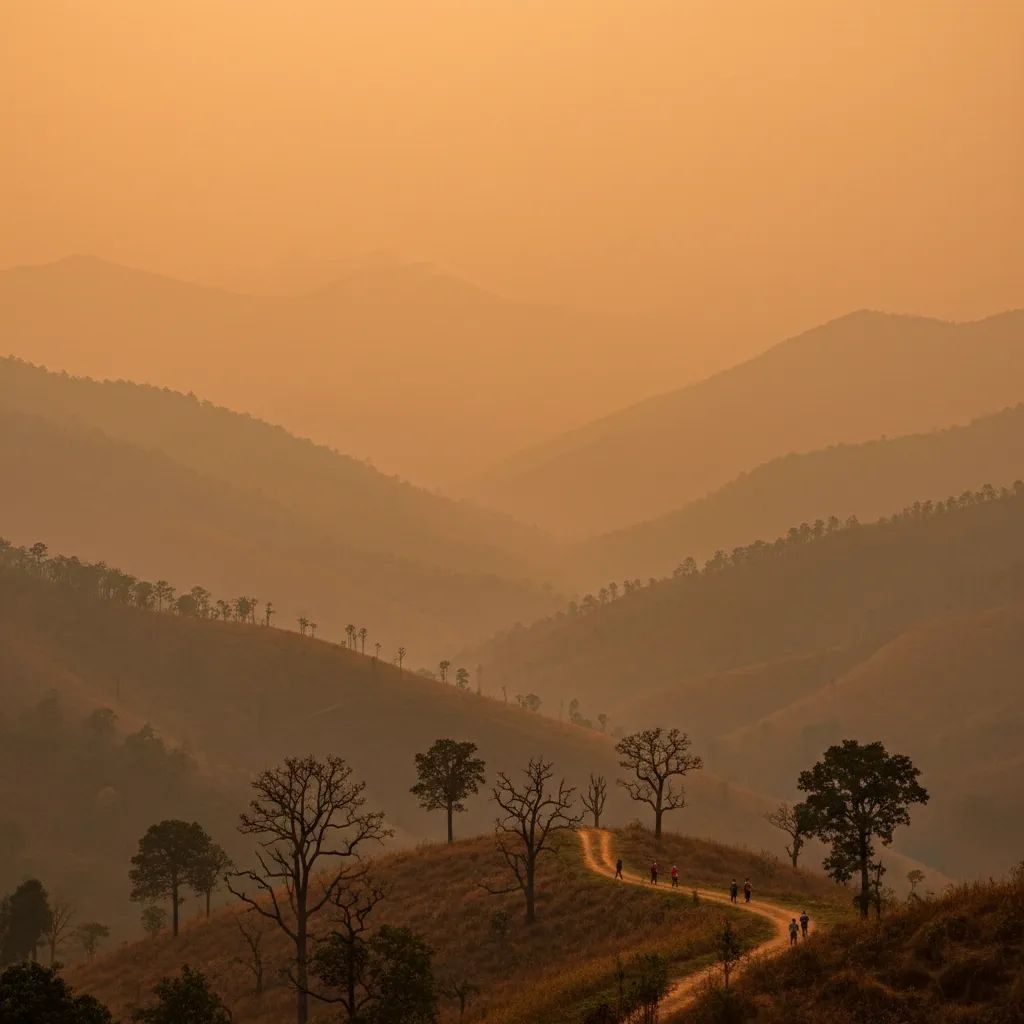
Thailand's Chiang Rai province has spent 12 consecutive days in the red zone for air pollution, a designation that signals imminent health risks for nearly everyone outdoors. PM2.5 readings in some districts now exceed 228 micrograms per cubic meter—more than 9 times the World Health Organization's recommended limit—and officials warn the crisis may intensify before it eases.
What This Means for Residents: Immediate Protective Actions
Immediate health guidance from the Thailand Public Health Ministry's Emergency Operations Center urges anyone in the three critical provinces to avoid outdoor exercise entirely. Schools in several Chiang Rai districts have switched to remote learning, and public-health stations are distributing N95 respirators to vulnerable households. Standard surgical masks offer negligible protection against particles as small as 2.5 microns; only masks with electrostatic filtration layers meet the safety threshold.
Resources for Residents:
• Real-time air quality: Check the Pollution Control Department website or AirVisual app for hourly updates
• N95 masks: Available at major pharmacies including Boots, Watsons, and hospital dispensaries across Chiang Rai
• English health consultations: Ministry of Public Health's online pollution clinic offers multi-language support for residents seeking guidance
Hospitals report a sharp uptick in admissions. Between March 19 and March 26 alone, 3,478 patients sought treatment for respiratory complaints in Chiang Rai—a rate that, if sustained, would place seasonal respiratory caseloads at roughly 30% of all outpatient visits. Early-April data from the Ministry's online pollution clinic show that respiratory and ocular symptoms account for 30% of consultations, followed by ear-nose-throat issues at 15% and skin or cardiovascular complaints at 8%.
Why This Matters
• Health emergency declared: The Thailand Ministry of Public Health activated its emergency operations center as Chiang Rai, Nan, and Lamphun remain in critical status since late March.
• Cross-border hotspots: Myanmar recorded 4,223 fire hotspots and Laos 3,348 between January and early April, dwarfing Thailand's 1,971 domestic fires.
• Tourism collapse: Signature sites such as Wat Phra That Doi Tung and the Chiang Saen Skywalk stand nearly empty, gutting revenue in a region that depends on visitors.
• Life expectancy drop: Air pollution in Chiang Rai already shaves 3.7 years off the average lifespan—the steepest penalty of any Thai province, according to University of Chicago research.
The Numbers Behind the Alarm
On April 5, the Pollution Control Department's mobile monitors clocked 228.6 µg/m³ (AQI 354) in Wiang subdistrict, Chiang Khong. That same day, Mae Sai district registered 210.6 µg/m³, while downtown Chiang Rai recorded 187.8 µg/m³. All three remain in the "hazardous" bracket, where even short-term exposure can trigger respiratory distress.
By April 6, the provincial average hovered near 225.4 µg/m³—a figure that reduces visibility to less than 2 km and leaves a pungent smell of smoke hanging over villages and cities alike. Authorities expect conditions to worsen over the next 24 to 48 hours as thermal inversions trap pollutants in the basin-shaped valleys that characterize northern Thailand's geography.
Those levels eclipse the emergency thresholds set by the Thailand Department of Health. Any reading above 75 µg/m³ (AQI 150) is classified as "unhealthy for sensitive groups"; levels above 150 µg/m³ require all residents to limit outdoor activity. Chiang Rai's sustained exposure at more than double that mark puts pregnant women, children, the elderly, and anyone with chronic lung or heart conditions at immediate risk.
Where the Smoke Originates
Chiang Rai sits at Thailand's northernmost tip, sharing extensive borders with both Myanmar to the north and Laos to the northeast—making it the first Thai province to receive transboundary smoke. The Thailand Disaster Prevention and Mitigation Department attributes roughly 70% of the current haze to transboundary emissions. Satellite data between January 1 and April 1 show 204,371 fire hotspots in Myanmar and 59,233 in Laos, many concentrated in the uplands directly west and north of Chiang Rai. Those blazes—often linked to slash-and-burn land clearance for maize and other cash crops—send plumes of fine particulate matter drifting southeast on prevailing winds.
Domestic fires account for the remainder. Farmers in Chiang Rai province ignited 1,253 agricultural fires during the same three-month span, though that figure represents a notable decline from previous seasons. The Ministry of Agriculture and Cooperatives deployed a 250 M baht subsidy package to promote zero-burn farming, funding 21 projects that include plowing-in stubble, producing organic compost, and cultivating high-value crops that eliminate the need for field burning.
Geography compounds the problem. Chiang Rai sits in a natural bowl ringed by mountains, and when high-pressure systems stall over the region—common in the late dry season—pollutants accumulate with little atmospheric ventilation. That topographic trap means even modest emissions can yield toxic air concentrations within hours.
Long-Term Health Impact
Long-term exposure carries serious consequences. Research from the University of Chicago's Air Quality Life Index estimates that chronic PM2.5 pollution costs the average Chiang Rai resident 3.7 years of life expectancy—nearly double the national penalty of 1.8 years. Across Thailand, 12.3 M people live with pollution-linked chronic conditions: 1.06 M asthmatics, 1.23 M with chronic obstructive pulmonary disease, and 22,000 with ischemic heart disease. Those figures represent a direct economic burden; in 2025, state hospitals treated approximately 10 M patients for smog-related ailments, consuming billions of baht in subsidized care.
Government Response: Cloud Seeding and Border Diplomacy
The Royal Rainmaking and Agricultural Aviation Department has positioned seven aircraft at Chiang Mai and begun artificial-rain operations over the northern highlands. Crews spray supercooled water and dry ice into cloud formations to trigger precipitation, a technique that can wash particulates out of the lower atmosphere within 24 hours if weather conditions cooperate. On days when cloud cover is sparse, however, rainmaking yields little relief.
On the ground, the Ministry of Interior declared Chiang Mai, Lamphun, and Phayao disaster zones covering 17 districts, unlocking emergency funds for medical supplies, air purifiers, and designated clean-air rooms in community centers. The Third Army Region deployed 1,000 volunteer territorial defense personnel to patrol forested areas and extinguish illegal burns before they spread. Provincial governors have imposed blanket burning bans across all 17 northern provinces, with violators facing up to 20 years' imprisonment and fines of 200,000 baht under forest-fire statutes.
Internationally, Thailand joined Laos and Myanmar in signing a 2026–2027 Joint Action Plan to share real-time satellite hotspot data and coordinate fire-suppression efforts. The pact includes a controversial trade measure: Thailand customs will reject agricultural imports—particularly animal-feed maize—unless exporters certify that cultivation involved zero burning. Industry groups in Myanmar have criticized the rule as a unilateral barrier, but Thai officials argue it provides the only leverage to curb cross-border emissions when diplomatic suasion fails.
The Ministry of Natural Resources and Environment has closed nine national forest reserves in Nan province, cutting off trails and access roads to prevent accidental or arson fires. Residents who need to enter forested areas for subsistence gathering must register in advance with village headmen or forestry rangers, a policy that has drawn complaints from indigenous communities but reduced ignition sources by an estimated 15%.
Economic Fallout in the Tourism Belt
Tourism operators in Chiang Rai report occupancy rates below 20% at hotels and guesthouses—a collapse that mirrors patterns seen in Chiang Mai during past haze seasons. International airlines have issued health advisories recommending travelers reschedule visits until May, when monsoon rains typically flush the atmosphere. That guidance effectively writes off the Songkran holiday period, traditionally one of the most lucrative weeks for northern Thailand's hospitality sector.
Small businesses reliant on foreign and domestic visitors face a compounding problem: even if tourists arrive, outdoor activities—trekking, temple tours, river cruises—become medically inadvisable. The Tourism Authority of Thailand's Chiang Rai office has pivoted marketing efforts toward indoor attractions and wellness spas, but operators acknowledge the messaging is a stopgap that cannot offset the revenue shortfall.
Agricultural exports, meanwhile, confront new scrutiny. European and North American buyers increasingly demand zero-burn certifications for Thai produce, a standard that forces growers to adopt costlier mechanical harvesting or composting methods. The Ministry of Agriculture estimates that full compliance would require 250 M baht in subsidies annually—funds that compete with other rural-development priorities.
The Cycle Repeats
Northern Thailand enters this crisis every dry season, yet the severity of 2026's episode has alarmed even seasoned environmental officials. The 12-day red-zone streak is the longest on record for Chiang Rai, exceeding the 10-day stretch documented in March 2023. Meteorologists attribute the duration to a persistent high-pressure dome that has blocked the usual late-March wind shifts, leaving the region in a state of atmospheric stagnation.
Public frustration is mounting. Social-media forums in Chiang Rai are flooded with photos of heavily obscured sunsets and ash-coated cars, and some residents have organized informal "clean-air coalitions" to lobby for stricter enforcement of burning bans. Critics point out that despite yearly promises, enforcement remains inconsistent: farmers caught igniting fields often receive warnings rather than prosecutions, and cross-border cooperation remains hampered by jurisdictional gaps.
The Thailand Cabinet has pledged to accelerate Euro 6 emissions standards for heavy diesel vehicles by January 2027 and expand electric-vehicle incentives under the EV3.5 program, but those measures address urban smog rather than agricultural burning. For Chiang Rai, the only near-term relief will come from weather: forecasters predict the first monsoon squalls may arrive in mid-May, roughly five weeks away.
Until then, residents face a stark choice—remain indoors with air purifiers running, or venture outside wearing industrial-grade masks and accept the health trade-off. Schools, hospitals, and government offices have installed HEPA filtration systems in select designated clean-air rooms where vulnerable populations can spend daylight hours. Yet those solutions are piecemeal, and the underlying combustion cycle—driven by economic incentives, cross-border geography, and inadequate enforcement—shows no sign of breaking without a fundamental shift in agricultural policy across mainland Southeast Asia.


