
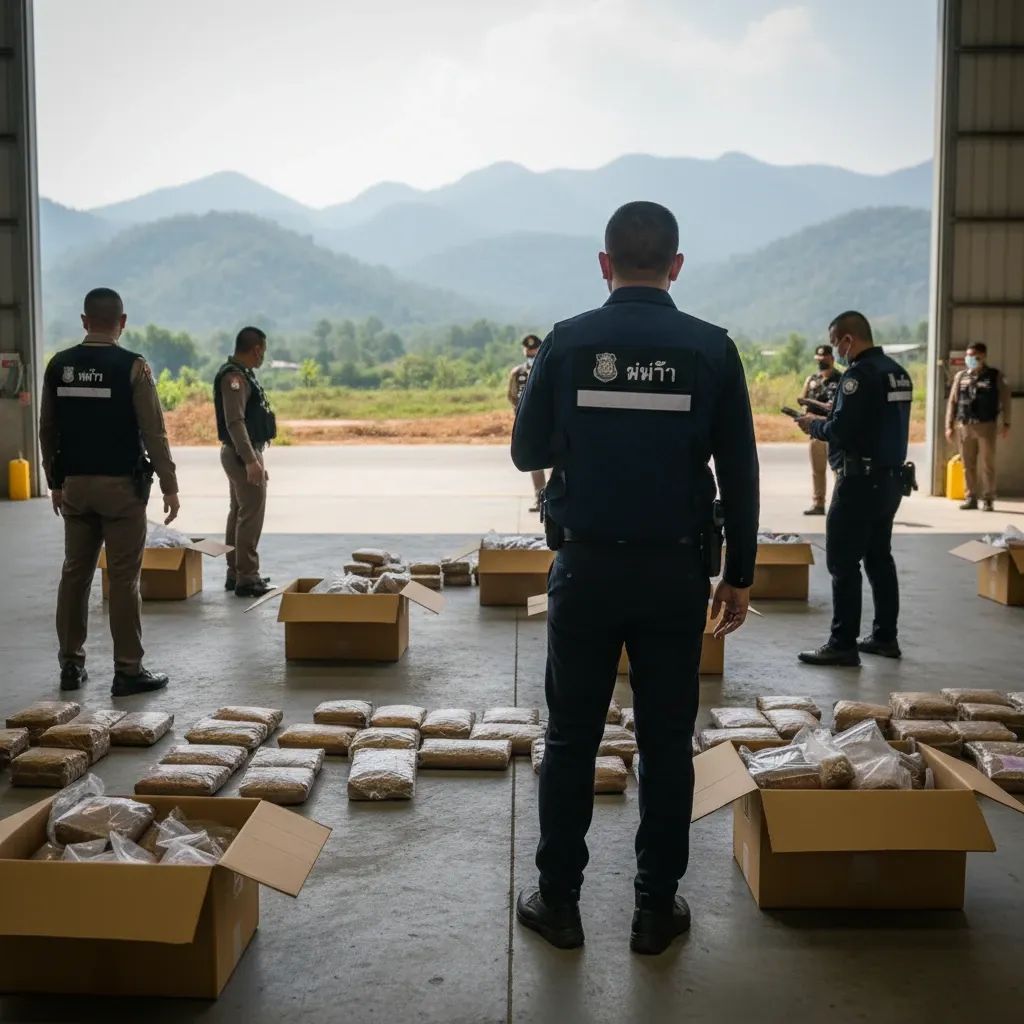
Authorities in Chonburi province have dismantled what officials describe as a coordinated synthetic drug operation spanning multiple locations, exposing the scale of foreign-run chemical networks quietly establishing footholds in residential neighborhoods near Thailand's most visited beach destination. The busts mark a turning point in how aggressively Thai law enforcement is now pursuing these operations—no longer waiting for complaints but systematically connecting the dots between warehouse storage, villa production sites, and overseas supply chains.
Why This Matters
• Your neighborhood isn't immune: Chemical labs are hiding in rental villas alongside families and expats, with May 2026 revealing at least three separate operations in Chonburi alone.
• The supply chain is traceable now: Thai authorities have begun identifying overseas financiers and foreign chemists directing operations via video calls, signaling real progress in dismantling transnational networks rather than just arresting street-level operatives.
• Etomidate possession carries seven-year prison sentences under its July 2025 reclassification as Category 2 narcotic, with additional penalties if the substance appears in vape form.
• These labs pose physical danger to entire neighborhoods: The chemicals used are volatile and flammable; contamination or fires directly threaten surrounding properties.
The May Raids: From Pool Villa to Warehouse Network
On May 19, Chonburi Governor Narit Niramaiwong coordinated a raid targeting a luxury pool villa in Huay Yai subdistrict, Banglamung district, following resident tips about suspicious Chinese nationals operating equipment inside what appeared to be a standard holiday rental. What officers found was unmistakable: a second-floor conversion featuring three industrial-scale chemical mixing machines, precision weighing instruments, glass transfer tubing, and stacked chemical containers positioned for active synthesis.
The villa's exterior offered no hint of the operation within—a deliberate deception that residents said made the discovery shocking. Police identified the detained individuals as Jia Jing, 47, and Teng, 24, both Chinese nationals. During questioning, both men conceded they had been hired specifically to monitor and operate the machinery, though investigators remain focused on identifying who financed and directed the entire network.
The raid triggered follow-up searches. Surveillance footage and cell records led officers 20 kilometers to a Bang Lamung warehouse where additional chemical containers, weighing apparatus, and laboratory components were seized. The dual-location structure reveals operational sophistication—the villa functioned as the active synthesis hub where Etomidate was being produced for use in "pot K" products, while the warehouse served as a holding facility, reducing visibility and operational risk for those managing the supply chain from offshore.
Recognizing the Pattern: A February Precedent
Authorities aren't treating this as an isolated incident. In February 2026, police conducted a similar raid in Nong Pla Lai, uncovering psychotropic chemical mixing activities also attributed to foreign networks. Governor Narit publicly acknowledged the connection during the May 19 press briefing, characterizing the increasing frequency and sophistication of these operations as evidence of an entrenched foreign criminal ecosystem rather than sporadic opportunism.
Early that same month, on May 11, a third raid unfolded at a fortified residence in Nongprue, where three Chinese nationals had converted a luxury home into a vape pod manufacturing facility. Neighbors described shock at learning the supposedly vacant property had functioned as an active production site. Equipment and chemical residue seized matched materials recovered in the February operation, suggesting a shared supply chain and possibly coordinated logistics.
Why Etomidate Became the Focus
Etomidate first surfaced in Thai vape products during late 2024, a development that initially puzzled health and law enforcement officials. The substance is a fast-acting intravenous anesthetic designed exclusively for hospital administration under clinical supervision—not consumer use. Yet by early 2025, it began appearing in illicit e-cigarette cartridges marketed in nightlife venues, particularly around Bangkok and Pattaya.
The drug's effects explain the street terminology. Users report extreme sedation, respiratory suppression, dangerously low blood pressure, and a dissociative mental state that earned products the nickname "zombie vapes" or locally "pot K." In extreme cases, particularly when combined with alcohol, overdose can trigger respiratory failure and death. Long-term abuse has been linked to adrenal gland damage, mood dysregulation, and psychotic episodes.
In response, Thailand's Office of the Narcotics Control Board (ONCB) reclassified Etomidate as a Category 2 psychotropic substance in July 2025, enabling stricter controls on importation and manufacturing. Possession now carries penalties up to 7 years imprisonment, with distribution charges triggering sentences of 10 to 15 years.
Tracing the Source: India and International Coordination
Thai investigators have identified India as the primary source for Etomidate precursors entering Thailand. The chemical is legally produced by Indian pharmaceutical manufacturers but diverted into trafficking networks before reaching clandestine Thai labs where it's converted into vape-compatible liquid formulations.
A significant breakthrough emerged when authorities in Chonburi documented a suspect receiving real-time technical guidance via video conference from an overseas chemist, suggesting overseas expertise is being remotely deployed to ensure product consistency and potency. This discovery was formally presented at the 2nd Annual Meeting of Drug Intelligence Analysts, hosted by the United Nations Office on Drugs and Crime (UNODC) in collaboration with Thai agencies. The presentation highlighted the cross-border architecture underlying these operations and prompted calls for deeper international investigation.
Thai officials are now coordinating with Interpol and law enforcement counterparts in source and transit countries, recognizing that disrupting production requires targeting overseas supply chains and financiers, not merely local manufacturing sites.
Government Response: Operation Anti Zombies and Multi-Agency Push
In April 2026, the Thai government launched "Operation Anti Zombies," a nationwide initiative explicitly targeting Etomidate trafficking and illicit vape production. The campaign mobilizes the Provincial Police, Immigration Police, Economic Crime Suppression Division, Tourism Police, and the ONCB in coordinated raids and enforcement.
That approach expanded in May with "X-ray, mobilise, sweep," a three-month crackdown addressing drug trafficking, human smuggling, cybercrime, and illegal business operations in areas with concentrated foreign populations. The initiative involves systematic review of immigration records, verification of visa status and extensions, inspection of foreign-owned businesses, and integrated database development linking property rentals to visa categories.
Officials have also begun tightening property oversight. Landlords renting to foreign nationals are now being encouraged to report unusual patterns—excessive chemical deliveries, modified security infrastructure, strong chemical odors, elevated electricity consumption, minimal visible activity despite active utilities. The government is considering legislative amendments requiring periodic inspections for certain visa categories and mandatory landlord reporting of suspicious tenant behavior.
The Health and Safety Equation
For residents living near these operations, the danger extends beyond narcotics concerns. The chemical synthesis of Etomidate involves volatile compounds; an accident or explosion poses immediate risk to neighboring properties. Toxin exposure from improperly stored or mishandled chemicals can affect air quality and groundwater.
For users—primarily youth and young adults in nightlife districts—the risks are acute. The illicit production environment means no quality control; dosage is unknown, purity unpredictable. Combined with alcohol (common in nightlife settings), Etomidate creates conditions for respiratory failure and sudden death. The long-term neurotoxic effects include mood instability, impulsive behavior, and potential psychosis.
Critically, it bears noting that vaping of any substance remains entirely illegal in Thailand under laws enforced since 2014. Tourists or residents discovered with vape devices face fines up to 30,000 THB and potential imprisonment up to 5 years. For foreigners, convictions trigger visa cancellations and potential blacklisting—ending your ability to live in Thailand regardless of fine payment. These penalties are compounded when the device contains narcotics.
What Community Awareness Can Accomplish
The May raids succeeded partly because residents reported suspicious activity. Local vigilance proved essential in alerting authorities to the Huay Yai villa operation. Recognizing this, authorities are now formally engaging village heads, neighborhood leaders, and expat volunteer networks in reporting suspicious foreign activity.
Practical warning signs residents should note include: sustained chemical deliveries to residential properties, excessive security modifications on rental homes, persistent chemical odors from supposedly unoccupied residences, unusually high electrical consumption in vacation villas, and minimal visible activity despite active utilities suggesting active operations. These observations, when reported to local police or the Tourism Police hotline, have proven instrumental in identifying production sites before larger quantities of chemicals accumulate.
Ongoing Investigation and Next Steps
The May 19 investigation remains active. Narcotics suppression officers are working backwards through the chemical supply chain, interviewing vendors, tracking import records, and identifying financial flows. The goal is to map the entire operation from overseas suppliers through Indian middlemen to Thai distributors and street-level sellers.
Additional arrests are anticipated as investigators broaden their focus to individuals managing logistics, financing, and overseas coordination. The presence of video-guided technical assistance from abroad suggests organizers remain insulated from direct involvement in Thailand, requiring international cooperation to bring cases to prosecution.
For residents in Chonburi and surrounding provinces, these operations underscore a difficult reality: criminal networks view tourist-destination residential areas as operationally advantageous. The solution combines traditional policing with legislative reform, community reporting, and international coordination. The government's demonstrated commitment to Operation Anti Zombies signals that this won't be treated as a passing concern but a sustained enforcement priority through 2026 and beyond.


