
Myanmar's Leadership Remake Leaves Border Dynamics Unchanged for Thailand
The Myanmar military has completed its administrative costume change, positioning former general Min Aung Hlaing as a civilian president on April 10, 2026. For people living in Thailand—whether in Bangkok's business districts or northern provinces hosting displaced populations—the practical consequences remain unpleasant and unresolved.
Why This Matters
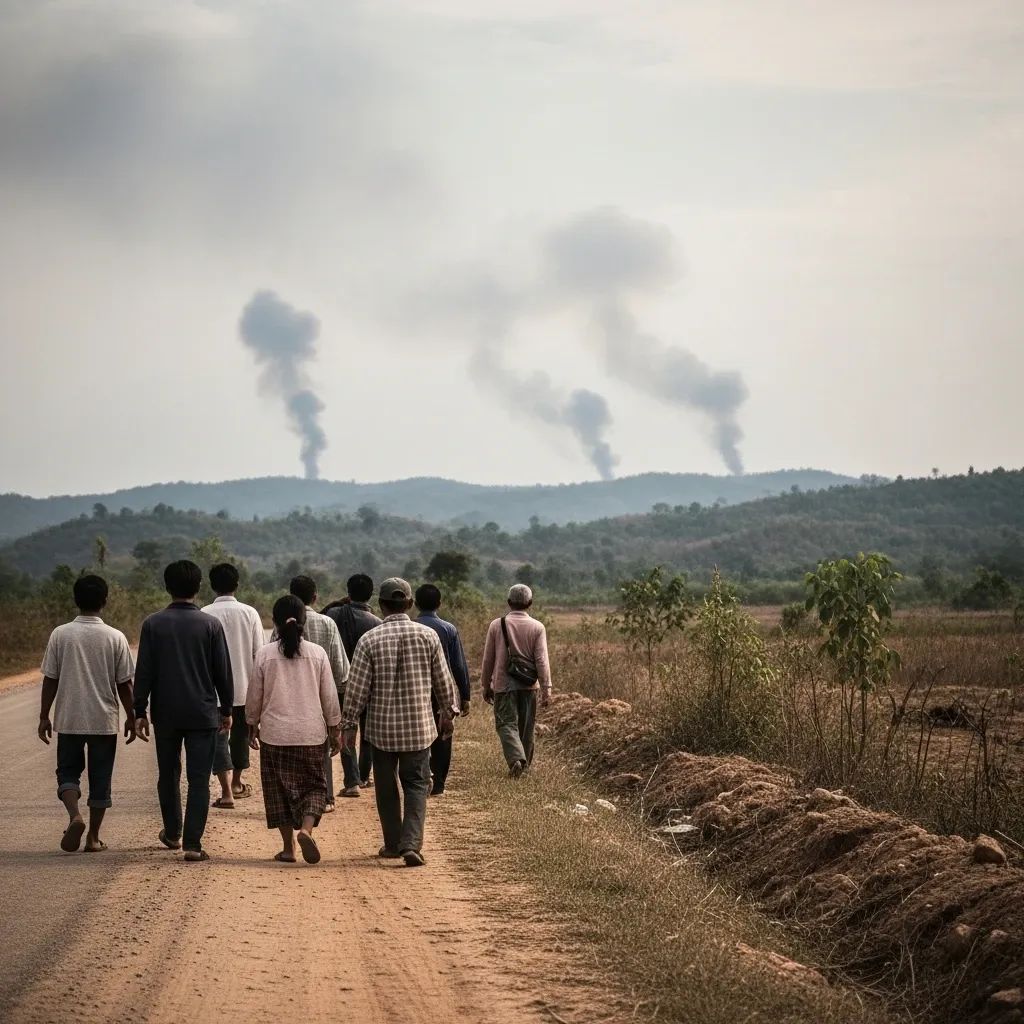
• Refugee strain intensifies: Thailand shelters 600,000 to 1 million displaced Burmese. Ongoing conflict means expanded humanitarian costs and security pressures in northern border provinces.
• Regional supply chain fragility: Myanmar suppliers and labor networks critical to Thai manufacturers face persistent disruption. Annual bilateral trade worth roughly ฿100 billion remains at risk.
• ASEAN diplomatic gridlock: Thailand's vote within the bloc on re-engaging Myanmar's new administration will reshape regional trade access and investment patterns.
• Legal exposure grows: International courts processing genocide and war crimes allegations create unpredictable legal terrain that may eventually force Thailand into uncomfortable diplomatic decisions.
The Uniform Swap That Changes Nothing Structural
Min Aung Hlaing resigned from active military service days before his inauguration, satisfying constitutional formalities. His cabinet tells the operative story: 22 of 30 ministers retain or recently held military rank. The parliament that elected him belongs entirely to the Union Solidarity and Development Party (USDP), selected through a three-phase election process that concluded in January 2026 and which international election monitors refused to recognize as legitimate.
This was not democratic competition. Opposition parties were excluded. Political opponents faced imprisonment rather than ballot placement. Voting occurred among pre-selected loyalists. China attended the ceremony and maintains active financial backing. India and Thailand sent diplomatic delegations—a pragmatic acknowledgment that Myanmar remains a neighbor regardless of internal governance structures.
The timing matters less than the substance. Whether military power operates through a council or a presidency, the authority structure remains unchanged. The same figures occupying uniform insignia months ago now wear civilian suits and hold the same decision-making authority.
A Presidency Without Mandate or Credibility
Min Aung Hlaing's inaugural address to parliament lasted under 20 minutes. He pledged democracy, federalism, agricultural development, foreign investment attraction, and reconciliation with international partners. He specifically mentioned restoring relations with ASEAN, the regional bloc that has barred Myanmar's junta leaders from high-level summits since 2021.
This pledge carries hollow weight. ASEAN's Five-Point Consensus, adopted in April 2021 following the initial coup, required five specific actions: immediate violence cessation, inclusive political dialogue, appointment of a special envoy, humanitarian assistance channels, and access for regional mediators. Five years forward, the Myanmar military has honored none of these commitments.
Violence has intensified rather than decreased. Aerial bombardments accelerated throughout 2025. Armed resistance forces—including the People's Defense Forces (PDF) and ethnic armed organizations—now control territory the junta cannot reclaim. No inclusive dialogue has materialized. The special envoy mandate expired without substantive results. Amnesty International, Human Rights Watch, and UN monitoring bodies document systematic violations: arbitrary detention, suppression of independent journalism, persecution of lawyers and religious leaders, denial of medical care to political prisoners.
International Legal Machinery Accelerates Independent of Political Theater
Three days before the inauguration, a Rohingya woman and human rights organizations filed charges against Min Aung Hlaing in Indonesian courts, invoking universal jurisdiction statutes permitting prosecution of war crimes without territorial limitation. The International Criminal Court opened investigation into crimes against humanity allegations in 2024. The International Court of Justice conducted hearings in January 2026 addressing genocide charges. A group of Norwegian plaintiffs pursues a class-action lawsuit against the telecommunications company Telenor for allegedly providing phone metadata on over 1,200 individuals to the junta following the 2021 coup—data subsequently used for arrest and torture operations.
These proceedings operate independently but converge. They expand accountability mechanisms that accumulate regardless of whether defendants wear military insignia or civilian clothing. Legal exposure persists across multiple jurisdictions simultaneously. A presidential title provides no insulation from international legal consequences.
Cosmetic Clemency Masks Unchanged Repression
Days before his swearing-in, the junta released limited numbers of political prisoners and invited blacklisted civil servants to rejoin government. Critics viewed these gestures as tactical theater rather than substantive reconciliation. Aung San Suu Kyi, Myanmar's ousted civilian leader, remains imprisoned facing decades of cumulative sentences. No amnesty touched her case. The National Unity Government (NUG)—the parallel administration formed by ousted civilian officials—rejected Min Aung Hlaing's presidency entirely. Amnesty International was direct: a civilian title does not erase criminal responsibility for grave violations of international law.
Border-Adjacent Consequences for Thailand's Economy and Security
For Thailand's Ministry of Foreign Affairs, April 10 represents a strategic choice point. Will Thailand advocate within ASEAN for re-engagement with Min Aung Hlaing's administration, betting that pragmatic diplomacy might encourage behavioral moderation? Or will Thailand align with member states demanding concrete progress on the Five-Point Consensus before diplomatic normalization?
That choice carries measurable consequences. Thailand hosts between 600,000 and 1 million displaced Burmese, a population likely to expand as conflict persists. Cross-border displacement strains healthcare, education, and social services in Tak, Mae Hong Son, and Chiang Mai provinces. Thai companies with supply chains extending into Myanmar confront ongoing disruption, international sanctions risk, and reputational exposure for operating within conflict zones.
If Thailand breaks ASEAN consensus to offer early legitimacy to Myanmar's military government, it signals tolerance for military rule that contradicts Thailand's own democratic commitments. If Thailand maintains pressure for genuine reform, it reinforces regional unity but risks trade retaliation and loss of market access.
Armed Resistance Network Consolidates Rather Than Fractures
In late 2025, nineteen armed resistance groups—ranging from urban civil disobedience networks to rural ethnic armed organizations—formed the Spring Revolution Alliance (SRA), committing to sustained armed struggle against the junta. The Karen National Union (KNU), one of Myanmar's largest ethnic armed organizations, established the Kawthoolei Federal Unit to strengthen civilian governance in territories under its control. This decentralized structure directly challenges Naypyitaw's authority and signals a long-term shift toward federal governance that Min Aung Hlaing's administration explicitly opposes.
The junta's response involves intensified drone strikes and aerial bombardments. Military strategists calculate that air power supplemented by ground operations can reclaim lost territory. That calculation has repeatedly failed. Armed opposition sustains operations, recruitment continues, and civilian support for the junta has collapsed in many regions. Rather than pacifying territory, intensive bombing campaigns produce radicalization, destruction of civilian infrastructure, and deepened humanitarian crisis.
Humanitarian Breakdown Expands
An estimated 4 million people in Myanmar will require humanitarian assistance in 2026. Food insecurity spreads as agricultural production collapses. The Myanmar Cybersecurity Law enacted in January 2026 restricts digital communications, limiting humanitarian organizations' ability to coordinate aid and document violations. Thai-based NGOs report mounting access restrictions, surveillance operations, and operational constraints. Cross-border displacement will likely accelerate as conditions deteriorate.
Why the Suit Matters Less Than the Structure It Conceals
Min Aung Hlaing's transformation from military uniform to civilian suit represents a rhetorical repositioning without underlying power transfer. The same military apparatus, the same command structure, the same individuals now occupy civilian titles. Parliament remains entirely loyalist. The cabinet is overwhelmingly military. Courts operate under junta direction. Security forces answer to military command.
For Thailand and ASEAN, the operative question is not whether this constitutes genuine change—it demonstrably does not. The question is whether the region will treat the junta's rebranded administration as a legitimate partner worthy of re-engagement and trade normalization. That decision will shape not merely Myanmar policy, but the region's broader willingness to legitimize military rule when it adopts civilian appearance. For Thailand, navigating that choice carries consequences extending far beyond ceremonial diplomacy into economic stability, humanitarian burden, and strategic credibility.


