
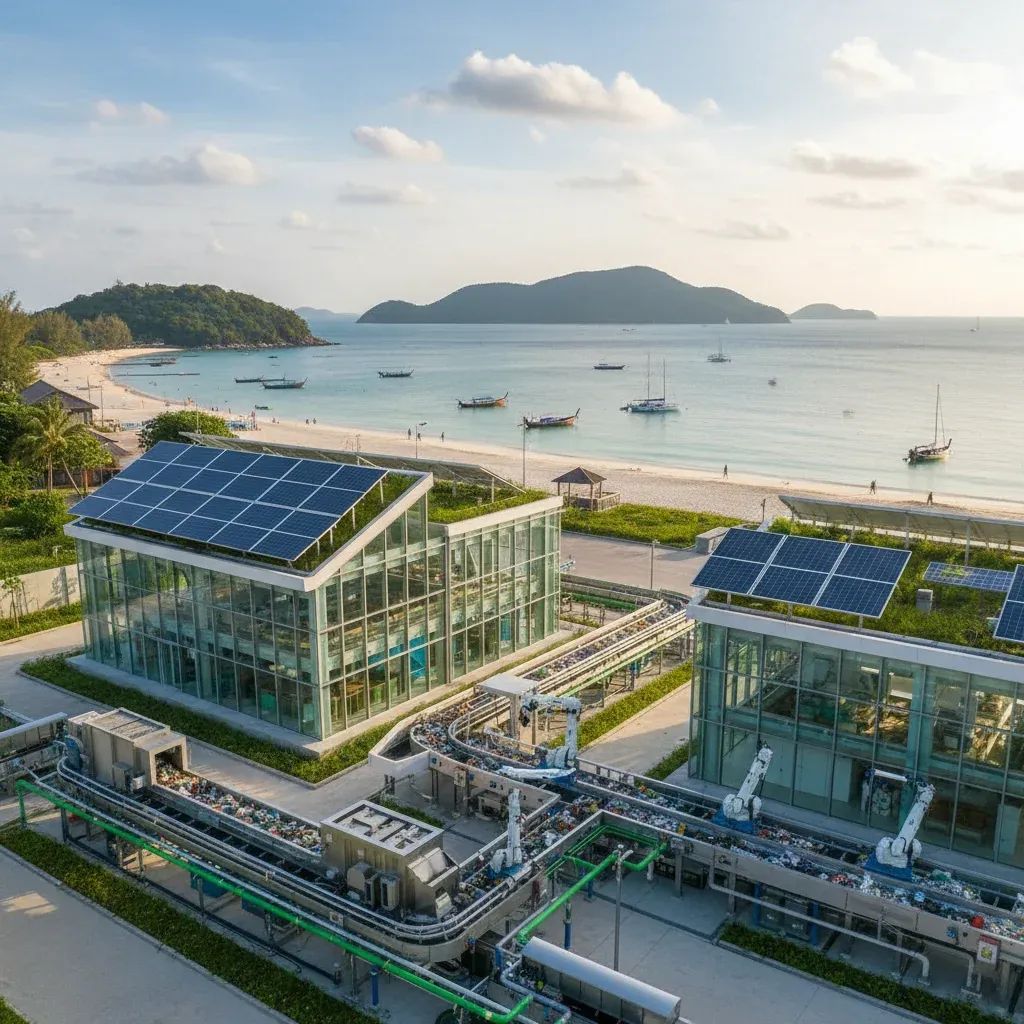
Koh Larn's Waste Crisis Enters Active Resolution Phase with Modern Processing Hub
The island's environmental future just took a tangible turn. Pattaya City activated an integrated waste management complex on Koh Larn designed to process 50 tons of garbage daily—a direct intervention into an ecological problem that has festered for decades and now threatens both marine ecosystems and the tourism economy that sustains the region.
Why This Matters
• Scale of intervention: The new facility can handle approximately double the daily waste volume currently generated, creating breathing room to address 150,000+ tons of backlogged garbage accumulated over years of inadequate disposal infrastructure.
• Marine protection mandate: Waste management improvements help protect coral reefs and swimming areas—critical for an island whose economy depends on clear water and healthy marine ecosystems.
• Tourism reputation stakes: Visible waste management directly influences how the destination competes against other Gulf islands; environmental degradation translates to negative online reviews and lost bookings.
• Private sector involvement: The facility operates under a BOT (Build-Operate-Transfer) contract model, bringing private sector efficiency to waste management operations.
The Island's Breaking Point
Koh Larn sits just 7 kilometers off the Pattaya coast—close enough for day-trippers to arrive via high-speed ferries within minutes, yet geographically isolated enough that waste removal historically required costly sea transport to mainland disposal sites. For years, this mismatch created a predictable outcome: mountains of refuse accumulated in open dumps while logistics remained cumbersome and expensive.
The situation reached critical levels when waste accumulation created visible environmental problems. Approximately 3,000 permanent island residents share their environment with thousands of weekly visitors, generating roughly 25 tons of waste daily—figures that excluded the decades of accumulated garbage already decomposing in open-air areas. During dry seasons, conditions worsened as decomposing organic matter created environmental hazards, while visible plastic debris accumulated near coastal areas. Local fishermen reported environmental changes, and the problem became measurably visible and economically significant.
Infrastructure as First Response
The new waste center employs modern combustion technology designed to meet environmental standards. The 50-ton daily capacity provides practical buffer capacity to address not just current waste flows but also the legacy stockpile accumulated from years of inadequate disposal infrastructure.
The BOT model brings private sector operation to facility management, introducing efficiency incentives compared to traditional public administration. However, the infrastructure choice reflects a particular philosophy: solve the disposal problem first through centralized capacity, then work toward behavioral and regulatory compliance downstream.
Competing Models Across Thai Islands
Elsewhere in Thailand, island communities have experimented with different strategies that challenge the centralized incineration-based model.
Koh Lanta in Krabi Province developed comprehensive waste segregation approaches with residents sorting garbage into specific categories at dedicated community stations. Food scraps circulate to local farmers as animal feed, and discarded materials transform into useful products rather than incinerator feedstock. Regular community engagement programs have helped reduce waste generation at the source level.
Koh Samui embraced waste banks—a financial incentive model where residents earn modest cash payments for sorted recyclables. This system aligns with a nationwide network of waste banks across Thailand. Refill stations for household products further reduce single-use consumption by allowing customers to return containers for refilling rather than discarding them.
These alternative models share a common philosophy: reduce waste generation and complexity before it becomes a disposal problem. The contrast with Koh Larn's centralized infrastructure approach is instructive. Infrastructure-heavy solutions solve immediate capacity crises but do not address consumption patterns driving waste generation. Without parallel efforts to curb plastic use, mandate reusable packaging, and educate visitors about low-impact behavior, Koh Larn risks simply upgrading its capacity to handle ever-larger garbage volumes rather than fundamentally restructuring the system.
What Residents and Operators Actually Experience
For Koh Larn's permanent inhabitants, the waste facility offers tangible quality-of-life improvements. Open dumps that attracted rats, stray dogs, and insect populations should gradually diminish, reducing disease transmission and unpleasant odors. Streets and beaches will likely appear cleaner, potentially boosting property values and rental competitiveness for guesthouse operators already struggling in a crowded market.
Tourism operators face reputational stakes. Online booking platforms and traveler review sites increasingly penalize destinations perceived as environmentally negligent or unsanitary. A visible garbage crisis generates negative press and becomes a competitive disadvantage against cleaner alternatives. By demonstrably addressing the waste problem, Koh Larn repositions itself as a more responsible destination option.
However, the incineration-centric model carries environmental considerations that merit attention. Environmental advocates have called for stronger upstream interventions: banning single-use plastics sold on the island, implementing deposit-refund schemes for beverage containers, and requiring on-site composting of organic matter. Such measures could lower the volume entering the facility and extend equipment lifespan over time.
There are also accountability questions embedded in the BOT structure. While private operation can improve operational efficiency, it also introduces commercial incentives that merit transparent oversight. Environmental groups have requested regular public disclosure of facility performance and community representation in oversight processes.
The Broader "Neo Pattaya" Context
The Koh Larn infrastructure investments form part of a municipal rebranding effort toward improved environmental standards and green infrastructure. The economic logic is straightforward: Thailand's tourism sector contributes significantly to the national economy, and environmental degradation directly erodes destination competitiveness against competitors in the region. As travelers increasingly prioritize sustainability when booking trips, municipal government perceives ecological rehabilitation as a business imperative.
Whether infrastructure alone can deliver genuine sustainability remains an open question. Waste management facilities solve disposal logistics but do not address the consumption patterns, tourist behavior, and commercial practices that generate garbage in the first place. Without mandatory waste reduction targets, visitor education campaigns, and enforcement of environmental standards, Koh Larn risks simply professionalizing the throughput of ever-larger garbage volumes rather than catalyzing systemic change.
Timeline and Realistic Expectations
Assuming the facility operates effectively under normal conditions, municipal planners expect Koh Larn could achieve waste balance—where disposal capacity meets ongoing generation—within several years, with the historic backlog substantially addressed over time. Full environmental connectivity and enforcement may require additional time and investment.
The real pressure test arrives if tourist arrivals continue climbing. Post-pandemic tourism to Pattaya rebounded sharply, and Koh Larn remains a top day-trip destination from the mainland. If visitor numbers increase without corresponding investments in waste reduction and environmental monitoring, the new facility could face capacity pressures—repeating the crisis cycle that demanded today's intervention. Municipal planners acknowledge this risk but have not yet articulated concrete demand-management strategies to moderate tourist impacts.
Lessons and Unresolved Tensions
The facility opening marks a tangible infrastructure milestone. Residents point to functioning equipment where none existed before. Tourists may notice environmental improvements. Policymakers gain a template for addressing similar pressures on other Thai islands.
Whether Koh Larn evolves into a genuine model of sustainable island tourism will depend on decisions made over coming years. Can authorities maintain high operational standards and transparency? Will they strengthen upstream waste reduction efforts, or simply optimize management of garbage volumes? Can community engagement move beyond compliance toward genuine behavioral change around consumption?
For now, the island has momentum. The facility functions. Planning authorities are watching to see whether centralized infrastructure investment proves sufficient, or whether Thailand's islands will eventually need more holistic, community-centered approaches. The outcome will inform waste management policy across Thailand's entire island economy.


