
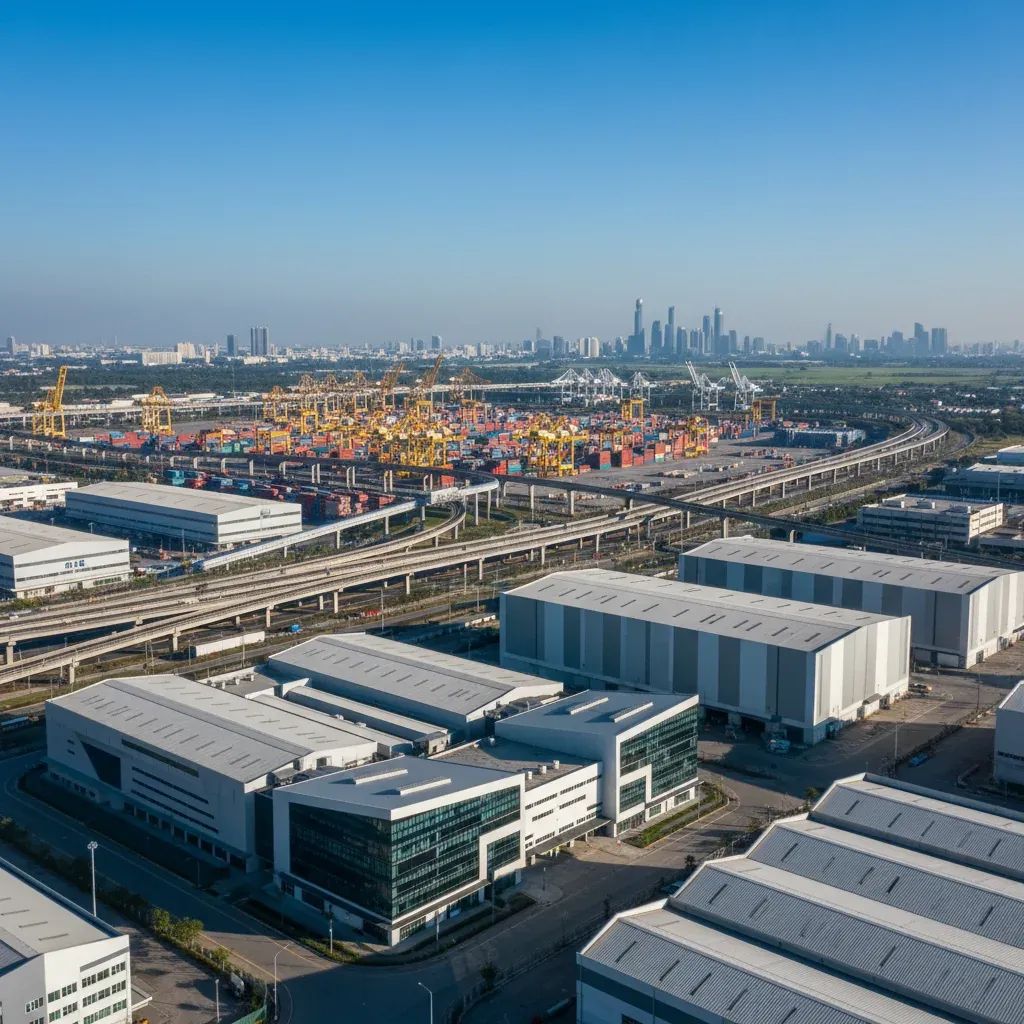
Manufacturing floors stay packed. Warehouses sit half-full. Thailand's industrial property market is splitting into two distinct worlds in 2026, each with its own physics and opportunities—yet both remain solidly anchored by government backing and foreign capital seeking alternatives to a tightening China.
Why This Matters
• Factory space is scarcer than ever: Ready-built factory vacancy sits below 5%, meaning manufacturers need to book fast or wait
• Warehouse supply is swelling: Modern logistics warehouses could see vacancy climb from 10% to 13% this year, favoring tenants with leverage
• Data centers are now the hottest property play: Capacity growth of 40-60% over three years is reshaping how industrial land gets valued and deployed
• The Eastern Economic Corridor remains where deals happen: Nearly 15% of national GDP now flows through these three provinces
The Factory Squeeze Persists
Walk into any conversation with a multinational planning production in Southeast Asia right now, and you'll hear the same story: "Where's our space?" For manufacturers executing what investors call the "China-Plus-One" strategy—establishing backup operations outside mainland China—Thailand's ready-built factory market has become almost claustrophobic.
Vacancy remains imprisoned below 5%, and new supply is essentially nonexistent. This isn't a coincidence. A combination of high pre-commitments from existing tenants and deliberate restraint from developers has created a bottleneck that favors any operator with production ready to deploy. Electronics makers, automotive suppliers, and emerging contract manufacturers are locking in multi-year leases at current rates, banking on the assumption that next year will only get tighter.
The constraint is real enough that some manufacturers are now exploring purpose-built facilities rather than waiting for ready-built inventory. This shift has quietly accelerated the Industrial Estate Authority of Thailand's transformation agenda. Traditional industrial parks are morphing into "Econopolis" zones—zones that bundle modern utilities, multimodal logistics routes, renewable energy systems, and waste processing infrastructure into a single ecosystem. For landlocked industries sensitive to supply chain friction, this value-add matters.
The Logistics Paradox: Glut Meets Momentum
The modern logistics warehouse story tells the opposite tale. Nearly 345,000 square meters of new prime warehouse space will hit the Greater Bangkok market alone in 2026, with substantial portions landing in the Eastern Economic Corridor and surrounding areas. Vacancy is expected to climb to 13% from today's 10%, opening up room for tenants to negotiate.
What matters here is who is building. Much of this supply didn't come from industrial specialists hedging their bets—it came from residential developers diversifying away from the condo slowdown, plus established players rushing capacity to market. A meaningful share is already spoken for through pre-lease or build-to-suit arrangements, which dramatically reduces speculative risk and ensures tenant customization. Still, a genuine oversupply window is opening for the first time in several years, and occupiers in logistics should feel less pressure.
The divergence between factory shortage and warehouse abundance speaks to market maturity. E-commerce operators, fast-moving consumer goods distributors, and third-party logistics providers now have leverage to renegotiate terms. Manufacturers, by contrast, face a buyer's market disguised as a seller's market—they must commit early or lose positioning.
Data Centers Emerge as the Real Prize
Step back from warehouses and factories, and the actual center of gravity becomes clear: data centers are now reshaping industrial land transactions across Thailand.
Global technology firms—the hyperscalers running artificial intelligence inference at scale—are in a land-grab phase. The Thailand Board of Investment approved digital industry projects exceeding 776 billion baht in 2025, with data center operators driving the lion's share of large industrial real estate deals. Projected expansion of 40-60% over three years means capacity additions of 360 megawatts planned for both 2026 and 2027 alone.
What makes this structurally important is power. Electricity availability has become the hard constraint on data center placement. The Thailand government is now actively coordinating with regional utilities to map grid capacity and support developers in site selection, a level of infrastructure coordination absent even five years ago. Provinces outside the Eastern Economic Corridor are struggling with supply-constrained grids, forcing operators toward proven power zones or requiring major grid upgrades before development can commence.
Semiconductor manufacturing and other high-value services have also captured attention. The ambition here is transparent: Thailand wants to climb the manufacturing value chain and compete with Malaysia and Vietnam in advanced technology production, not just assembly operations.
What This Means for Residents and Business Operators
If you run a factory in Thailand, act now. Secure ready-built factory capacity before 2027 if your production timeline is tight. The shortage will persist, and negotiating leverage is with landlords, not occupiers.
If you operate a warehouse or distribution hub, you've inherited unexpected negotiating power. Rents will stabilize, not accelerate. Consider locking in multi-year deals at current rates while market conditions favor flexibility.
If you're an investor, understand the split market. Factory landlords face steady long-term demand; warehouse investors are experiencing a normalization phase that should correct by late 2026 as omnichannel retail absorption accelerates. Data center land parcels are fundamentally different assets now—they're trading on power availability and technical specifications, not proximity to ports.
For workers and entrepreneurs, the implication is employment. This industrial rotation creates real jobs—not just construction, but permanent operational positions in logistics, tech support, and supply chain management. Skill premiums are rising for workers who understand automation, inventory software, and data infrastructure.
Government Has Loaded the Dice—But Must Keep Playing
The Thailand Board of Investment overhauled its incentive package in January 2026, replacing expired programs with stronger tax breaks and expanded sectoral eligibility. Businesses aligned with the "Thailand 4.0" strategy can now claim corporate income tax exemptions for up to 13 years, plus an additional 50% CIT reduction for five years in designated zones. Import duty waivers on machinery and raw materials remain standing pillars. Permission for 100% foreign ownership and streamlined land acquisition rights have become table stakes for competing with Vietnam and Indonesia.
The Eastern Economic Corridor—spanning Chachoengsao, Chonburi, and Rayong—sweetens the pot further. Operators get Free Zone customs treatment, a 17% income tax cap, and expedited visa and work permit processing. The EEC now represents nearly 15% of national GDP and continues drawing electric vehicle manufacturers, semiconductor producers, and renewable energy firms. Infrastructure bets are visible: Laem Chabang Port is being upgraded for higher throughput, and U-Tapao Airport expansion targets 60 million annual passengers by 2030, positioning the corridor as the region's most diversified gateway.
But incentives only work if execution follows. Thailand ranked 10th among emerging markets in the 2025 Foreign Direct Investment Confidence Index, a respectable standing that reflects investor patience—not enthusiasm. The country benefits from stable energy supply, neutral geopolitical positioning, and a skilled labor pool. These aren't flashy; they're reliable. Yet Vietnam is running faster on infrastructure, Indonesia is deploying scale, and Malaysia is climbing the tech ladder. Thailand's window to cement its position as Southeast Asia's premier industrial hub isn't closing—it's narrowing.
Competitive Reality: The Region Is Crowding
Here's what keeps policy makers in Bangkok up at night. Vietnam's competitive operating costs and Indonesia's massive infrastructure spending are tangible threats. Malaysia's pivot toward semiconductors and advanced manufacturing is no longer a distant threat—it's happening now. Regional FDI competition is intensifying, not softening, and Thailand's advantage lies in execution consistency, not wishful thinking.
Domestic headwinds compound the challenge. Weak purchasing power dampens consumer goods demand, which translates directly into warehouse utilization pressure. Rising land and labor costs squeeze margins for operators in low-margin logistics. Construction productivity remains uneven despite government rhetoric about efficiency.
The path forward requires three things: land law reforms to unlock crucial industrial parcels currently tied up in regulatory limbo; streamlined permitting for foreign investors that actually moves faster than competitors' bureaucracies; and continued investment in high-speed rail and multimodal networks that actually reduce logistics friction. These aren't aspirational—they're prerequisites for sustaining momentum.
The Realistic Outlook
Thailand enters 2026 with genuine industrial property strengths. Record BOI approvals in 2025, persistently tight factory vacancy, and explosive data center growth are real economic signals. The EEC's evolution into a sophisticated ecosystem for digital infrastructure, electric vehicle manufacturing, and clean technology offers a coherent value proposition for investors hunting exposure to high-growth sectors.
But this outlook is conditional. Government must deliver on infrastructure timelines. Land parcels must become available at competitive speed. Power grids must expand faster than data center demand. If these conditions hold, Thailand sustains its role as a preferred destination for industrial investment and generates the foreign capital, job creation, and regional connectivity that translate into tangible gains for residents.
The industrial sector's resilience signals something deeper: economic stability in an uncertain global environment. For the 70 million people living in Thailand, that's the real story—not whether warehouses sit full or factories sit empty, but whether Thailand's policy framework can evolve as quickly as the markets it's trying to lead.


