
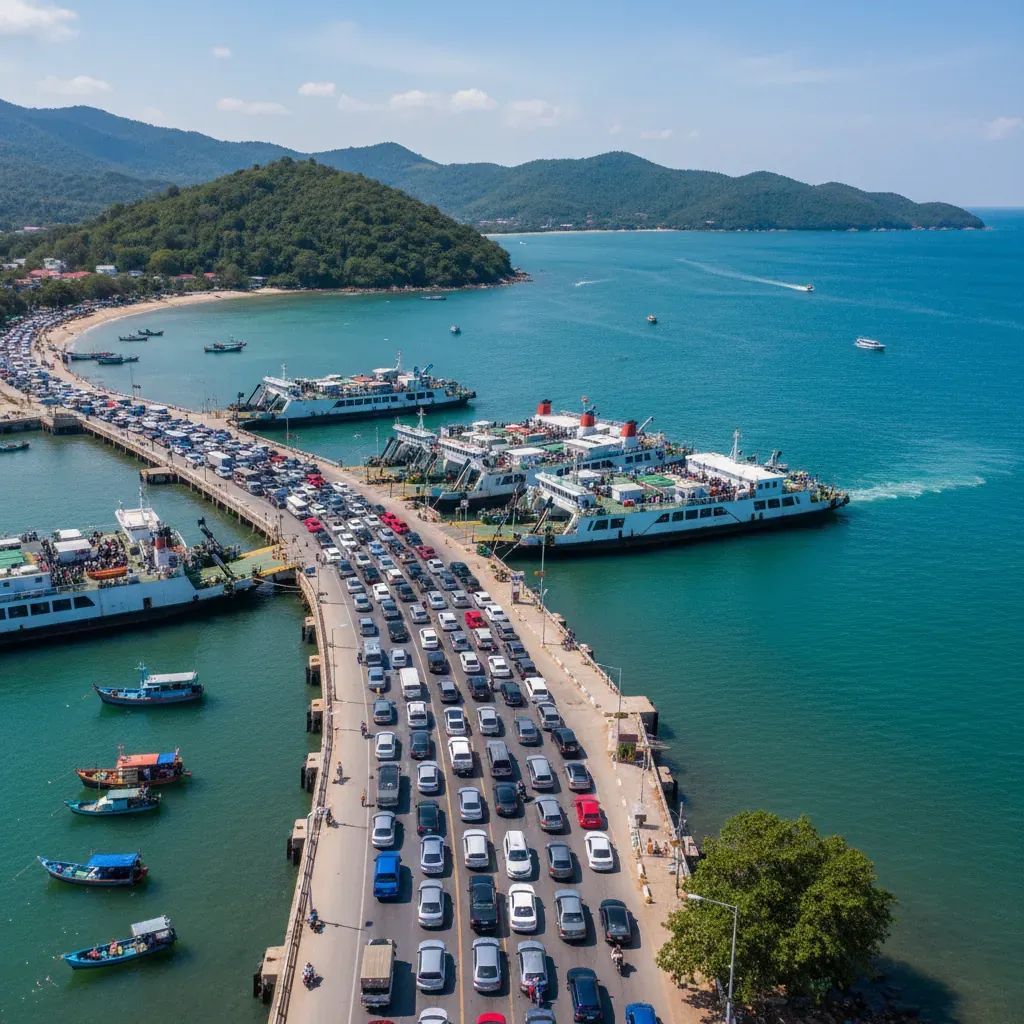
Thailand's island ferry system faced a genuine infrastructure test during the May 1-5, 2026 long weekend holiday period, as nearly 24,000 people arrived at Koh Chang on a single day, creating significant traffic congestion and forcing ferry operators to run vessels past midnight just to clear the backlog. The incident highlighted structural limitations in the current system that extend beyond typical holiday inconvenience.
Why This Matters
• Travel delays extend across the entire return window. The critical period arrived on May 3-4, when tens of thousands departed simultaneously; anyone boarding after 10:00 should expect 2-4 hour waits for vehicles, though walk-on passengers typically crossed in under an hour.
• Domestic tourism is a growing share of visitor traffic. Thailand's eastern provinces have experienced strong domestic tourism interest, with local families prioritizing weekend leisure spending during extended holiday breaks—a pattern reflecting broader tourism trends as international arrivals remain moderate.
• One pier cannot sustain this volume. The Ao Thammachat mainland terminal and its corresponding Ao Sapparot pier on the island operate a single-threaded system with no redundancy—when ferries fill, everything grinds to a halt.
• Industry is formally demanding a second terminal. Business leaders have petitioned Thailand's Ministry of Transport to greenlight a second ferry pier at Laem Klat, approximately 5 kilometers north of the current facility, to split outbound traffic and double effective capacity.
What Sent 24,000 People to One Small Island
The four-day holiday spanning National Labour Day (May 1) and Coronation Day (May 5) converged with three simultaneous events: the XRACE OCEAN 2026 endurance race, the Koh Chang Junior Cup youth football tournament, and a regional wellness expo. Each pulled participants and spectators beyond the typical leisure traveler base, flooding accommodation that typically runs near capacity anyway.
But the broader context is demographic. Thai households have increasingly prioritized leisure spending at coastal destinations during extended breaks. The few long weekends the calendar offers tend to concentrate travel into compressed timeframes, creating periodic surges in visitor volume.
On May 1 alone, over 2,500 vehicles queued at the pier. The four-ferry fleet, operating at theoretical maximum capacity of 150 cars per hour, managed closer to 100-120 cars per hour when accounting for boarding, disembarking, and turnaround protocols. Even so, some travelers arrived at noon and boarded only after dark.
The Breakdown: How Operations Actually Unraveled
Ferry operators deployed emergency protocols born from necessity rather than standard planning. Vessels returned to the mainland immediately after dropping passengers—"empty ferry" runs that depart from the typical practice of waiting for full loads. Service hours stretched from 05:30 in the morning past midnight, an unsustainable rhythm that illustrates the system's operational constraints.
Thailand's Trat Division police officers directed vehicles along Highway 3148, the sole access route to the pier, which became congested for several kilometers. The crossing itself—normally 25-40 minutes depending on sea state—became almost incidental; the real challenge occurred during the boarding phase.
What made May 1 significant was the velocity at which arrivals concentrated. Ferries ran 119-128 round-trips daily, near the absolute maximum of what the infrastructure permits. On normal days, the same ferries complete 80-90 trips. The differential between normal and crisis operation is minimal.
Impact for Residents and Traveling Families
If you live in Bangkok or the surrounding provinces and plan to visit Koh Chang during peak periods, the practical considerations have shifted. Arriving before 11:00 is no longer optional—it's necessary if you want to maximize your day. Departing after 10:00 during a holiday's final 48 hours means expecting 2-4 hours at the queue.
Ferry operators and the Trat Wellness Trade Association recommend a practical workaround: leave your vehicle on the mainland. Passenger-only ferries and speedboats operate independently and face minimal delays. Once on the island, motorcycle taxis (songthaew) and rental scooters provide adequate mobility for most travelers. This shifts the challenge from a systemic bottleneck to a personal convenience calculation.
Another option is to stagger departure times deliberately. Midday on the final day of any long weekend produces the heaviest outbound traffic. Leaving at 07:00 or 19:00 can reduce wait times to 30 minutes or less, a calculation worth considering if your schedule permits flexibility.
For residents driving from Bangkok—a typical journey of 320 kilometers to Laem Ngop requiring 4-5 hours on Highway 3 under normal conditions—factor an additional 2-3 hours for ferry boarding and the crossing itself during holiday periods.
Why a Second Pier Matters (and Why It Takes Years)
Jaruwan Jitkanan, president of the Trat Wellness Trade Association, has made a formal case to Thailand's Ministry of Transport that current infrastructure capacity requires expansion. A second terminal at Laem Klat would split vehicular traffic between two embarkation points, significantly increasing throughput and reducing cascading delays that occur when a single pier reaches saturation.
However, such projects require environmental impact assessments in protected marine areas, land acquisition negotiations, and multi-year construction timelines. A decision is expected by late 2026, with construction potentially beginning in 2027 if environmental clearances proceed.
Hotel operators on the island have begun documenting operational impacts. Negative reviews citing ferry delays have become a recurring complaint on booking platforms, with some guests choosing alternative destinations like Koh Kood or Koh Mak, which are accessible via speedboat and bypass the vehicular bottleneck.
Broader Pressure on Thailand's Island Tourism
Koh Chang's infrastructure challenge mirrors bottlenecks across Thailand's Gulf and Andaman coasts. Larger destinations like Koh Samui, Koh Phangan, and Phuket have invested in airport expansions and high-speed catamaran services. Smaller destinations reliant on car ferries—Koh Samet, Koh Lanta—face similar seasonal congestion but lack equivalent resources for major infrastructure investment.
The concentration of domestic tourism during extended holiday breaks has raised expectations that infrastructure will absorb periodic demand spikes. Regional governments are now engaged in discussions with business leaders and environmental groups, weighing economic benefits against ecological considerations in marine protected areas. These conversations will determine whether destinations like Koh Chang maintain accessibility or face capacity constraints that limit visitor volumes.
What to Expect During Future Holiday Periods
As May 2 transitioned to the final holiday days, inbound traffic to Koh Chang had stabilized somewhat. However, ferry operators and police indicated that the May 3-4 period would represent the actual stress test, when tens of thousands attempted to return home simultaneously.
Operators planned to maintain extended hours to manage departing traffic, but vehicles boarding after 10:00 should anticipate multi-hour waits. Passenger-only speedboats remained the fastest option, with crossings typically completing in under an hour even during busy periods. For those who brought vehicles, the Trat Provincial Administration activated additional parking areas near the pier and deployed volunteers to direct traffic, though capacity limits meant delays were unavoidable.
The Longer View
The May 2026 holiday period highlighted capacity constraints in Thailand's eastern island ferry system. Whether the response includes a second terminal or incremental infrastructure improvements will determine the destination's accessibility for working families during future long weekends.
Until infrastructure expands, practical strategies remain consistent: travel light, arrive early, and seriously consider leaving the vehicle behind. The island's natural assets remain compelling—the logistical challenges are what require planning and patience.


