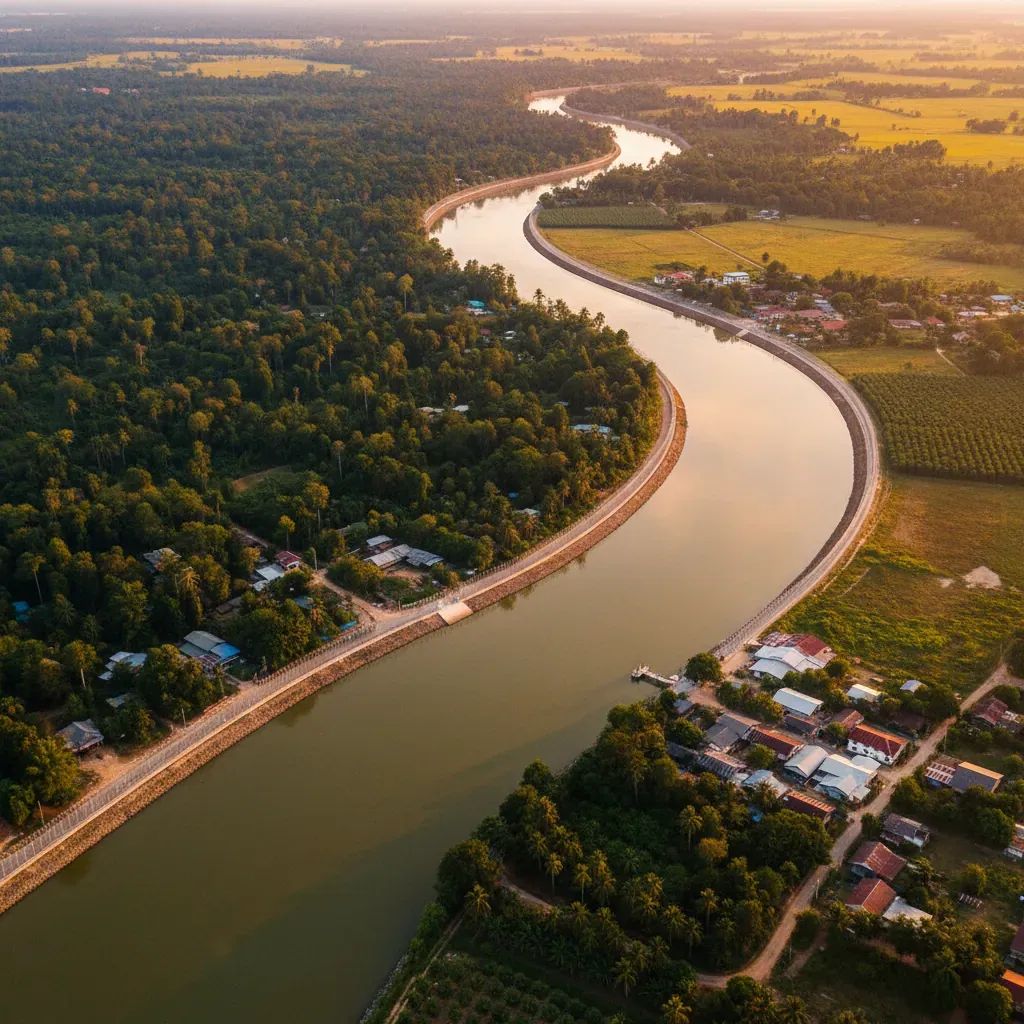
Chinese travelers are voting with their wallets—and second-tier beach towns across Thailand are reaping the rewards. During the 2026 lunar new year window, Ao Nang in Krabi province emerged as the breakout destination, with accommodation searches jumping 407.59% compared to the same period in 2025, a figure that reveals how sharply the geography of Chinese tourism in Thailand is shifting.
Why This Matters
• Krabi's accommodation market saw demand more than quadruple during the February 2026 festival window, outpacing traditional hubs like Bangkok and Phuket.
• Nearly 241,000 Chinese visitors arrived in Thailand during the 10-day holiday, generating an estimated ฿42 billion in spending across lodging, dining, transport, and entertainment.
• Peak daily arrivals reached 28,000–30,000 Chinese tourists during early February weekends—more than double the typical baseline of roughly 13,000 per day.
• Property owners, restaurant operators, and small business investors in coastal areas now face both unprecedented revenue opportunities and mounting infrastructure strain.
A Seismic Shift in Travel Patterns
The data tells a story of fundamental change in how Chinese tourists experience Thailand. Rather than concentrating in traditional anchor cities, travelers are spreading into smaller, less saturated destinations. Ao Nang's beachfront—a 3-kilometer strip functioning as the gateway to island-hopping excursions—represents exactly the kind of destination seeing explosive growth: intimate in scale, rich in natural features, and free from the overcrowding that has come to define Bangkok and central Phuket.
The phenomenon extends well beyond Ao Nang. Ko Samet in Rayong province logged a 319.41% surge in searches, while Ko Lipe in Satun posted 274.42%, and Hua Hin in Prachuap Khiri Khan reached 262.23%. Even Chiang Mai, the northern cultural hub, posted a 234.73% increase. Within Phuket itself, secondary beaches—Kata (232.66%), Karon (188.03%)—significantly outperformed the saturated Patong beachfront (110.53%).
This redistribution reflects a behavioral shift among Chinese travelers: away from large, shepherded group tours concentrated in sprawling cities, and toward independent travel, couples, and small groups seeking authentic experiences, natural settings, and manageable crowd sizes. It's a distinction with real consequences for both business opportunity and resource management.
The Economic Engine Accelerates
The lunar new year period in February 2026 brought an estimated ฿42 billion in direct spending to the Thai economy. The Civil Aviation Authority of Thailand (CAAT) reported significant passenger volumes through Thai airports during the festival period, with Chinese travelers averaging peak arrivals. On select days in early February, daily arrivals topped 30,000. WeChat Pay transaction data indicated strong spending growth among Chinese travelers during the February festival period, with Thailand capturing a substantial share.
The engine driving this surge is not mysterious. Thailand's permanent visa waiver policy between China and Thailand, implemented in early 2025, has eliminated a bureaucratic friction point that plagued other Southeast Asian destinations. Direct flight connectivity, established Mandarin-language services, and a reputation for safety and hospitality complete the picture. The tourism sector has set ambitious targets for Chinese visitor expansion in coming years, and if current momentum persists, these targets appear well within reach.
What This Means for Residents and Business Owners
For entrepreneurs in coastal provinces, the message is unambiguous: Chinese demand is no longer urban-centric. Guesthouse operators, mid-market hoteliers, tour arrangers, and restaurant owners in previously quiet zones—Ao Nang, Ko Samet, Ko Lipe—are experiencing a financial windfall that few anticipated this rapidly.
The volume of business translates to steady occupancy, rapid turnover of rooms, and stable employment for staff. Language skills—particularly Mandarin—have become a genuine employment asset; service workers, tour guides, and hotel managers with Chinese language proficiency command premium wages and better work conditions.
For property investors, short-term rental yields look compelling in the near term. High occupancy rates, strong nightly rates, and a decade-long recovery trajectory for tourism suggest measurable returns. However, the surge also exposes a secondary risk: rapid, poorly coordinated development invariably triggers regulatory blowback. Any future environmental violation, national park encroachment, or wastewater discharge incident could trigger permitting freezes or forced operational closures—outcomes that have befallen other Thai beach zones in recent cycles.
Infrastructure and Environmental Reckoning
Prosperity and strain arrive together. Ao Nang's 3-kilometer beachfront is already densely packed with hotels, restaurants, tour operators, and boat piers—a space not designed for the volume now passing through it daily.
Waste management emerges as an immediate pressure point. Both Ao Nang and the nearby Phi Phi islands operate under inadequate sewage treatment capacity. Wastewater discharges into nearshore waters remain an ongoing environmental and public health concern. Untreated waste is not a future risk; it's an active problem that seasonal tourism surges exacerbate.
Marine ecosystem degradation is accelerating. Anchor damage to coral reefs, illegal construction encroaching on national park boundaries, and systematic destruction of mangrove forests continue as visitor volumes climb. The structural integrity of underwater ecosystems that draw snorkelers and divers is steadily deteriorating—a self-defeating dynamic where the destination's natural assets degrade in proportion to its commercial success.
Congestion and overcrowding on land and water are intensifying. Pier congestion, road traffic bottlenecks, noise, and inadequate emergency services oversight create both safety risks and quality-of-life degradation for both residents and visitors. During peak periods, basic services—electricity, fresh water supply, solid waste collection—operate under strain.
Land-use conflicts have become visible. Limited space has created friction between budget and luxury operators, between family-oriented and party-focused venues, and between commercial developers and conservation advocates. The spatial constraints that made Ao Nang appealing—its compactness, its walkability—are simultaneously the source of mounting pressure and competition for every usable square meter.
Krabi provincial authorities have prioritized road safety improvements leading to Krabi International Airport and upgraded marine safety protocols. Yet infrastructure upgrades consistently lag behind demand growth. The pace of construction and regulatory adaptation cannot match the velocity of tourism arrival.
The Double-Edged Prosperity Question
Thailand's economic reliance on Chinese tourism is both an asset and a vulnerability. In previous decades, Chinese visitors generated substantial direct tourism-related GDP and supported hundreds of thousands of jobs nationwide. When pandemic-related travel restrictions halted Chinese tourism for extended periods, the economic and employment consequences were severe and swift across tourism-dependent provinces.
This history has prompted the Thailand Cabinet and TAT to publicly pivot toward "quality over quantity" tourism strategies—emphasizing higher per-visitor spending and longer stays over pure volume. Yet on the ground, the Ao Nang surge and similar phenomena suggest that in practice, sheer volume remains the dominant driver, particularly in provincial destinations where environmental safeguards and infrastructure planning remain less developed than in urban centers.
The data also hints at diversity within the Chinese traveler cohort. Interest in cultural immersion, adventure activities (kayaking, snorkeling, jungle treks), and wellness tourism is rising alongside traditional beach leisure. This presents an opening for operators capable of delivering premium, low-impact experiences rather than mass-market package operations. The margin opportunity lies not in volume but in segmentation.
Environmental Advocates and Sustainability Questions
The economic gains are tangible and beneficial for thousands of small business operators, guide workers, taxi drivers, and restaurant staff. But the environmental ledger is more complex. Ao Nang and Phi Phi have become canonical examples of rapid, inadequately planned tourism expansion. Plastic waste accumulates visibly on beaches, boat fuel contamination affects nearshore waters, and the density of human activity disrupts marine life, nesting sites, and natural recovery cycles.
Sustainable tourism advocates argue persuasively that without stronger environmental regulation enforcement, investment in wastewater treatment infrastructure, and implementation of daily visitor caps at sensitive sites, Krabi risks repeating the trajectory of Pattaya and parts of Phuket—places where overdevelopment has permanently degraded the natural assets that originally drew tourists in the first place. Short-term revenue and long-term asset destruction are not compatible outcomes; they are opposing forces.
Regional Competition and Thailand's Edge
Thailand's position as the preeminent destination for mainland Chinese travelers during lunar new year was not inevitable. Competing Southeast Asian nations—Vietnam, Malaysia, Indonesia—have implemented visa facilitation programs and increased marketing spend. Thailand's decisive advantage stems from a convergence of practical factors: established Mandarin-language infrastructure, a strong reputation for traveler safety, direct-flight availability, and critically, the permanent visa waiver that removes bureaucratic friction from the decision to travel.
For expats and foreign residents living in Thailand, the influx has immediate, observable consequences. Peak season beaches are measurably more crowded; flight capacity tightens; accommodation rates spike. But it also creates employment and business opportunities in sectors serving the Chinese traveler population—digital payment integration (Alipay, WeChat Pay), Mandarin-language hospitality roles, and e-commerce logistics are sectors experiencing accelerated hiring.
The Trajectory Ahead
Booking.com data and China's National Immigration Administration jointly confirm that Chinese travel demand has not merely recovered from pandemic disruptions; it is actively reorganizing the geographic distribution of tourism within Thailand. Ao Nang's 407% surge is not an outlier—it is a harbinger signaling that secondary destinations with natural beauty, accessibility, and relative freedom from saturation are entering the spotlight and competing directly with established urban anchors.
The sustainability question is neither rhetorical nor abstract. Whether Thailand can expand this tourism sector without sacrificing the environmental and cultural assets that make these places commercially valuable in the first place will determine long-term viability. For now, the trajectory is clear: business operators with exposure to Krabi's tourism economy are experiencing favorable tailwinds, property investors see compelling near-term returns, and the working population has access to expanded employment. Yet the infrastructure and environmental pressures building beneath this prosperity may prove consequential. Growth without planning creates short-term wealth and long-term fragility.