
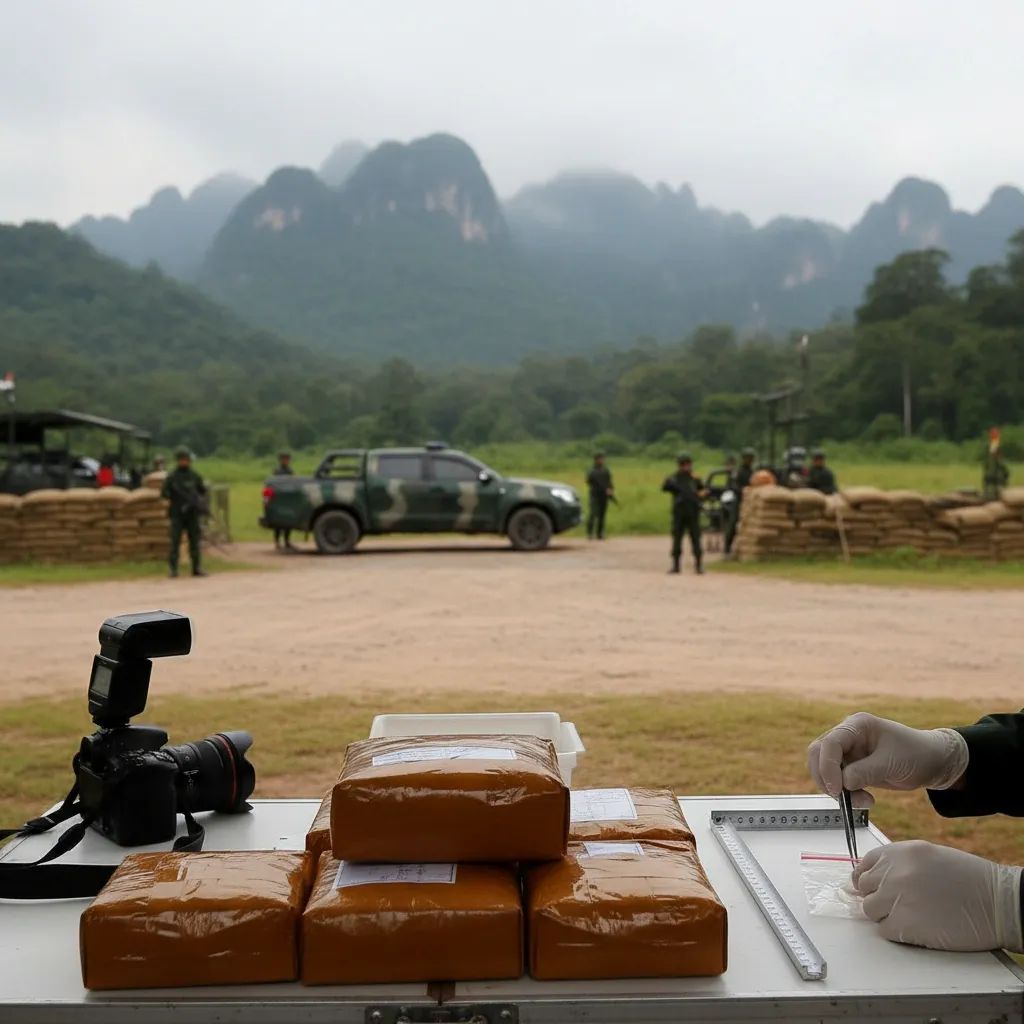
The Thailand Tourist Police Sub-division 1 of Division 2 intercepted a major methamphetamine shipment in Khon Kaen's Kranuan district on Sunday, May 3, 2026, seizing 1 million pills worth more than ฿30M and arresting two couriers linked to Lao trafficking networks. The bust underscores the province's role as a critical distribution node for synthetic drugs flowing from the Golden Triangle through Laos into Thailand's interior.
Why This Matters
• Scale: 1 million pills—worth over ฿30M—were destined for smaller dealers in central Thailand, indicating the region's function as a staging ground rather than an endpoint.
• Route shift: Traffickers are increasingly avoiding the Thailand-Myanmar border in favor of the less-guarded Laos crossing, with Khon Kaen serving as a key transit hub.
• Local recruitment: Both suspects are Khon Kaen natives recruited by foreign syndicates, highlighting how financial distress fuels the supply chain in northeastern Thailand.
The Chase Through the Sugarcane
Officers from the Tourist Police Division 2 acted on intelligence about a drug run near the entrance to Huai Jod village in tambon Huai Jod. When they attempted to inspect a black Toyota Altis sedan and a black Honda CBR motorcycle matching the tip-off description, both drivers bolted into a nearby sugarcane plantation. Police pursued on foot and apprehended the pair within minutes.
A search of the abandoned vehicles and surrounding area yielded five sacks of methamphetamine tablets bearing a "Y1" logo—a marking increasingly associated with Myanmar-origin batches. One sack containing 200,000 pills was discovered in the sedan's trunk, while the remaining four sacks, holding 800,000 pills, were stashed in shallow ditches at the field's edge.
The suspects were identified as Jutha Saeng-ae, 40, and Thaweesak Chomphusri, 33, both from Khao Suan Kwang district in Khon Kaen. Pol Col Ronnaphat Phengyuak, chief of the tourist police sub-division, stated that intelligence indicated the drugs were en route to Chum Phae district, where they would be subdivided for distribution to smaller dealers in central provinces.
What This Means for Residents
For communities across northeastern Thailand, this seizure is a reminder that the region remains a high-traffic corridor for narcotics—not merely a border zone but an active logistics hub. The Mekong River basin and the Thailand-Laos border have become the preferred entry points for synthetic drugs since security tightened along the Thailand-Myanmar frontier. Provinces like Nakhon Phanom, Bueng Kan, Nong Khai, and Mukdahan are frequently cited as crossing points, with Khon Kaen serving as a central node for onward distribution.
The recruitment of local couriers—often from economically struggling districts—is a pattern that law enforcement and community leaders are working to disrupt. According to authorities, poverty in Isan makes residents vulnerable to lucrative, short-term courier jobs that carry severe legal consequences: possession of a Category 1 narcotic with intent to sell can result in life imprisonment or death, depending on the quantity. It is important to note that Thailand maintains capital punishment for major drug offenses, a policy strictly enforced.
The Golden Triangle Pipeline
The Golden Triangle—the border region where Thailand, Myanmar, and Laos converge—remains the epicenter of synthetic drug production in Southeast Asia. Since Myanmar's 2021 military takeover, industrial-scale methamphetamine manufacturing has surged, with Shan State emerging as the primary production hub. Various armed groups, including factions within the Myanmar military, are reportedly profiting from the trade to finance their operations amid ongoing civil conflict.
Production and Distribution Networks
In 2024, East and Southeast Asia witnessed a record seizure of 236 tons of methamphetamine, with Thailand alone confiscating 1 billion pills. The efficiency of modern chemical-based production—no longer reliant on traditional opium cultivation—has accelerated output and lowered costs, making methamphetamine more accessible and more profitable for transnational syndicates.
Criminal networks have adapted to heightened surveillance by shifting routes. The Thailand-Laos border and the Mekong River are now the arteries of choice, with long-tail boats ferrying narcotics across the water into Isan provinces. From there, drugs are trucked or transported by motorcycle to central and southern Thailand, and in some cases, onward to international markets including Australia, New Zealand, and South Korea.
Khon Kaen's Role in the Supply Chain
Khon Kaen's central location within the Isan region makes it a natural hub for drug logistics. The province sits along major highways connecting the Laos border to Bangkok and southern Thailand, and its relative urbanization provides cover for trafficking operations that might stand out in more rural areas.
Tourist Police in Khon Kaen have been increasingly active in drug enforcement. Earlier this year on January 12, 2026, officers arrested a 28-year-old man linked to the trafficking of 440,000 methamphetamine pills. On April 11, 2026, Region 4 investigative police apprehended a Laotian trafficking network in the province, seizing over 1 million pills and 24.9 grams of crystal methamphetamine. These operations, combined with Sunday's bust, underscore the province's status as a frontline in Thailand's anti-narcotics campaign.
Yet the sheer volume of seizures also reveals the scale of the problem: if authorities are intercepting millions of pills, how many more are slipping through? The Thailand Office of the Narcotics Control Board has acknowledged that methamphetamine remains the country's most pressing drug threat, with production and trafficking networks highly adaptable to enforcement pressure.
The Human Cost
The suspects in Sunday's arrest told investigators they were recruited by a Lao national and offered cash to transport the shipment from Kranuan to Chum Phae district. Jutha allegedly cited financial difficulties as the reason for accepting the job—a scenario that recurs across Isan and other economically marginalized regions.
The influx of drugs has also driven a surge in substance abuse. Border communities in northern and northeastern Thailand have reported a tripling of methamphetamine use over the past five years, particularly among youth and vulnerable ethnic groups. Economic hardship and limited opportunities often push individuals into drug-related labor or low-level smuggling, perpetuating a cycle that authorities are struggling to break.
What Residents Can Do
If you suspect trafficking activity in your area, contact the Tourist Police hotline at 1155 or the Border Patrol Police at 0-2668-6700. Many communities in northeastern Thailand also work with local administrative organizations (Subdistrict Administration Organizations or TAO) to report suspicious activity. Communities along known trafficking routes should remain vigilant and report any unusual vehicle or personnel movement to authorities, as local intelligence is often critical to interdiction efforts.
Enforcement and International Cooperation
Thai law enforcement agencies, including the Royal Thai Police, Tourist Police, and Border Patrol Police, are intensifying efforts to dismantle trafficking networks through increased patrols, community cooperation, and advanced detection technology. In early 2026, coordinated operations across Khon Kaen, Nakhon Phanom, Bueng Kan, and other northeastern provinces resulted in multiple arrests and the seizure of hundreds of thousands of pills.
Yet the problem is transnational, and no single country can solve it alone. The Myanmar civil war has weakened governance in key production areas, and Laos—a transit country with limited resources—has struggled to stem the flow. Thai authorities have called for enhanced regional cooperation and more robust chemical precursor controls, given that most of the ingredients for methamphetamine production are sourced from China and shipped through third countries.
Outlook
The seizure of 1 million pills in Kranuan on May 3, 2026, represents a tactical victory, but it is unlikely to disrupt the broader network. As long as Myanmar's Shan State remains a permissive environment for large-scale production, and as long as economic desperation in Isan provides a ready supply of couriers, the flow of methamphetamine will continue. The challenge for Thai authorities is to balance enforcement with community-level interventions that address the root causes of recruitment and addiction.
For residents of northeastern Thailand, the seizure highlights an ongoing challenge for local communities—the drug trade remains deeply embedded in regional logistics networks, with consequences that reach into villages, schools, and families. Sunday's arrests may have taken 1 million pills off the street, but they also underscore that the battle against transnational drug trafficking requires sustained effort from both law enforcement and civil society.


