
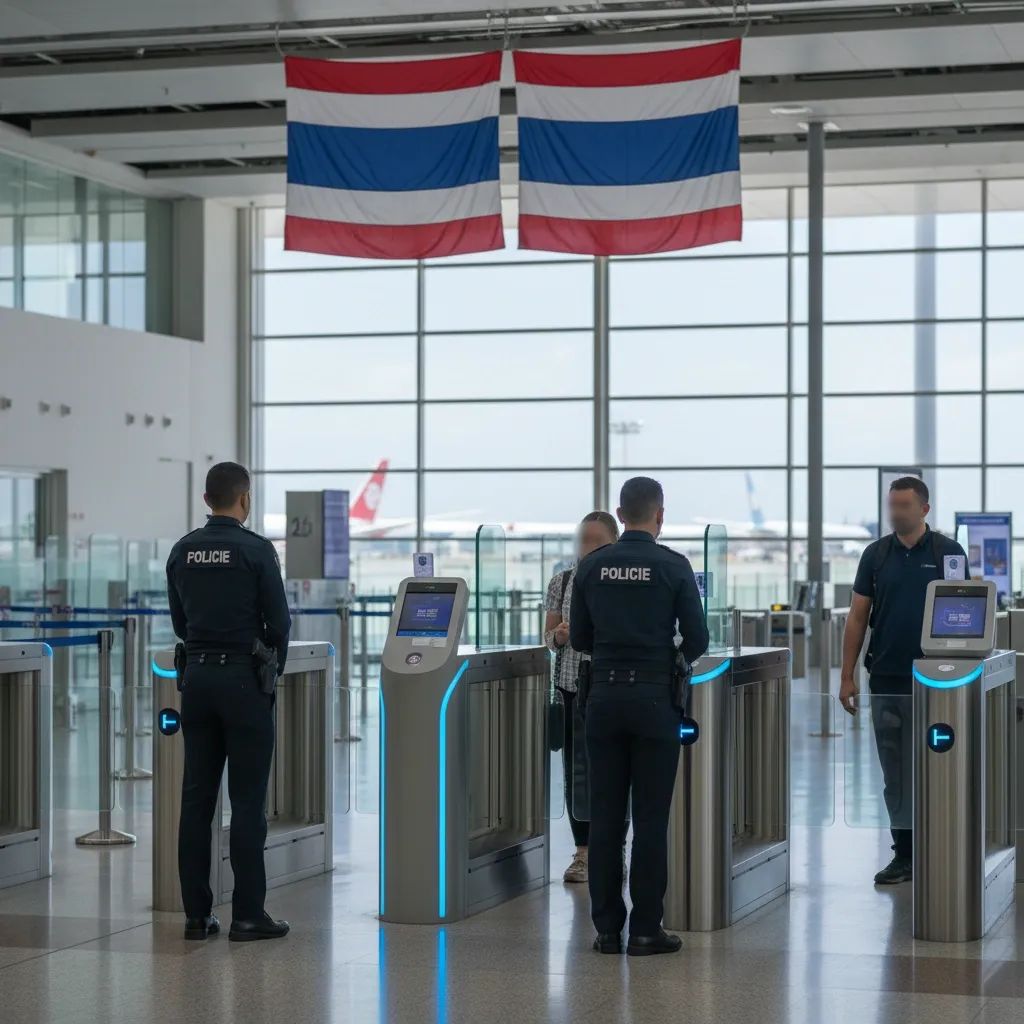
Thailand Immigration Police have successfully detained a South Korean fugitive who had been living undisturbed in Phuket for more than eight years, demonstrating renewed coordination between Thai and international law enforcement to prevent the kingdom from becoming a haven for wanted criminals. The arrest of the individual, identified only as Mr. Lee, marks a significant enforcement action in a province known for its transient foreign population.
Why This Matters
• Visa enforcement tightening: Immigration officials are leveraging biometric tracking systems and Interpol Red Notices to locate long-term overstays connected to serious crimes.
• Extradition likely: Thailand and South Korea maintain a bilateral extradition treaty in force since 2001, meaning Mr. Lee will likely face court proceedings and potential transfer back to Seoul.
• Criminal network disruption: Authorities allege Mr. Lee led a transnational drug trafficking operation exporting narcotics from Thailand to South Korea, raising questions about enforcement gaps.
• Overstay penalties escalating: Mr. Lee's 2,992-day overstay (over eight years) will result in substantial fines, blacklisting, and potential immigration detention beyond his criminal charges.
The Arrest Operation
On the evening of August 12, 2026, officers from the Thailand Immigration Bureau and the Office of the Narcotics Control Board (ONCB) converged on a luxury condominium complex in Mueang Phuket district. Acting on intelligence shared by South Korean law enforcement and verified through Thailand's immigration biometric database, the joint team had been conducting surveillance on the property for several days.
When a man matching Mr. Lee's description emerged from the building around 7 p.m., officers moved in to verify his identity. A document check confirmed he was the target of the operation, and a subsequent search of his condominium unit yielded three debit cards and a mobile phone believed to be linked to his alleged criminal enterprises. He was taken into custody without incident and formally charged with overstaying his visa—an initial holding charge while extradition procedures begin.
Immigration records showed Mr. Lee arrived at Phuket International Airport on March 6, 2018, on a standard tourist visa granting him permission to remain in Thailand until June 3, 2018. He never left, accumulating 2,992 days of illegal presence—equivalent to roughly 8.2 years—before his apprehension.
The Charges Awaiting Him
South Korean authorities have issued an Interpol Red Notice for Mr. Lee, accusing him of orchestrating a sophisticated drug trafficking network that moved narcotics and cannabis from Thailand to South Korea. He is also wanted for defrauding South Korean citizens of more than 800 million won (approximately 20 million baht)—a sum that represents significant financial harm to multiple victims.
Beyond the primary drug and fraud allegations, investigators have linked Mr. Lee to 23 additional criminal cases spanning assault, prostitution-related offenses, and further fraud schemes. The breadth of the accusations suggests a pattern of organized criminal activity rather than isolated incidents.
Pol Maj Gen Phanthana Nuchanart, deputy commissioner of the Thailand Immigration Bureau, emphasized the kingdom's commitment to international cooperation: "Thailand will not serve as a refuge for fugitives. We work closely with security agencies worldwide to identify and apprehend individuals who exploit our borders."
How He Stayed Hidden for Eight Years
Mr. Lee's ability to evade detection for such an extended period highlights both the challenges and vulnerabilities within Thailand's immigration enforcement system, particularly in high-traffic tourist zones like Phuket. The island's transient population, constant flow of foreign visitors, and abundance of short-term rental properties create an environment where individuals can blend in relatively easily.
However, the successful operation also demonstrates the effectiveness of Thailand's immigration biometric system, which retained Mr. Lee's entry records and enabled authorities to confirm his presence once intelligence from Seoul arrived. The collaboration between the Thailand Immigration Bureau, ONCB, and South Korean intelligence agencies proved critical—underscoring the importance of international information-sharing in tracking fugitives who cross borders.
The luxury condominium where Mr. Lee resided suggests he had access to financial resources, likely derived from the alleged criminal activities he is accused of coordinating from Thai soil. The seizure of multiple debit cards indicates he may have maintained active financial operations during his time in hiding.
What This Means for Residents
For expatriates and long-term foreign residents in Thailand, this case serves as a stark reminder of the consequences of overstaying and the increasing sophistication of immigration enforcement. While Mr. Lee's case involves serious criminal allegations, even minor overstays can result in substantial fines (up to 20,000 baht), detention, deportation, and multi-year bans from re-entering Thailand.
The case also highlights Thailand's growing capacity to track and locate individuals through biometric systems and international law enforcement networks. Foreigners living in Thailand should ensure their visa status remains current and understand that immigration violations—even if initially overlooked—can resurface years later with serious consequences.
The Extradition Process Ahead
Under the Thailand-South Korea Extradition Treaty (in force since 2001) and Thailand's Extradition Act B.E. 2551 (2008), Mr. Lee will likely face a formal extradition process managed by the Thai Ministry of Foreign Affairs and the Office of the Attorney General, which serves as Thailand's central authority for extradition matters.
South Korean prosecutors must submit a formal extradition request through diplomatic channels, including arrest warrants, court judgments, and evidence—all translated into Thai and authenticated. The request will be evaluated based on dual criminality, meaning the alleged offenses must be punishable by at least one year of imprisonment in both countries. Drug trafficking and fraud easily meet this threshold.
If the Office of the Attorney General approves the request, the case moves to the Thai Criminal Court for an extradition hearing. These proceedings typically conclude within 60 to 90 days, though appeals to the Supreme Court can extend the timeline. The court does not assess guilt or innocence but rather determines whether legal prerequisites for extradition are satisfied.
Key protections include the rule of specialty (Mr. Lee can only be prosecuted for crimes specified in the extradition request) and human rights considerations. However, given the strength of the bilateral treaty and the serious nature of the charges, legal experts consider extradition highly probable unless significant procedural flaws emerge.
Border Enforcement Under Scrutiny
This arrest arrives amid broader scrutiny of Thailand's immigration enforcement, particularly in tourist-heavy provinces like Phuket, Pattaya, and Bangkok, where large foreign populations can strain monitoring resources. The Thailand Immigration Bureau has invested in technology upgrades—including biometric entry-exit systems and enhanced database integration—to better track visa compliance and identify individuals with outstanding warrants.
The collaboration with Interpol and foreign law enforcement agencies has intensified, with Thai authorities seeking to avoid the reputation of being a soft refuge for international fugitives. Recent years have seen multiple high-profile arrests of wanted individuals from South Korea, China, and other countries who had sought to disappear into Thailand's expatriate communities.
For Phuket specifically, where an estimated tens of thousands of foreigners reside at any given time—many on tourist visas or visa exemptions—the arrest underscores the reality that immigration violations and criminal fugitives do eventually surface, even after years in hiding. Property managers, condominium operators, and landlords are increasingly required to report foreign tenants to immigration authorities, tightening the net around those overstaying or evading warrants.
The case of Mr. Lee serves as both a warning to those considering Thailand as a hideout and reassurance to residents that law enforcement cooperation is functional and improving.


