
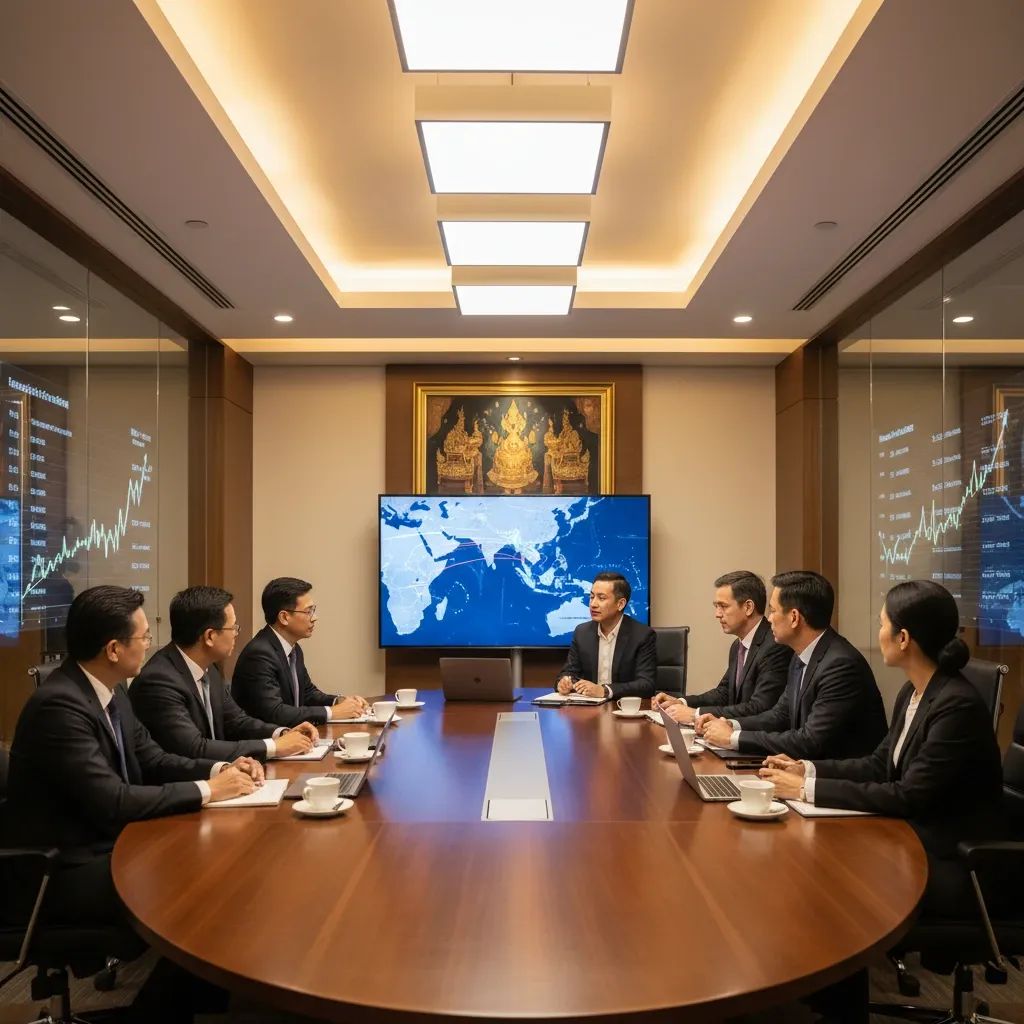
Tencent Cloud, Huawei, and Alibaba Cloud are ramping up operations across Thailand's enterprise AI sector, a move that positions the country as the next frontier for China's tech giants while raising questions about data sovereignty and geopolitical dependencies. As these firms deploy agentic AI solutions—autonomous systems capable of executing complex business tasks—Thailand finds itself navigating the dual challenge of attracting foreign investment while building its own digital capabilities.
Why This Matters
• Enterprise exposure: Chinese platforms are integrating deeply into Thai retail, finance, government, and healthcare systems through cloud-based AI tools.
• Geopolitical friction: A Bangkok-based firm was flagged in May 2026 for allegedly diverting US-restricted Nvidia servers to Chinese companies, highlighting the US-China AI chip war's spillover effects.
• Local ambition: The Thailand government aims to position the country as a regional AI hub by 2035, with a domestic AI law taking effect March 1, 2026.
• Talent shortage: Thailand produces only a few hundred AI engineers annually but needs tens of thousands to meet industry demand.
Chinese Tech Giants Deploy Agentic AI Across Thai Industries
Tencent Cloud has emerged as one of the most aggressive entrants, pitching its Tokenhub platform to Thai enterprises seeking cost-efficient deployment of AI agents. The platform optimizes token usage—a key cost driver in generative AI—while enabling firms to automate customer service, inventory management, and fraud detection. Tencent has partnered with Bitkub Group, a major Thai digital asset platform, to integrate AI-powered risk controls and eKYC verification. Another collaboration with Amaze, a local live-commerce player, now offers AI-powered multilingual subtitles and real-time translation, targeting the cross-border e-commerce boom between Thailand and China.
Huawei is taking a sector-specific approach. The company has rolled out AI computing infrastructure and industry solutions tailored for Thai government agencies, financial institutions, and hospitals. The Thai Food and Drug Administration now uses Huawei's automated document analysis to process product registrations faster, while the Ministry of Commerce employs AI-driven market trend analysis. In the private sector, Huawei Cloud is helping Thai banks transition to cloud-native databases, a critical step for real-time fraud detection and digital lending.
Alibaba Cloud has established a second data center in Thailand and launched the Alibaba Cloud Academy AI Lab at Bangkok University, training students in cloud computing and generative AI. Its Qwen3 models and open-source AgentScope framework enable Thai developers to build multi-agent applications without relying on expensive proprietary systems. The company's Wan2.1 video generation model powers the "Eye for Thailand" marketing challenge, which aims to showcase Thai products to global audiences through AI-generated content.
ByteDance, the parent company of TikTok, is positioning itself as an AI infrastructure provider across Southeast Asia, with significant data center investment in Thailand. Meanwhile, Baidu is focusing on tourism, partnering with the Tourism Authority of Thailand (TAT) to deploy AI-powered travel insights and customized content for Chinese tourists, a demographic that represents roughly a quarter of Thailand's pre-pandemic visitor arrivals.
The Geopolitical Tightrope: Export Controls and Data Diversion
The intensifying US-China AI chip war is creating a compliance minefield for Thailand. In May 2026, a Bangkok-based company linked to the national AI push was flagged for allegedly helping divert Nvidia-powered servers to Chinese firms, including Alibaba. The accusation underscores how US export rules now focus on ultimate ownership: any company with a Chinese parent is treated as if it were based in China, regardless of where its subsidiary operates.
For Thailand, this creates a strategic dilemma. The country needs foreign capital and technology to build out AI infrastructure, but accepting investment from Chinese firms risks entanglement in US sanctions. At the same time, Thailand's digital economy is projected to reach approximately $140.3B in 2025, with the generative AI market alone expected to grow from $312M in 2025 to $1.8B by 2030. Turning away investment could slow this trajectory.
Thailand has tried to navigate this tension through a hybrid governance model. The country's first comprehensive AI law, which took effect March 1, 2026, adopts a risk-based approach similar to the EU AI Act, categorizing systems into unacceptable, high, and limited risk tiers. The AI Governance Practice Center (AIGPC), established under the Electronic Transactions Development Agency (ETDA), is tasked with developing standards and tools to ensure responsible AI adoption.
What This Means for Residents and Businesses
For Thai businesses, the influx of Chinese AI platforms offers immediate access to cutting-edge tools at competitive prices. DeepSeek, a Chinese AI startup, has gained traction across Southeast Asia with its low-cost, high-performance R1 and V4 models, which are particularly attractive to small and medium-sized enterprises that cannot afford proprietary Western systems. AgiBot, a Shanghai-based robotics developer, announced plans in July 2026 to establish an Asia-Pacific sales office in Thailand, signaling a push into advanced manufacturing and logistics automation.
However, this dependency raises questions about data sovereignty. Unlike Thailand's domestic ThaiLLM, which is hosted on the national supercomputer ThaiSC and ensures local data processing, Chinese cloud platforms typically route data through servers located outside Thailand. For sectors like healthcare and finance, this creates potential vulnerabilities around privacy and regulatory compliance.
Microsoft, by contrast, is injecting over $1B into Thailand's cloud and AI infrastructure between 2026 and 2028, a move that offers an alternative to Chinese platforms. The company has also helped upskill over 2M people in Thailand through AI training programs, partnering with the Ministry of Education to integrate AI into school curricula.
Thailand's Domestic AI Ecosystem: Catching Up or Falling Behind?
Thailand is betting heavily on its ability to develop indigenous AI solutions. The National AI Action Plan (2022–2027) sets ambitious targets, including the development of at least 100 R&D prototypes within six years and the training of more than 30,000 AI professionals. The University of the Thai Chamber of Commerce (UTCC) has adopted an "AI first" strategy, launching initiatives like the AI solution factory & digital workforce lab and the AI talent for Thailand project.
Local startups are also emerging. Alisa, developed by Glory Forever Co., Ltd., is a virtual assistant optimized for the Thai language, while Anissa AI focuses on generating Thai content for social media and SEO. Mandala AI, created by Ocean Sky Network, provides deep social media data analysis tailored to Thai consumer behavior. HappyRecruit by Jenosize uses machine learning to automate recruitment, a critical tool in a labor market where finding skilled tech workers is increasingly difficult.
Yet the talent gap remains the most pressing bottleneck. Industry estimates suggest Thailand needs tens of thousands of AI engineers annually, but universities produce only a few hundred. Programs like "AI Gov4Govt" and the "AI Change Agent Program" aim to train thousands of government employees, but scaling these efforts to meet private-sector demand will require sustained investment and curriculum reform.
Regional Hub or Client State?
Thailand's ambition to become a regional AI hub by 2035 hinges on its ability to balance foreign investment with domestic control. The country signed 14 MOUs with China in February 2025 to enhance collaboration in the digital economy, AI, and space technology, with a focus on joint AI development and research. But as Chinese platforms become embedded in Thai government agencies, banks, and retail operations, the risk of long-term dependency grows.
The AI Governance Practice Center (AIGPC) is seeking UNESCO recognition to cement Thailand's leadership in AI ethics and governance across Southeast Asia. If successful, this could position Thailand as a neutral broker in regional AI policy, offering a counterbalance to both Chinese and Western influence.
For now, Thailand is threading the needle—welcoming Chinese capital and technology while building the legal and institutional frameworks needed to protect its digital sovereignty. Whether this strategy succeeds will depend on how quickly the country can close its talent gap, enforce its new AI regulations, and avoid becoming a casualty in the broader US-China tech rivalry.


