
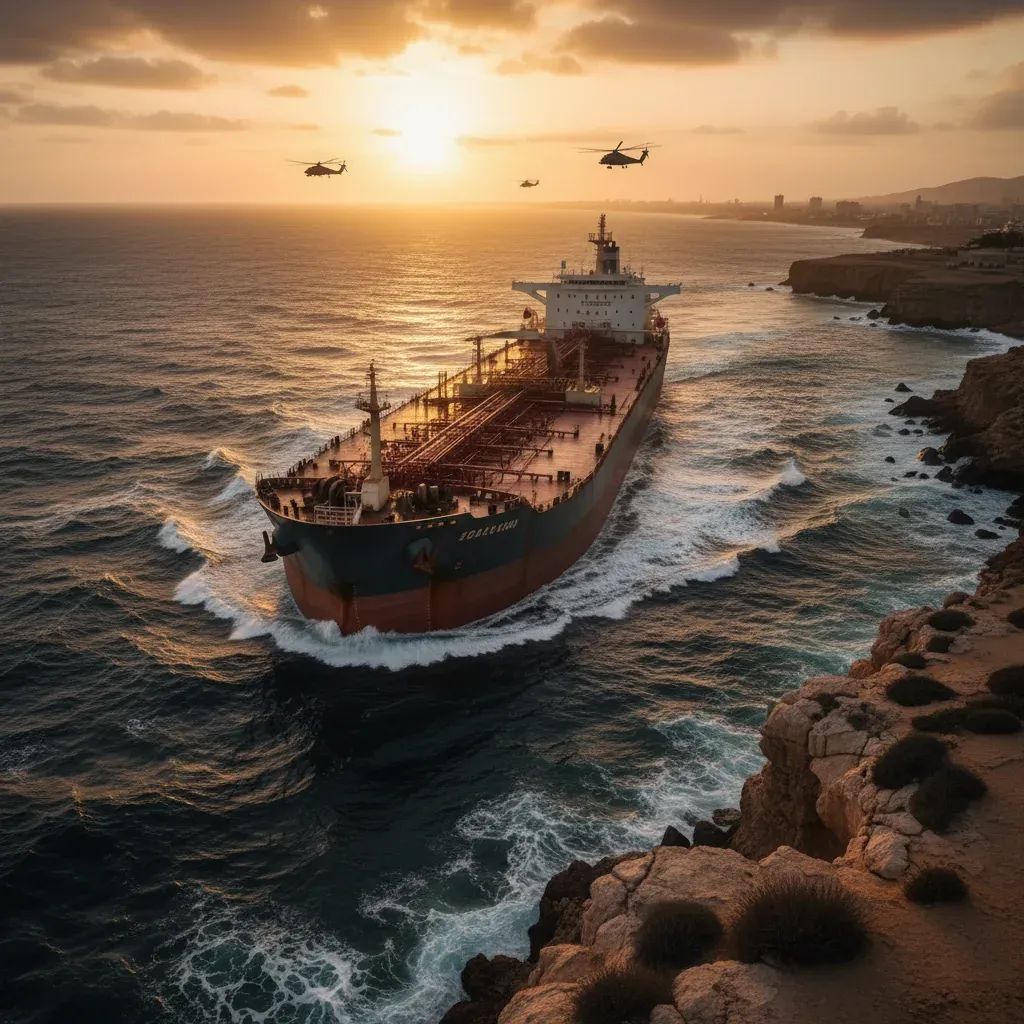
Thailand's fuel costs are rising, manufacturing jobs are at risk, and shipping expenses are soaring—all because of a distant military standoff in the Strait of Hormuz. Since late February 2026, Iran's Revolutionary Guard has systematically blockaded the waterway, and the consequences are hitting Thai households and businesses hard. Crude oil now trades at $88 per barrel, war-risk insurance has tripled, and supply chains that once moved like clockwork are now backed up for weeks. For residents and expats working in Thailand's energy-intensive sectors, this crisis is no longer distant geopolitics—it's a direct threat to employment and cost of living.
Why This Matters
• Energy costs rising in real time: Brent crude surged from $69/barrel in July to $88 by mid-August; Thai petrol pumps already reflect these increases, straining household budgets and compressing margins for transport operators.
• Insurance premiums have become prohibitive: War-risk coverage jumped from 0.125% to 0.4% of vessel value per transit—roughly $250,000 extra per tanker voyage—a cost absorbed by Thai importers.
• Manufacturing competitiveness under pressure: Automotive, electronics, and chemicals sectors depend on steady feedstock flows; rerouted shipping and delayed supply chains translate into production delays and cost inflation for export-oriented manufacturers.
Thailand's Vulnerability and the Cascading Cost Structure
Thailand imports virtually all of its crude oil, making exposure to Hormuz disruption unavoidable. The blockade has created a three-tier cost problem: higher base prices, inflated insurance expenses, and extended supply lead times.
Marine war-risk insurance has surged from 0.125% of vessel value to 0.4% per transit. For a very large crude carrier, that adds approximately $250,000 to the cost of each voyage—money that petrochemical facilities, automotive plants, and electronics manufacturers must absorb or pass to customers. The Thailand Energy Policy and Planning Office has flagged the volatility as material to the 2026 economic outlook. Energy-intensive sectors—logistics, chemicals, heavy manufacturing—are experiencing structural margin compression.
Multinationals operating in Thailand are already restructuring operations. Fuel hedging has become standard practice. Supply contracts are being renegotiated quarterly. Companies that previously relied on just-in-time inventory and single-source procurement are redesigning for slower, costlier transit. The Thailand Board of Investment has fielded repeated inquiries from foreign manufacturers asking whether the kingdom remains a viable production hub or whether they should shift sourcing to insulate themselves from Persian Gulf volatility.
What This Means for You: The US Energy Information Administration forecasts Brent crude will average $85 per barrel in the third quarter of 2026—significantly above historical norms and sufficient to reshape profitability across import-dependent industries. If you drive a truck or taxi, or work in manufacturing exports, your margins are shrinking. If you work in automotive, electronics, or chemicals sectors, your employer is likely reviewing whether to continue or consolidate Thailand operations. The Thailand Ministry of Energy and the National Security Council have privately acknowledged that this blockade may not resolve quickly, meaning these pressures could persist through 2026 and into 2027.
How Iran's Blockade Became Structural
In late February 2026, the Iranian Revolutionary Guard Corps began systematically controlling the waterway. The force boarded merchant vessels, deployed sea mines, and fired on commercial shipping. A temporary ceasefire and memorandum of understanding signed in June briefly eased pressure, but Iran reimposed restrictions weeks later, citing alleged violations and asserting its right to collect transit fees.
What distinguishes this blockade from previous flare-ups is its duration and the absence of off-ramps. Iran has set three non-negotiable preconditions for reopening: an end to what it calls "aggression," comprehensive sanctions relief, and compensation for wartime damage. The United States has responded with naval blockades on Iranian ports and threats of "unprecedented economic isolation." Neither side shows movement toward compromise, suggesting the closure could persist well into the fourth quarter of 2026 and beyond.
The practical effect has been stark. Shipping lines have suspended or rerouted services away from both the Strait of Hormuz and the Red Sea. Tanker traffic has slowed to minimal levels. Port congestion has rippled across Southeast Asian hubs. The International Energy Agency downwardly revised global oil demand by 1.6 million barrels per day, a staggering reduction driven by supply disruption and persistently elevated fuel costs.
The Legal Backdrop: Why International Law Matters But Hasn't Worked
The Strait of Hormuz is just 22 nautical miles wide at its narrowest point and lies entirely within Iranian and Omani territorial waters. The United Nations Convention on the Law of the Sea (UNCLOS) establishes a "transit passage" doctrine that grants all vessels the right of unobstructed passage through straits used for international navigation. However, Iran never ratified UNCLOS and argues that looser "innocent passage" rules apply instead, giving coastal states greater discretion to regulate movement.
When US President Donald Trump recently suggested declaring the waterway "territory of the United States," Iran's response was swift: Deputy Foreign Minister Kazem Gharibabadi stated flatly that the strait "cannot be seized by tweet, nor by aircraft carrier, nor by issuing an order." The UN Secretary-General has issued pointed reminders that unilateral actions impeding international transit violate established international law. Trump's assertion has no foundation in any recognized maritime legal framework, and a White House official later characterized the remark as a joke—but it signals a hardening posture that offers little prospect of negotiated resolution.
Government Contingency Planning and What It Means
The Thailand National Security Council has recommended that major importers maintain higher inventory buffers for critical raw materials and explore diversification of energy suppliers, particularly from African and Central Asian sources. This is a quiet acknowledgment that the blockade may not resolve quickly and that Thailand cannot rely on diplomatic breakthrough.
The Thailand Ministry of Foreign Affairs continues monitoring developments through embassies in Tehran and Washington. The Thailand Ministry of Energy and private sector partners are tracking the crisis closely, though their ability to resolve it unilaterally is limited.
For residents and workers: This means large energy importers are rotating contracts and establishing relationships with non-Gulf suppliers. Shipping logistics providers are absorbing extended lead times and hedging fuel procurement where possible. State enterprises and private operators alike have begun constructing contingency scenarios for a blockade extending into 2027. Adaptation costs money and reduces efficiency—just-in-time supply chains are being redesigned for longer lead times and higher inventory buffers, which raises carrying costs. The alternative—remaining exposed to Hormuz volatility—now feels riskier than the cost of adaptation.
Regional Powers Hedging While US and Iran Dig In
Gulf Cooperation Council states—the United Arab Emirates, Kuwait, Bahrain, and Saudi Arabia—have condemned Iranian attacks on commercial shipping and called for unconditional reopening of the waterway. Oman, uniquely positioned as Iran's neighbor, has not publicly attacked Trump's territorial claim and is instead pursuing a formal governance role in strait administration. The European Union has notably issued no direct statement on Trump's territorial claim, a silence that suggests diplomatic caution.
What Comes Next
As mid-August 2026 turns toward September, the blockade enters its seventh month with no visible path to resolution. The most probable scenario is continued blockade through the fourth quarter of 2026, according to analysts tracking the standoff. What distinguishes this from previous Hormuz crises is the structural changes it has forced. Supply chains have been redesigned. Risk premiums have been rebuilt into contracts. Insurance products have been repriced. These shifts, once made, tend to persist even if the crisis eventually resolves.
For Thailand, the uncomfortable lesson is this: geopolitical friction in distant regions translates directly into economic friction at home. The international community's inability to enforce freedom of navigation through diplomatic or legal channels has left commercial operators dependent on military escorts, expensive insurance, and risk management—an arrangement that is neither cost-effective nor sustainable indefinitely.
Thai businesses have adapted as they always do: managing uncertainty, absorbing costs, and building redundancy into systems. But this adaptation has a price, paid in higher logistics costs, lower manufacturing margins, and reduced competitiveness in global markets. The blockade has become less a crisis to resolve and more a permanent condition to manage. For anyone living and working in Thailand, that distinction matters a great deal.


