
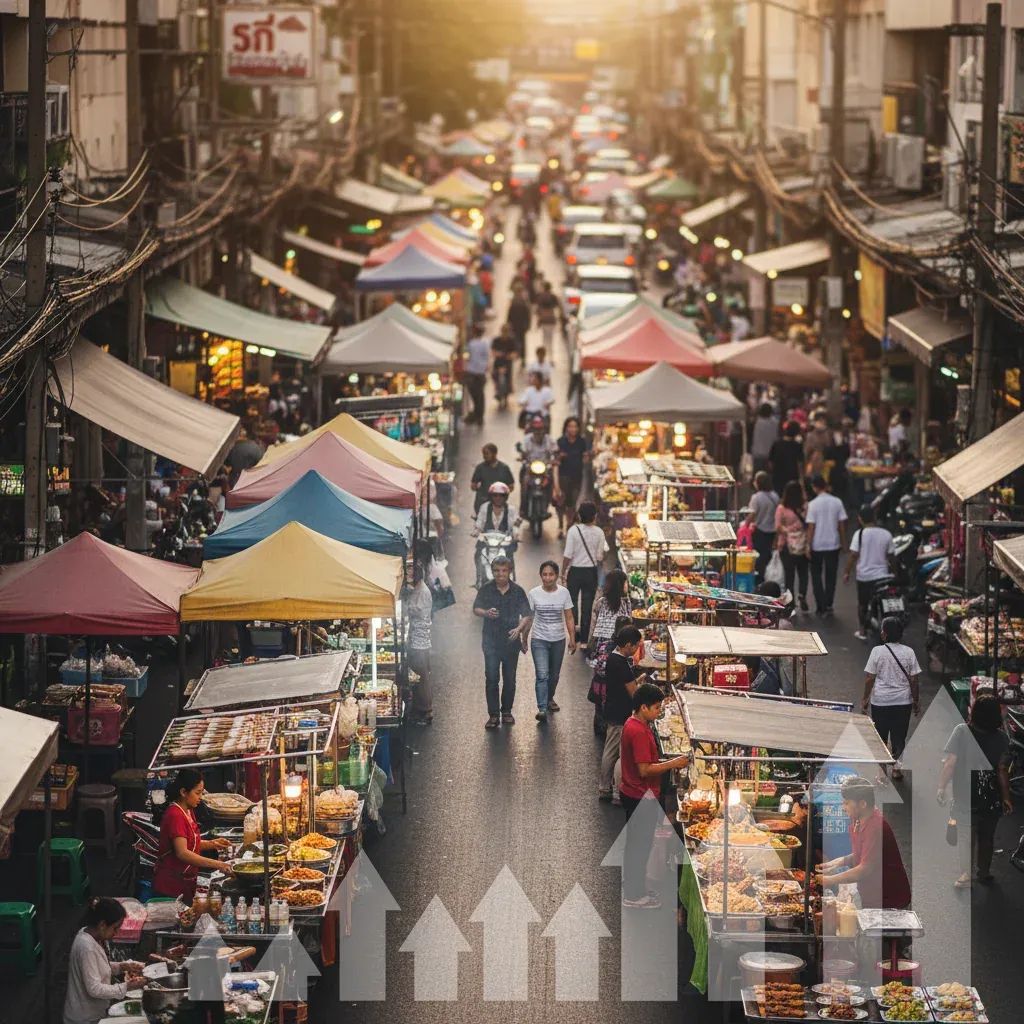
Thailand's southern border district of Betong in Yala province is grappling with a dual crisis that is squeezing household budgets and threatening agricultural livelihoods: an intense heatwave colliding with global fuel supply disruptions. The result is a dramatic spike in food costs—some vegetables have more than doubled in price—and rationing measures at petrol stations that leave farmers scrambling to irrigate their crops.
Why This Matters
• Vegetable prices have surged sharply: Limes now cost 5-6 baht per fruit, up from 2-3 baht, while water spinach jumped from 40 baht/kg to 60-70 baht/kg in March.
• Fuel rationing is in effect: Some petrol stations in Yala limit container purchases to 500 baht (roughly 16 liters), directly impacting durian growers who need 12 liters daily for irrigation tankers.
• National price caps are holding—for now: The Thailand government has capped diesel at 29.94 baht/liter for 15 days using the Oil Fuel Fund, but supply constraints persist in the south.
• Economic growth at risk: The Bank of Thailand projects the Middle East conflict could shave 0.1-0.2 percentage points off national GDP in 2026.
The Climate Squeeze on Southern Agriculture
Betong Municipality Fresh Market has become the front line of a climate-driven price shock. Vendors report that the 2026 dry season—forecast to be unusually intense across Thailand's southern and eastern regions—has throttled agricultural output just as households enter the peak summer months. Water spinach, a staple green in Thai cooking, now commands 60-70 baht per kilogram, a 50-75% increase from February levels. Limes, essential for countless dishes and beverages, have jumped to 80 baht/kg for large fruit from the previous 20-30 baht range.
The Meteorological Department of Thailand warns that temperatures will remain above average from March through August, with some northern provinces approaching 42-43°C. Southern provinces including Yala, Narathiwat, and Pattani face elevated heatwave risk, compounded by severe thunderstorms and gusty winds expected between March 11-13. This volatile weather pattern is disrupting traditional planting cycles and straining water resources across the region.
Durian orchards—a critical cash crop in Yala—are particularly vulnerable. Growers must pump groundwater using fuel-powered equipment to sustain trees during the dry spell, consuming approximately 12 liters of petrol daily per operation. With fuel supplies constrained and purchasing limits in place, some farmers face the grim choice of rationing irrigation or accepting lower yields and quality.
Fuel Supply and Rationing in the South
The closure of the Strait of Hormuz amid escalating Middle East conflict has sent ripples through Thailand's fuel distribution network, hitting southern provinces especially hard. In Phatthalung, Songkhla, and Trang—provinces neighboring Yala—fuel deliveries to stations have been sharply reduced, prompting rationing measures. Although Betong was not explicitly named in official rationing announcements, local station operators have imposed their own restrictions: 500 baht maximum for fuel sold in containers, and shortened operating hours to stretch available inventory. These measures directly affect agricultural operations, where farmers fill portable tanks to power irrigation pumps and transport vehicles in remote orchard areas.
Panic buying has emerged as residents queue to stockpile petrol, a behavior the Yala provincial governor has sought to counter through public reassurance campaigns and site inspections confirming adequate station reserves. Yet the psychological impact lingers, amplified by uncertainty about how long the Middle East crisis will constrain global crude flows.
Government Response and Price Stabilization
The Thai government moved quickly on March 3 to cap nationwide diesel prices at 29.94 baht/liter using the Oil Fuel Fund subsidy mechanism, though this intervention addresses pump prices but not the underlying supply squeeze. The national response includes an immediate suspension of fuel exports and mandatory increases in domestic petroleum reserves held by oil traders.
Major retailers like PTT, Bangchak, and PTG have maintained the government's capped diesel price, though independent stations and international brands initially raised rates before regulatory pressure forced alignment. Gasohol 95 and Gasohol 91 prices held steady at 30.55 and 30.18 baht/liter respectively at major chains, showing slight declines from January levels.
The Ministry of Commerce, coordinating with provincial governors and the Department of Internal Trade, has deployed inspection teams to prevent exploitative price hikes and stockpiling. Businesses found unjustly inflating prices face penalties up to 7 years imprisonment or fines reaching 140,000 baht. On the ground in Yala, the governor's office continues station surveys to verify fuel inventory and reassure the public. Yet these measures address symptoms rather than root causes: the global supply shock and the climate-driven agricultural shortfall are structural problems beyond local administrative remedy.
What This Means for Residents
For households in Betong and surrounding Yala districts, the dual pressures translate to immediate financial stress. Fresh produce—already subject to seasonal price fluctuations—is now absorbing both reduced supply from drought and higher transport costs from fuel constraints. While February cost-of-living data for Yala province showed relative stability (milk at 54.1 baht/liter, rice at 39.53 baht/kg, chicken at 96.6 baht/kg), March's vegetable market reflects a sharp deterioration.
Practical Steps for Residents:
• Monitor fuel prices: Check PTT, Bangchak, and PTG stations for current diesel prices capped at 29.94 baht/liter. Independent stations may charge more.
• Affordable food alternatives: When water spinach and limes are expensive, consider substituting with morning glory (also nutritious), local seasonal vegetables, and dried lime powder for flavoring—typically 30-50% cheaper than fresh imports.
• Government support: The Ministry of Interior and provincial Agricultural Extension offices offer assistance for farmers. Contact your local Yala Agricultural District Office for irrigation management guidance and potential relief programs.
• Consumer protection: Report price gouging to the Department of Internal Trade hotline or your provincial office. Residents can file complaints if businesses exploit the shortage to inflate prices unfairly.
The agricultural sector faces compounding threats. The Office of Agricultural Economics projected firmer durian prices in 2026 due to strong export demand, yet that optimism is tempered by heat stress reducing fruit quality and yield. Rubber farmers, another key constituency in the south, confront weakening global demand alongside weather volatility. The Ministry of Interior issued drought preparedness guidelines to all provincial governors in February, prioritizing domestic water supply and systematic irrigation management—an acknowledgment that the 2026 water deficit could exceed 4,450 million cubic meters nationwide.
Agroclimate experts increasingly describe farming in Thailand as a "lottery game," with droughts, sudden floods, and unstable seasons destroying predictable planting and harvesting rhythms. For Yala's agricultural communities, this March 2026 crisis is both an acute emergency and a preview of longer-term climate adaptation challenges.
Outlook: Navigating Uncertainty
The Bank of Thailand warns that energy price volatility from the Middle East conflict is currently contributing to inflationary pressures in 2026. For residents of Betong and the broader Yala region, this macroeconomic reality translates to sustained pressure on household budgets and farm incomes.
Weather patterns offer mixed signals. Thailand is transitioning away from El Niño conditions, which typically bring hotter and drier weather, toward a potential La Niña phase that could deliver above-average rainfall later in 2026. However, experts caution that a recurrence of severe drought in the coming months remains plausible.
The immediate question for Yala's agricultural communities is whether the government's 15-day diesel price cap—set to expire mid-March—will be extended, and whether fuel supply chains can stabilize before the peak irrigation season intensifies. Vegetable prices are expected to climb further as supplies tighten, and durian growers watch nervously as irrigation constraints threaten both yield and quality ahead of the export season.
For now, residents of Betong are adapting by adjusting meal plans around cheaper staples, limiting fuel purchases to essentials, and hoping that seasonal rains arrive on schedule. The convergence of climate stress and geopolitical disruption has laid bare the fragility of southern Thailand's food and energy systems, a reality that policymakers and farmers alike must confront in the months ahead.


