
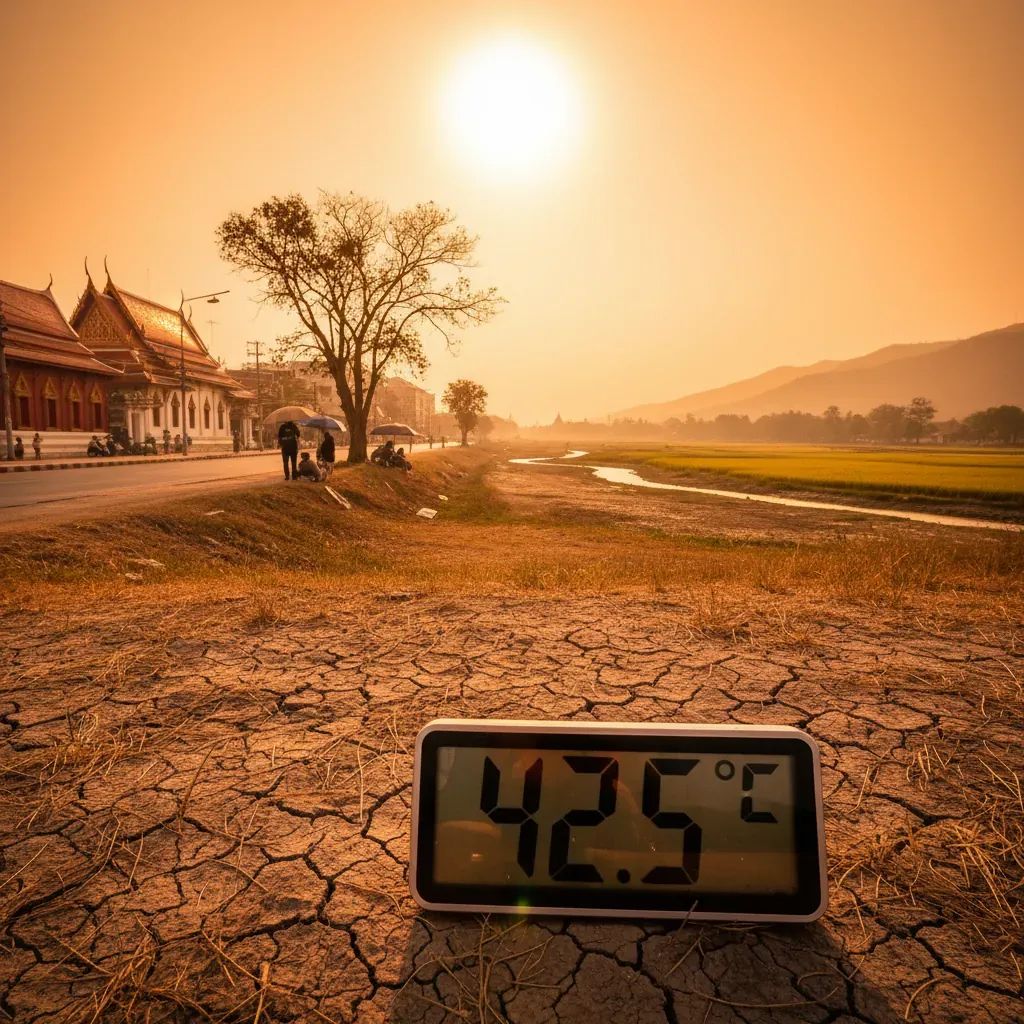
Thailand's Ministry of Public Health has issued urgent warnings as the country braces for potentially lethal heat conditions this summer, with medical experts cautioning that severe heatstroke can push core body temperature beyond 41°C—high enough to cause irreversible damage to the brain, kidneys, and cardiovascular system.
Why This Matters
• Record temperatures expected: Some northern provinces may exceed 43°C, with the heat index—the temperature your body actually experiences—potentially reaching a dangerous 58-60°C in high-humidity areas.
• Fatal risk zones identified: Bangkok and central plains are under "danger" alerts, with the heat index already hitting 42-51.9°C in mid-April.
• Outdoor workers most vulnerable: Construction laborers, delivery riders, street vendors, and agricultural workers face heightened exposure, with 21 deaths recorded in 2025 linked to heat-related illness.
• Emergency care is time-critical: Heatstroke victims require immediate hospital transport—every minute of delay increases the risk of organ failure.
When Your Body's Thermostat Fails
Dr. Teerawat Hemachudha, director of the Center of Excellence for Integrative Medicine and Public Health and adviser at Rangsit University's College of Oriental Medicine, described severe heatstroke as a critical failure of the body's temperature regulation system. "The brain's control center becomes overwhelmed," he explained. "It's like the thermostat malfunctions, and the body continues to heat up internally despite desperate attempts to cool down."
The physician emphasized that the danger lies not just in air temperature but in the heat index—a composite measurement that factors in humidity. When moisture saturates the air, sweat cannot evaporate effectively, crippling the body's primary cooling mechanism. In Thailand's tropical climate, where humidity regularly exceeds 70%, this creates a particularly dangerous environment for heat illness.
Dr. Teerawat described the severity: "At core temperatures above 40°C, proteins in cells begin to denature—a process similar to what happens when you cook an egg." Brain tissue, kidney cells, muscle fibers, and the blood clotting system can all sustain permanent damage within minutes once this threshold is crossed.
The Four-Stage Progression to Emergency
Medical authorities in Thailand classify heat-related illness into four escalating stages, each requiring progressively more urgent intervention:
Stage 1: Sunburn—Skin damage from UV exposure, often the first warning sign of excessive heat exposure.
Stage 2: Heat Cramps—Painful muscle spasms caused by electrolyte imbalance, typically affecting the legs and abdomen.
Stage 3: Heat Exhaustion—Marked by heavy sweating, rapid pulse, dizziness, nausea, and weakness. The body is still attempting to cool itself but struggling.
Stage 4: Heatstroke—A medical emergency. The skin becomes hot, red, and dry (though some patients may still sweat). Confusion, slurred speech, seizures, or loss of consciousness indicate that brain function is compromised. The pulse remains rapid and strong even as internal systems begin to fail.
According to surveillance data from the Thailand Disease Control Department, the country recorded 182 heat-related illness cases in 2025, with 17 classified as severe heatstroke (9.3% of cases). The Northeast region saw the highest fatality rate, accounting for 52% of the 21 deaths. Males comprised 59.3% of victims, with working-age adults (15-34 years) representing 42.8% of cases—underscoring the occupational dimension of the crisis.
High-Risk Groups Require Special Vigilance
Dr. Teerawat stressed that even young, healthy individuals can succumb to heatstroke if severely dehydrated or overexerted in extreme conditions. However, certain populations face disproportionate risk:
Elderly residents and those with pre-existing cardiovascular disease, hypertension, or chronic kidney conditions have reduced capacity to regulate body temperature and compensate for fluid loss. Infants and children under 5 possess immature thermoregulatory systems and higher surface-area-to-body-mass ratios, making them vulnerable to rapid temperature swings.
The expert also highlighted an often-overlooked danger: indoor heatstroke. People exercising in poorly ventilated gyms, working in factories without adequate airflow, or living in un-air-conditioned apartments can experience life-threatening heat illness without direct sun exposure. The key factor is the body's inability to shed heat faster than it accumulates.
What This Means for Residents
Thailand's meteorological service projects that temperatures will breach 40°C in multiple provinces between April 2-7, with some northern areas—Mae Hong Son, Lampang, and Tak—approaching 42-43°C. The summer season, which began in late February, is expected to extend through mid-May.
For the approximately 53.3% of Thailand's workforce engaged in outdoor or manual labor—including the country's large informal sector of delivery riders, construction workers, and street vendors—this represents a direct threat to livelihood and life. Unlike salaried employees in air-conditioned offices, these workers often lack access to rest facilities, adequate hydration, or the economic flexibility to avoid midday shifts.
Bangkok issued a heat index "danger" warning on April 16, advising residents that the perceived temperature would range between 42-51.9°C—levels at which prolonged outdoor activity can trigger organ failure within 60 minutes. The capital's urban heat island effect, where concrete and asphalt amplify ambient temperatures, exacerbates conditions in densely populated neighborhoods.
Tourism operators face a parallel challenge. Thailand's vital travel sector, which accounts for a significant portion of GDP and employment, has seen reduced beach and outdoor activity bookings as visitors shy away from extreme heat. Coral reef ecosystems, critical to marine tourism, are suffering accelerated bleaching due to elevated sea surface temperatures—a longer-term threat to destinations like Phuket and Krabi.
Life-Saving First Response
The Thailand Ministry of Public Health has issued explicit protocols for bystanders encountering suspected heatstroke victims. Speed is paramount: brain damage can become irreversible within 10-15 minutes at core temperatures above 41°C.
Immediate actions:
Move the person to shade or an air-conditioned space. Every second in the heat worsens the condition.
Position the victim flat on their back with legs elevated to improve blood flow to vital organs.
Remove or loosen tight clothing. Any fabric trapping heat must be eliminated.
Apply cold compresses to the neck, armpits, groin, and forehead—areas where major blood vessels run close to the skin. Combine this with fan airflow or manual fanning to accelerate evaporative cooling.
If the person is conscious and able to swallow, offer small sips of plain water or electrolyte solution. Never attempt to give fluids to an unconscious person—this creates a choking hazard and can cause fatal aspiration.
Call 1669 for ambulance dispatch immediately or transport the victim to the nearest hospital yourself if faster. Communicate that this is a suspected heatstroke case so emergency staff can prepare cooling equipment and IV fluids.
Prevention Strategies That Work
The Thailand Disease Control Department recommends a multi-layered approach to heat illness prevention:
Hydration discipline: Consume 2-3 liters (8-10 glasses) of water daily, distributed throughout the day rather than in large volumes at once. Don't wait until you feel thirsty—thirst is a late-stage dehydration signal.
Strategic timing: Avoid strenuous outdoor activity between 10:00 AM and 4:00 PM, when UV intensity and heat index peak. If outdoor work is unavoidable, take 10-15 minute shade breaks every hour.
Clothing selection: Wear light-colored, loose-fitting garments made from breathable fabrics like cotton or moisture-wicking synthetics. Dark colors absorb more heat; tight fits prevent air circulation.
Environmental modification: Ensure living and working spaces have adequate ventilation. Even without air conditioning, cross-ventilation from open windows or fans can reduce indoor temperatures by 3-5°C.
Substance awareness: Alcohol, caffeinated beverages, and high-sugar drinks accelerate dehydration. Stick to water or oral rehydration salts during hot weather.
Worker Protections and Rights
Employers bear legal obligations under Thailand's Ministerial Regulation on Occupational Safety Standards Concerning Heat, Light, and Noise (2016). Under this regulation, employers must provide rest breaks of at least 10 minutes per hour in temperatures exceeding 32°C, ensure access to drinking water, and provide shaded rest areas. Workers experiencing heat-related symptoms have the right to refuse unsafe work. Violations can be reported to the Department of Labour Protection and Welfare through their hotline or mobile app. Labor advocacy groups note that enforcement remains inconsistent, particularly for informal-sector workers who fall outside traditional regulatory frameworks.
The Climate Context
Rising temperatures in Southeast Asia reflect broader climatic shifts. Meteorologists attribute the severity to three converging factors: anticipated El Niño conditions, which typically bring drought and above-average temperatures to Southeast Asia; ongoing global temperature increases that have made each successive year warmer than historical averages; and record-high sea surface temperatures in the Indian and Pacific Oceans, which increase atmospheric moisture and heat retention over land.
Last year's maximum heat index reached 59.5°C—a figure that officials warn may be exceeded. Provincial authorities in Lopburi recorded 39.3°C in early March, while Bangkok hit 38.2°C, and forecasts suggest these will be exceeded as April and May progress.
For residents and visitors alike, understanding that Thailand's heat season now poses measurable mortality risk represents a necessary adjustment. The days when heat was merely uncomfortable have given way to conditions where a 30-minute walk in midday sun can become life-threatening. Medical professionals emphasize that this is not alarmism but statistical reality: with 21 heat-related deaths recorded in 2025 and temperatures climbing higher this year, the threat demands behavioral adaptation at individual, community, and policy levels.


