
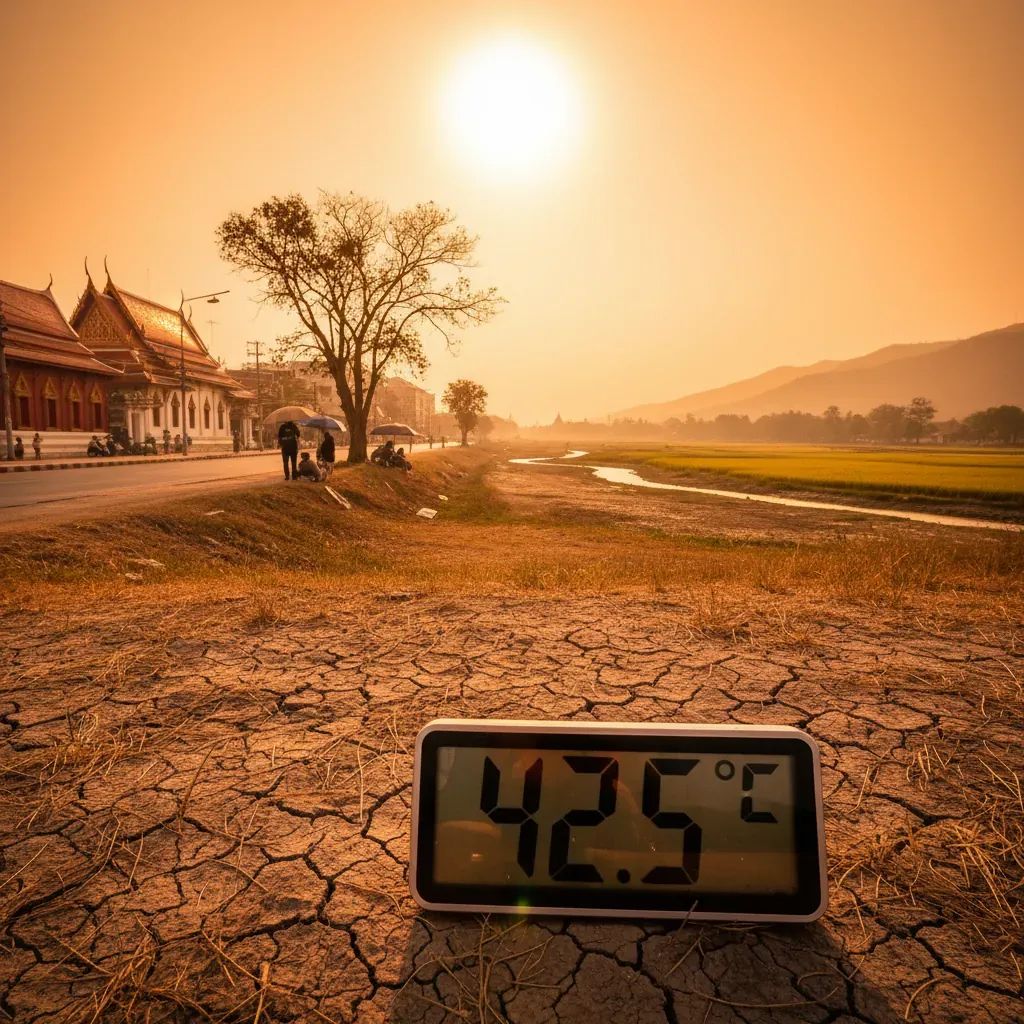
Bangkok is experiencing its most dangerous heat phase in years, with conditions now reliably fatal. On Thursday, June 25, 2026, thermometer readings have become secondary—what matters is the heat index, which has climbed to 51.9°C, a reading that clinical data associates directly with rapid organ failure and death in unprotected populations. The Thailand Meteorological Department and Environment Department have jointly classified this as the "Danger" threshold, a designation that will govern daily survival logic for millions through the end of June.
Why This Matters
• Peak risk window: 11am to 3pm — the four-hour stretch when body core temperature rises fastest, forcing workers indoors or into shade.
• Eight populations face immediate medical jeopardy: elderly residents, construction workers, street vendors, pregnant women, people with chronic illness, children, individuals with obesity, and those with alcohol dependency.
• Heat escape centers operational citywide: The Bangkok Metropolitan Administration has activated publicly funded cooling facilities across all districts, offering free water and medical staff trained to identify early heat illness.
• Mortality trajectory worsening: Thailand logged 37 heat deaths in 2023, surpassed that total by mid-May 2024, and recorded 17 confirmed deaths during 2025—signaling heat risk is accelerating, not seasonal.
The Physical Reality: What 51.9°C Actually Means
The number on the alert system isn't raw air temperature. The heat index combines thermometer readings with relative humidity, producing the "feels like" measurement the human body actually experiences. On the Gulf coast where Bangkok sits, humidity routinely exceeds 80% during hot season months. At that combination, sweat stops evaporating from skin. The body's primary cooling mechanism fails. Core temperature climbs.
At 51.9°C, the Thailand Meteorological Department recognizes this as the boundary between "Danger" and total system failure. Readings above 52°C trigger "Extreme Danger" alerts, at which point any outdoor exertion becomes medically contraindicated. A person working outdoors during the 11am-3pm window at these indices risks losing consciousness within 20 to 40 minutes if they lack shade, water, and rest.
For perspective: air temperature of 35°C on a dry day remains challenging but manageable. The same 35°C at 75% humidity—routine in Bangkok—becomes a genuine medical emergency for anyone over 60, anyone working in direct sun, or anyone with cardiovascular disease.
Eight Groups Requiring Protective Intervention
The Thailand Ministry of Public Health has specified populations that require active monitoring and access to cooling infrastructure:
Infants and young children lack developed thermoregulation; they cannot communicate distress before heat illness becomes critical. Elderly residents, particularly those living alone, frequently miss early warning signs—fatigue, dizziness, muscle cramping—until collapse occurs. Pregnant women experience elevated resting metabolic rate, meaning their core temperature rises faster than non-pregnant adults under identical conditions.
People with chronic conditions—diabetes, hypertension, heart disease, kidney failure—face multiplied risk because these illnesses impair sweating capacity and cardiovascular response. Individuals with obesity retain excessive body heat due to reduced surface-area-to-mass ratio. Alcohol consumers often maintain inadequate hydration, masking early symptoms. Outdoor laborers—construction crews, delivery riders, street vendors, agricultural workers—cannot escape peak-hour heat; their income depends on exposure.
The eighth group encompasses recreational athletes and tourists unaccustomed to tropical heat intensity who underestimate the pace of physiological collapse.
Precursor symptoms appear before heatstroke becomes irreversible: fatigue, lightheadedness, muscle cramps, nausea, unexplained skin flushing or swelling. These evolve within minutes to heatstroke proper—loss of sweating capacity, confusion, rapid irregular heartbeat, and multi-organ failure. Medical intervention must occur within hours of onset to prevent death or permanent neurological damage.
Bangkok's Cooling Infrastructure Response
The Bangkok Metropolitan Administration has established a citywide network of "heat escape rooms" (BKK Cooling Centers)—air-conditioned public facilities distributed across all 50 districts. Each center maintains free drinking water, supervised rest areas, and nursing staff trained to recognize heat illness progression. During peak heat alerts, these facilities extend operating hours into evening.
The network targets outdoor workers, street vendors, and households without air conditioning access. Real-time location data and facility status updates are available through the AIR BKK mobile application or the AIR BKK LINE account, both providing live heat index readings alongside cooling center availability.
This represents genuine infrastructure—not merely advisory language. However, it requires active knowledge and ability to reach a center during working hours. A construction laborer on a crowded Bangkok site during afternoon heat cannot simply leave; the cooling center must be proximate and reachable during legitimate breaks.
The Accelerating Death Toll: Evidence the Risk Is Real
The advisory moves beyond seasonal inconvenience when mortality data is examined. In 2023, Thailand recorded 37 confirmed heatstroke deaths. The Central Region, encompassing Bangkok and surrounding provinces, accounted for 35% of that total. Chonburi and Buriram each reported 4 deaths; Lopburi, Samut Songkhram, and Samut Prakan each saw 3.
April historically carries the highest monthly death toll—46% of the annual figure concentrated in that single month. The trend accelerated dramatically in 2024. By mid-April, Thailand had already logged 30 confirmed heat deaths, exceeding the same period in 2023. By May 10, the national toll reached 61 deaths—surpassing the entire 2023 year within just five months of 2024.
During 2025, Thailand recorded 17 confirmed heatstroke deaths across the year. The Northeastern region accounted for 52% of 2025 deaths, though the Central Region and Western region each contributed 24%.
This progression indicates heat illness is no longer a summer spike but a recurrent public health crisis requiring permanent response infrastructure.
The 2P-2R Framework: Thailand's Structured Response
The Thailand Department of Health operates a 2P-2R strategy structured around four intervention phases designed to reduce both immediate casualties and long-term vulnerability.
Prevention and Mitigation focuses on reducing exposure. This includes public awareness campaigns advising schedule shifts, mandatory shade and hydration breaks for outdoor workers mandated by labor inspectors, and urban greening initiatives—tree planting along pedestrian routes, parkland preservation, roof gardens on government buildings—all designed to lower ambient street temperature and reduce the urban heat island effect that concentrates heat in dense urban districts.
Preparedness involves training healthcare workers and district-level officials to rapidly recognize heat illness, stockpiling oral rehydration solutions and ice baths at hospitals and cooling centers, and pre-positioning mobile medical teams in high-risk occupational sites (construction zones, port facilities, outdoor markets).
Response activates during peak heat periods. Cooling center networks operate extended hours, the four-tier color-coded heat alert system distributes guidance via mobile platforms, and hospital systems prepare for surges in heat-related admissions during dangerous windows.
Recovery consists of post-event analysis—reviewing what interventions worked, which populations were missed, which cooling centers proved inadequate—to refine protocols for subsequent years. Environmental systems damaged by extreme heat (urban tree canopies stressed by drought, water infrastructure strained) receive restoration focus.
This framework parallels approaches pioneered in India, which developed systematic Heat Action Plans following catastrophic heat waves in the 2010s that killed tens of thousands. Thailand's adoption reflects regional learning—heat casualties are preventable through coordinated, evidence-based response.
Practical Survival Logic for Bangkok Residents RIGHT NOW
The current heat emergency demands immediate behavioral adjustments today and through the end of June. Delivery riders and outdoor workers should reorganize routes to incorporate pit stops at cooling centers or air-conditioned establishments—shopping malls, hospitals, government offices. Avoid the 11am-3pm window if possible; early morning and evening labor are safer.
Parents should restrict outdoor play and sports to before 10am or after 4pm, when heat index readings remain in the "caution" rather than "danger" range. Supervised play in shaded locations with continuous water access is acceptable during cooler hours.
Office workers commuting by motorcycle or foot should carry insulated water bottles and identify air-conditioned refuge points (shopping centers, hospitals, libraries) along regular routes. Do not wait until symptoms appear to enter cooling.
The Thailand four-tier color-coded alert system, accessible through AIR BKK, provides real-time guidance distinguishing manageable conditions from dangerous ones. "Green" and "yellow" alerts permit normal outdoor activity with precautions. "Orange" alerts require schedule adjustments—avoiding peak hours, increasing rest frequency, aggressive hydration. "Red" alerts indicate conditions where outdoor exertion should be minimized unless absolutely critical.
Specific protective measures recommended by the Ministry of Public Health include aggressive hydration—drinking clean water every 15-20 minutes regardless of thirst sensation—while strictly avoiding alcohol, sugary beverages, and tobacco, all of which accelerate dehydration. Light-colored, breathable clothing; wide-brimmed hats; sunscreen; and scheduled rest in shade become non-negotiable. For outdoor workers, rotating shifts with frequent breaks in cool areas reduces individual heat load accumulation.
Critically: checking on vulnerable neighbors—elderly residents living alone, families without air conditioning, people with chronic illness—functions as direct harm prevention. Many heat deaths occur among isolated individuals who fail to recognize symptoms or lack access to help when collapse occurs.
Long-Term Resilience vs. Annual Crisis Management
Cooling centers and early-warning systems represent genuine progress and save lives. However, they are emergency measures, not solutions. Bangkok's underlying vulnerability—rapid urbanization producing dense built environments with minimal vegetation, extensive paved surfaces that absorb and re-radiate heat, aging building stock lacking passive cooling design—means heat extremes will intensify regardless of individual precautions.
Preventing future heat deaths requires structural change: green infrastructure investment (expanding tree canopy to 30% of street networks, mandating parkland in new developments), building efficiency standards (passive cooling design, reflective roofing materials, improved insulation becoming code requirements), and equitable adaptation ensuring low-income residents receive equivalent protection as affluent neighborhoods, not cooling centers as last-resort triage.
For those living in Bangkok now, heat risk has become permanent urban infrastructure. Immediate survival requires constant vigilance: monitor official heat alerts, adjust activity schedules during peak hours, maintain aggressive hydration, and maintain active awareness of at-risk individuals around you. Residents treating this emergency with the seriousness appropriate to any public health crisis—comparable to flood warnings or air quality alerts—will substantially reduce personal risk and contribute to community resilience.


