
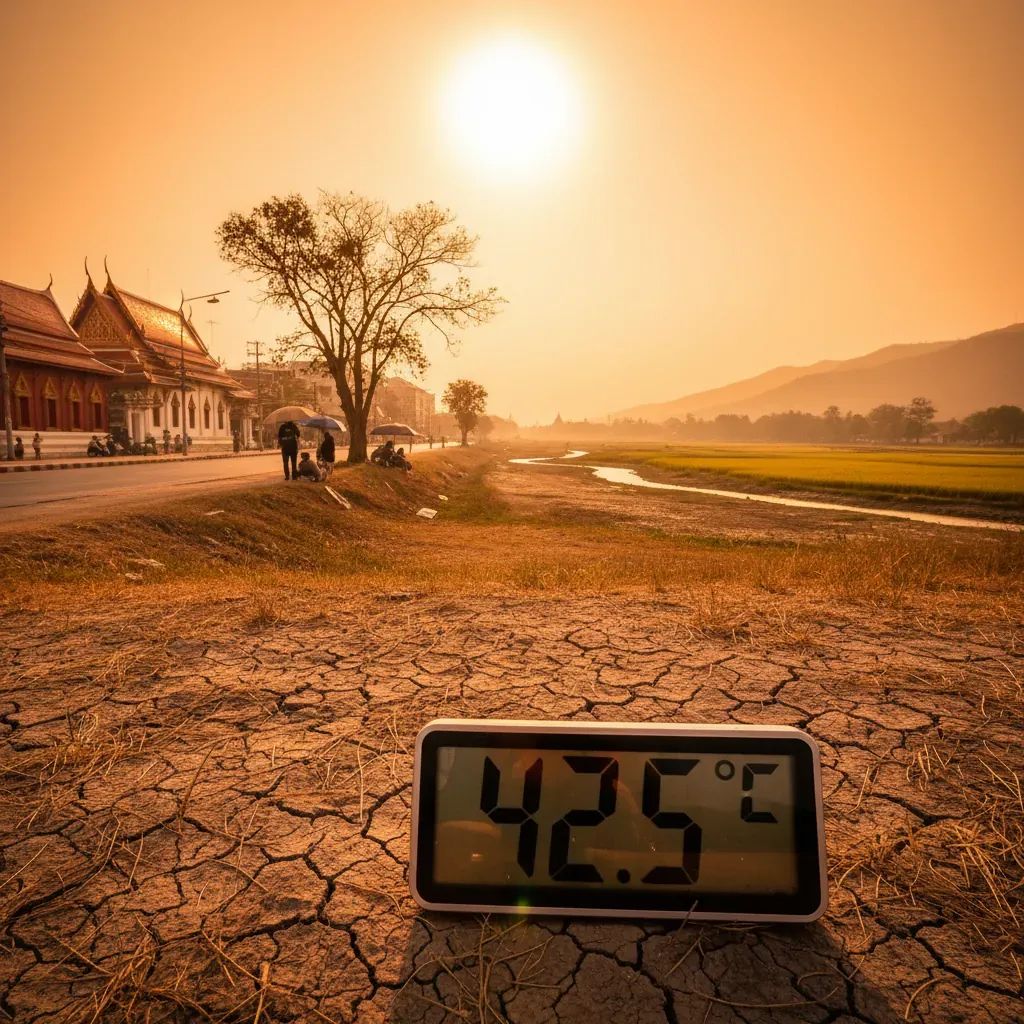
Thailand's unrelenting heat is no longer a summertime certainty—it has become a compounding crisis. This April, the Thailand Meteorological Department is tracking 16 provinces where thermometers will climb to 40-42°C, but the real number residents should fear is the calculated heat index: up to 60°C in some areas, a threshold medical authorities classify as immediately dangerous to human physiology.
Why This Matters
• Heat index of 52-60°C poses acute medical risk: Heatstroke can develop within hours at these levels; organ failure becomes a genuine possibility without rapid intervention.
• Peak intensity window: April 8-9, 2026: Plan indoor activities during this critical 48-hour span; outdoor work should cease or shift to dawn and dusk.
• Agricultural revenue decline projected at 4% year-over-year: Rice yields face pollen sterility risks; high-value exports (durian, mango, rubber) face crop loss and quality degradation during flowering cycles.
The Regional Heat Breakdown: Where Conditions Will Be Most Severe
Thailand's geography divides sharply across this crisis. The North—particularly Mae Hong Son, Lampang, and Tak—will absorb the worst punishment. Temperatures topping 42-43°C are not unprecedented, but their timing and combination with high humidity of 60-75% creates a physiological emergency. The heat index here will spike above 54°C for hours each day.
Bangkok and surrounding provinces sit in a different category: developed infrastructure means air conditioning is accessible, but ground-level reality remains grim. The capital will hit 37-40°C, yet the dense urban fabric—concrete, asphalt, vehicles—traps radiant heat. The urban heat island effect pushes perceived temperatures several degrees higher than nearby rural areas. Heat index values will regularly exceed 52°C even in the capital's wealthier districts.
The Northeast and Central Plains form a heat corridor, with haze accumulation trapping stagnant air at ground level. Wind speeds of 15-30 km/h offer minimal reprieve. The Eastern seaboard experiences marginally cooler peaks (34-40°C), but isolated thunderstorms create dangerous flash transitions between intense sun and sudden downpours—a combination that destabilizes drivers and outdoor workers.
Southern regions show comparative mercy. The Gulf coast (Phatthalung, Songkhla, Pattani, Yala, Narathiwat) will see thunderstorms across roughly 10% of the area; the Andaman coast (Krabi, Trang, Satun) expects storm coverage at 20%. Temperature ranges here of 34-37°C still produce heat indices above 45°C when humidity is factored in. Sea waves around 1 meter will spike above 1 meter in thundery areas, complicating maritime safety.
Who Is Most Vulnerable: Understanding the Medical Reality
At a heat index of 52-60°C, the human body's cooling mechanism begins to fail. Sweat no longer evaporates effectively; core temperature climbs. Heatstroke—when core body temperature exceeds 40°C—develops rapidly and silently. Early symptoms (confusion, slurred speech, hot dry skin) can progress to seizures, loss of consciousness, and organ failure within minutes.
Certain populations face acute risk. Infants and children under five lack physiological heat regulation maturity. Adults over 60 have diminished thermoregulatory responses; their bodies communicate danger signals poorly. Pregnant women at temperatures above 39°C face premature labor risks and fetal developmental complications. People with chronic conditions—hypertension, diabetes, heart disease—find their medications interfere with heat adaptation. Outdoor workers, athletes, and farmers face unavoidable exposure during peak hours.
Medication matters. Those taking diuretics, blood pressure regulators, or psychiatric medications should consult physicians before extended outdoor work. Alcohol consumption during heat exposure dramatically increases heatstroke risk; this risk is particularly acute during Songkran (April 13-15), when celebration coincides with lingering extreme conditions.
Practical Protection: Actionable Steps for Survival
Hydration is non-negotiable. Drink clean water continuously—not when thirsty, but before thirst signals. Aim for 8 glasses daily minimum. Avoid caffeine, alcohol, and high-sugar beverages; these accelerate dehydration. Choose loose-fitting, light-colored clothing made of breathable fabric. Most critically: remain indoors between 11:00 and 15:00, the window of peak solar intensity. If outdoor activity is unavoidable, wear a wide-brimmed hat, carry an umbrella, apply high-SPF sunscreen (30+), and wear UV-protective sunglasses.
Never leave children or animals in parked vehicles. Interior temperatures become lethal within minutes in 40°C ambient conditions.
For outdoor workers: Reschedule work to early morning (before 09:00) or evening (after 16:00). Double water intake. Increase rest breaks. Monitor colleagues for warning signs: excessive fatigue, dizziness, rapid pulse, nausea, slurred speech.
First aid for suspected heatstroke: Move the person immediately into shade or air conditioning. Remove excess clothing. Lay them flat with feet elevated. Apply wet cloths to the entire body and direct a fan toward them to accelerate evaporative cooling. Place ice packs at the neck, armpits, and groin—areas where major blood vessels run close to skin. If unconscious, position them on their side to prevent airway obstruction. Call emergency services immediately. Transport to hospital is non-negotiable; heatstroke is a medical emergency.
The Climate Science: Why This Year Is Different and Worse
This is not merely a typical hot April. Multiple climatic systems are converging. A persistent low-pressure heat trough has settled over upper Thailand, trapping hot air and creating characteristic haze. But deeper drivers are at work.
The transition from La Niña to El Niño is accelerating. El Niño will reach full strength by May 2026 and persist through early 2027. Historically, El Niño brings Thailand 30-40% less rainfall and noticeably higher temperatures. Global sea surface temperatures in the Indian Ocean and Pacific have hit historic highs; this warm ocean amplifies heat retention over land.
The 2026 heatwave is tracking significantly hotter than 2025. Last year, upper Thailand averaged 35-36°C. This year's forecast places the average at 36-37°C, with localized spikes to 42-43°C. For comparison, 2024's previous record heatwave saw temperatures above 44°C in Phetchabun and Kanchanaburi. That event, driven by strong El Niño, caused agricultural output to contract 1.5% in the second quarter alone.
Over the past decade (2016-2025), Thailand's annual average temperature has never once dipped below historical norms. Days exceeding 35°C have exploded: from 1.9 days annually in 1950 to 49.43 in 2020. Climate models project this escalation will continue. Extreme weather events—heatwaves, droughts, floods, cyclones—are becoming more frequent, more severe, and harder to predict.
The long-term outlook is sobering. Global temperatures are on track to rank among the top 5 warmest years in the 176-year instrumental record (74.8% probability according to meteorological agencies). For Thailand, this means the "hot season" is no longer seasonal—it is becoming structural.
Agricultural Collapse in Slow Motion: Crops, Livelihoods, and Rural Survival
Thailand's agricultural sector employs millions and anchors rural economies. When the heat index exceeds 41°C, crops enter acute heat stress, disrupting photosynthesis, stunting growth, and destabilizing internal physiology.
Rice is particularly vulnerable during flowering and grain-filling stages. Extreme heat sterilizes pollen and reduces grain set, sometimes slashing yields by 20-30%. For a nation dependent on rice exports, even moderate production loss triggers revenue decline and farmer hardship.
High-value fruit exports face different but equally serious threats. Durian, mango, and mangosteen experience premature fruit drop and "sunburn" on developing fruit—visible browning that destroys market value. Rubber plantations, another economic pillar, see reduced latex yields under prolonged heat and water stress. Smallholders dependent on consistent output face income collapse.
El Niño compounds these threats by extending drought and reducing irrigation water availability. Farmers are being advised to maintain higher water levels in paddies to protect roots, supplement potassium to improve heat tolerance, and consider drought-resistant seed varieties. Without sustained government support—improved water infrastructure, technology adoption, climate-resilient seed programs—the sector faces structural decline.
Revenue from Thailand's five main economic crops is projected to fall 4.0% in 2026. This echoes the 2024 El Niño-driven contraction. In 2025, agriculture expanded 3.3% due to carry-over water from late 2024. That reprieve is unlikely this year. Rural incomes will tighten; lower-income households may face food security concerns.
Songkran During a Heat Crisis: Celebration and Caution
The Songkran festival (April 13-15) arrives just days after the peak heat window of April 8-9. Festival-goers face dual exposure: lingering extreme heat and water-based activities that accelerate dehydration if unmanaged.
Health authorities emphasize practical precautions. Pack quick-dry clothing. Wear eye protection for water exposure. Maintain hydration before, during, and after water activities. Critically: alcohol consumption during heat exposure dramatically increases heatstroke risk. A pattern repeated year after year, yet poorly understood among revelers.
Plan outdoor Songkran activities in early morning or late evening, not midday. This simple scheduling shift significantly reduces exposure risk.
The Broader Structural Shift: What "New Normal" Actually Means
Looking beyond April, the Thailand Meteorological Department projects that extreme heat will persist through early 2027 as El Niño strengthens. The official "hot season" began February 22, 2026—about two weeks later than typical—but the delayed start has done little to moderate intensity.
For people living in Thailand, this signals a fundamental change. The annual heat crisis is no longer a predictable seasonal disruption. It is becoming an extended, intensifying environmental condition that demands year-round vigilance, household-level adaptation, and long-term climate resilience planning at the national level.
This is not weather drama to discuss casually. The convergence of record heat, high humidity, emerging El Niño conditions, and agricultural vulnerability creates a public health and economic crisis. Stay cool, stay hydrated, take the warnings seriously—your wellbeing and, for farmers, your livelihood depend on it.


