
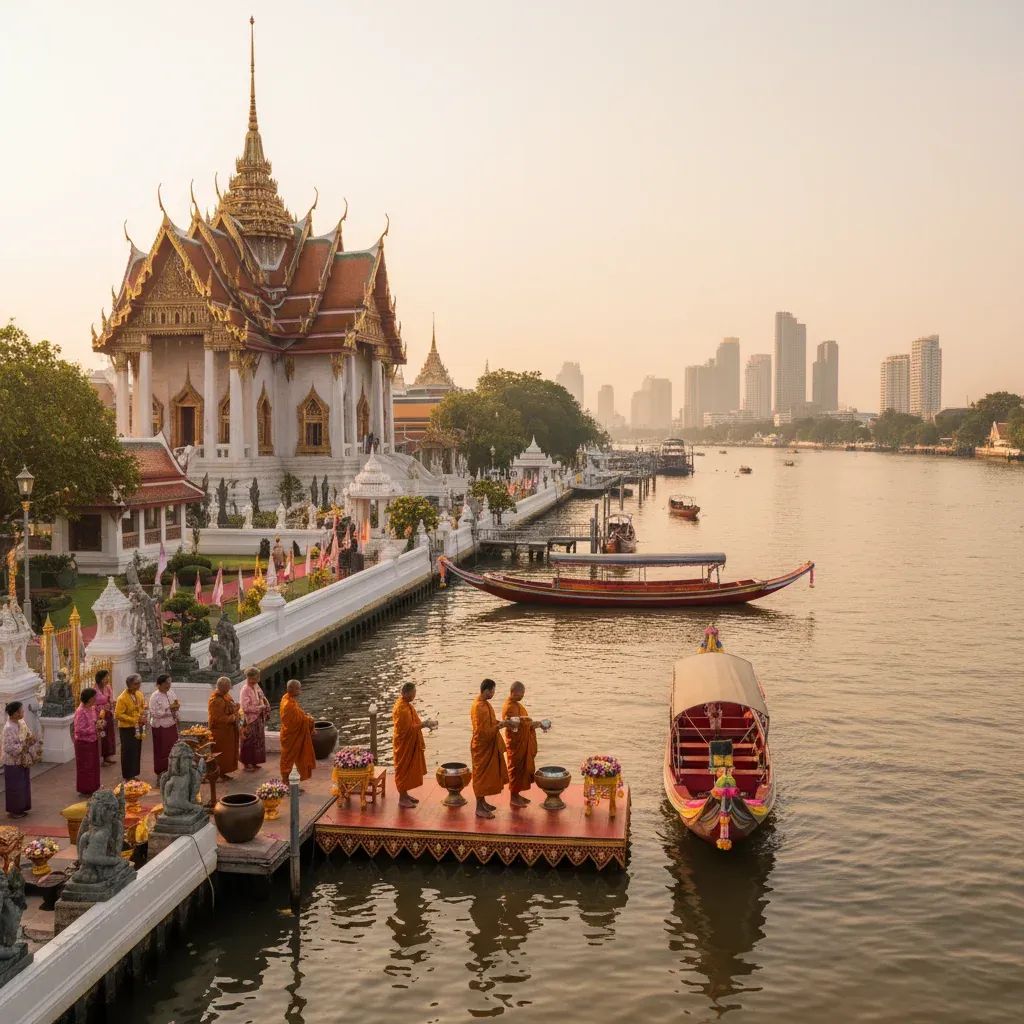
A Different Songkran Waits Across the River
Phra Pradaeng District in Samut Prakan is hosting a deferred cultural observance on April 24–26, 2026—a celebration that emphasizes ritual merit-making alongside community traditions. If you've already navigated Bangkok's Songkran crowds during the April 13–15 national holiday, this later festival staged just outside the capital offers something genuinely distinct: a living exhibition of Mon heritage where water-splashing serves cultural purposes rather than primary entertainment.
Why This Matters
• One week after national Songkran: Travel flexibility and substantially reduced congestion compared to city-center venues
• Merit-making takes precedence: Ancestor veneration ceremonies, fish releases, and communal blessings structure the festival rhythm, not consecutive hours of recreational water fights
• Authentic Mon identity on public display: An ethnic community organizes its own celebration, maintaining genuine cultural control
• Accessible without major infrastructure hurdles: Ferry routes bypass road closures; bus services remain frequent; parking concerns disappear entirely with river crossing
The Mon Heritage of Phra Pradaeng
Phra Pradaeng has long been a center of Mon cultural identity in Thailand. The Mon people maintain distinct traditions, architectural styles, and spiritual practices that distinguish their community from mainstream Thai culture. Wat Khan Lat Mon museum functions as a repository of this heritage, housing artifacts and documented histories that preserve Mon knowledge and customs.
The delayed Songkran tradition carries particular significance for the Mon community. Rather than observing the national holiday timing, Phra Pradaeng celebrates later in April—a timing that reflects the district's distinct cultural calendar and priorities. This choice to maintain a separate festival schedule represents deliberate cultural affirmation, visible proof that the community operates according to its own traditions and identity.
What Distinguishes Celebration from Spectacle
The Nang Songkran procession represents the festival's ceremonial centerpiece. Unlike water-throwing at mainstream Bangkok venues, this is choreographed cultural performance. Participants emerge in Thai-Raman embroidered garments—textiles featuring distinct patterns and construction methods that diverge from central Thai dress codes. The procession includes the Songkran Queen, selected through community process and adorned in complete traditional costume, accompanied by Loi Chai boys and Raman girls dressed in formal ancestral attire.
The visual effect combines deliberate ceremony with moments of celebration—ritualized rather than chaotic. This distinction matters because it signals the underlying purpose: public reinforcement of collective identity and cultural heritage, not continuous high-energy recreational activity.
Saba folk games occupy afternoon programming slots with deliberate intentionality. These team-based skill challenges rooted in Mon social tradition have largely vanished from contemporary Thai cultural practice. Their public staging at Phra Pradaeng functions as an educational experience for younger Mon community members encountering their own heritage and as cultural tourism for outside observers. The games create intergenerational transmission moments that photographs and museum displays cannot replicate.
Mon "Thae Yam" folk music fills evening hours with distinctive call-and-response vocal patterns layered over traditional percussion instrumentation. The genre bears minimal resemblance to central Thai musical forms, preserving melodic and rhythmic sensibilities distinct from mainstream Thai traditions. Festival performances create rare occasions when traditional sonic heritage receives public recognition.
The merit-making ceremonies operate as visible ritual rather than abstraction. Families and individuals release fish and birds into the Chao Phraya River—a practice rooted in Theravada Buddhist cosmology where such acts carry spiritual significance and extend blessings to deceased relatives. These ceremonies typically occur at dawn and late afternoon, establishing natural rhythm to festival activities.
Phra Pradaeng kala mae, the district's distinctive palm-sugar and coconut toffee, carries cultural significance beyond confectionery. Production during the festival becomes communal activity rather than commercial transaction. Neighborhood groups gather around massive cooking pots, stirring the darkening mixture as it thickens, transforming candy-making into social event. The resulting product, distributed among families and visiting guests, functions simultaneously as edible souvenir and material evidence of collective labor.
After sunset, the Phlaeng Faifa Fortress Historical Park activates with illuminated installations. This nighttime programming offers visitors quieter, contemplative experiences after daytime festival intensity. The lighting design uses modern visual techniques to highlight archaeological significance.
Practical Navigation Through Movement and Access
Transportation planning distinguishes successful attendance from frustrating gridlock. The Phra Pradaeng District Office remains the festival's geographic epicenter, but reaching this location demands advance consideration of available options.
Road closures predictably accompany the festival. During 2025's Songkran period, authorities sealed multiple roads from 1:00 PM to 8:00 PM. Comparable restrictions are probable for 2026, rendering private automobile transport inefficient. Drivers arriving during closure hours face diversions, extended travel times, and limited parking options.
Ferry transport eliminates these complications entirely. Departure points include Pu Chao Saming Phrai Road, Wat Bang Na Nok Pier, Klong Toery Pier, and Petra Pier. Journey duration ranges 20–30 minutes depending on water conditions and pier traffic. For travelers unfamiliar with Bangkok's riverine infrastructure, advance reconnaissance proves valuable—identify your preferred pier, confirm scheduling, and anticipate possible minor waits.
Bus services provide reliable alternatives. Routes 82, 138, and 506 serve Phra Pradaeng Market, positioned within walking distance of festival venues. Services depart Victory Monument every 10–20 minutes with estimated travel time of 15–19 minutes under normal conditions. Festival-period congestion predictably doubles this estimate.
Taxi options exist but warrant skepticism. Journey estimates of 14–15 minutes under off-peak conditions expand substantially during festival periods. Rates accumulate without corresponding speed improvements.
Motorcycle transport presents safety complications. Reduced visibility due to water activity, compromised vehicle control, and pedestrian traffic create compounded risk. Road safety improves with reduced speed and defensive positioning.
Cultural Preservation Within Urbanizing Pressure
The Mon community in Phra Pradaeng maintains architectural traditions through deliberate practice. Traditional Mon houses observe specific spatial orientations and reflect spiritual beliefs regarding cosmic alignment and protective forces. Village shrines honor phi, protective spirits inhabiting particular localities—a religious layer distinct from mainstream Theravada Buddhist institutional practice.
Language preservation operates simultaneously as priority and struggle. Mon remains spoken within some village households, with cooperative arrangements between schools and temples supporting intergenerational transmission. Younger generations, however, predominantly adopt Thai, creating language shift pressures. The festival creates occasions when Mon cultural heritage carries heightened social value.
The Wat Khan Lat Mon museum functions as institutional memory repository, collecting and presenting Mon history through curated artifacts and interpretive materials. Museums cannot preserve living culture independently, but they create reference points for community members and external researchers, preventing cultural knowledge from dispersing.
The Convergence of Recognition and Opportunity
UNESCO recognition of Songkran as Intangible Cultural Heritage in 2023 indirectly elevated Phra Pradaeng's cultural standing within national tourism frameworks. Thailand's Ministry of Culture and the Tourism Authority of Thailand increasingly promote the district as exemplifying sustainable heritage tourism—a strategic reorientation away from spectacle-driven development. Phra Pradaeng functions as proof-of-concept demonstrating that heritage tourism can operate sustainably when host communities retain structural control.
The economic dimensions deserve attention. Thailand's broader Songkran economy generated significant spending in 2024, with increased visitor arrivals during the extended festival period. Phra Pradaeng captures a fraction of this spending—accommodation, meals, local transportation—but the flow of visitors remains modest compared to major Bangkok venues. This distinction matters: modest commercial pressures enable cultural preservation where unbridled tourism development would likely trigger gradual commodification.
The festival operates as a deliberate alternative to commercialized heritage tourism. The Tourism Authority of Thailand officially promotes the event, but the Mon community retains management authority, deciding ritual emphasis, vendor participation, and festival programming. This structural autonomy presents both durability and vulnerability. Durability emerges from community investment; the festival belongs to the Mon. Vulnerability arises if attendance escalates beyond existing infrastructure capacity. Road closures and ferry congestion naturally constrain crowd sizes. Should new infrastructure development enhance accessibility, the festival could face gradual dilution.
For residents observing this evolution, Phra Pradaeng offers valuable perspective: how minority cultures navigate cultural change while preserving distinctiveness, how festivals can expand without sacrificing meaning when communities retain control, and how intentional programming can successfully resist commercialization pressures.


