
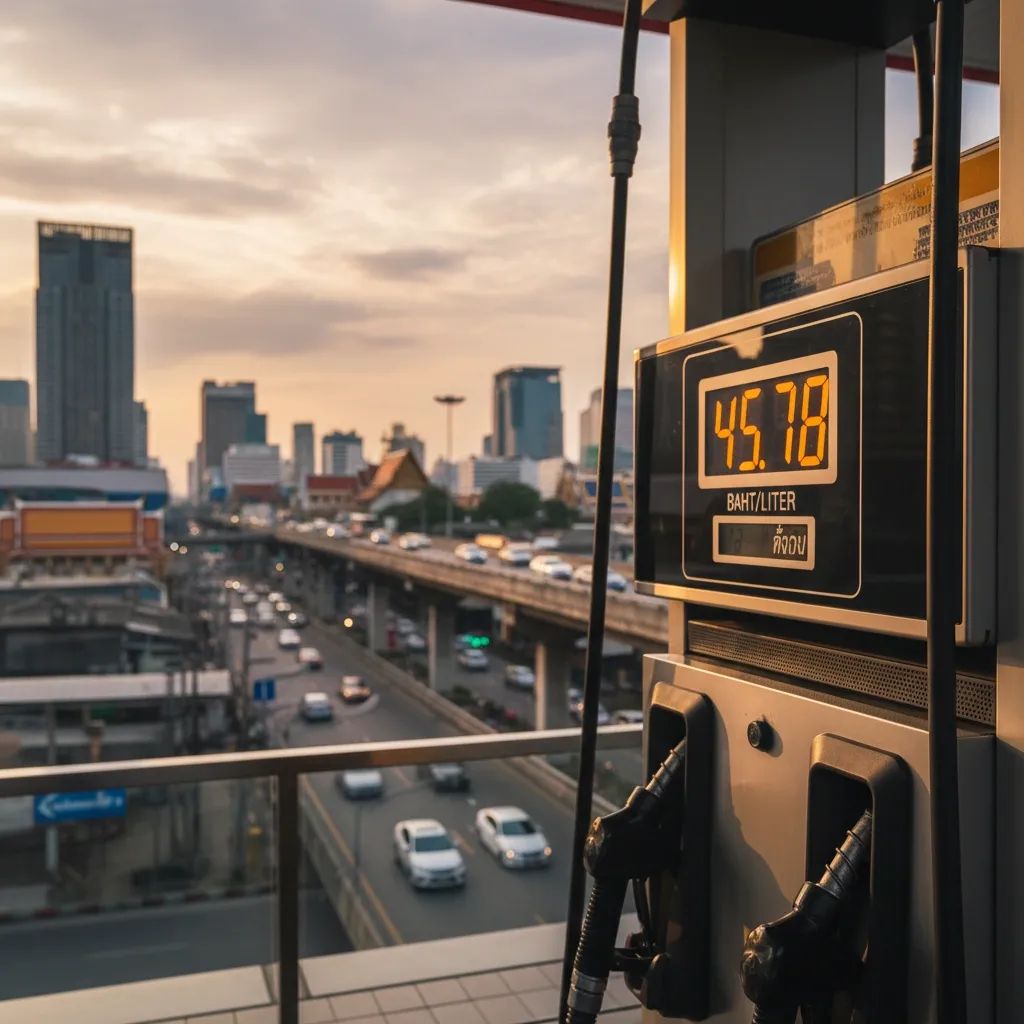
The Thailand Oil Fuel Fund Management Committee has pulled back diesel subsidies sharply over the past month, a policy shift that pushed pump prices as high as ฿50.54 per liter in early April before settling to ฿44.40 for B7 diesel by mid-month—still nearly 50% above the government's former ฿30 ceiling. For households and businesses across the kingdom, the change marks the end of an era of price controls and the start of a more volatile fuel market tied directly to global crude swings and Middle East tensions.
Why This Matters
• Diesel subsidy cuts: The fund slashed support for B7 diesel from ฿15.00 to ฿6.41 per liter under Announcement No. 44, effective April 10.
• Price volatility: Diesel spiked above ฿50 in the first week of April, then fell ฿6 within ten days as the fund adjusted rates.
• Transport cost ripple: Every ฿1 rise in diesel typically lifts logistics expenses 1–2%, feeding through to retail prices for food, goods, and services.
• Relief package approved: The Cabinet greenlit ฿2.06 billion to support 460,000 transport operators for 42 days starting April 20.
From Price Ceiling to Market Reality
For much of 2025 and into early 2026, the Thailand government maintained a de facto ceiling on diesel at or below ฿30 per liter, absorbing the difference through the Oil Fuel Fund. By March, with global crude hovering near multi-year highs and conflict in the Middle East squeezing supply routes, that model became unsustainable. The fund's balance sheet turned negative—฿65.7 billion in the red as of October 2025, split between a ฿20.8 billion deficit on the petroleum account and ฿44.9 billion on LPG.
On March 27, the fund committee issued Announcement No. 30, trimming the subsidy on standard rapid diesel to ฿16.02 per liter and B20 to ฿18.94. A day later, Announcement No. 31 cut standard diesel support to ฿16.67 and ended subsidies entirely for Gasohol 95 and 91, replacing them with a ฿0.43 per-liter levy into the fund. E20 gasohol retained a ฿2.66 subsidy. Then, on April 10, came the steepest reduction yet: Announcement No. 44 brought B7 support down to ฿6.41 and B20 to ฿9.58 per liter.
Interior Minister and Deputy Prime Minister Anutin Charnvirakul publicly declared the end of the "price freeze" language, signaling that pump rates would henceforth track market fundamentals more closely. The fund would still cushion sharp spikes, but the era of guaranteed ฿30 diesel was over.
What Drivers and Consumers Are Paying Now
On April 3, diesel was ฿47.74 per liter at most stations. By April 5 it had jumped ฿2.80 to ฿50.54—the highest retail price in years. Ten days later, after the committee's intervention, B7 stood at ฿44.40 and B20 at ฿37.40 at PTT and Bangchak outlets. That ฿6 drop in B20 offered brief relief, yet even the lower figure represents a roughly 50% increase over the old ceiling.
For a six-wheel truck covering 300 kilometers daily, the difference between ฿30 and ฿44 diesel adds approximately ฿1,000 per day in fuel costs—enough to wipe out a week's margin for owner-operators. Transport associations warned of imminent fare hikes, and retailers confirmed that the lag between diesel spikes and shelf-price adjustments runs about two weeks.
Impact on Residents & Investors
Residents who lease property in Bangkok or Chiang Mai will see the effect in two ways: higher taxi and Grab fares, and a creep in supermarket bills as distributors pass on logistics surcharges. Imported goods face a double squeeze—both the stronger dollar (if applicable) and elevated inland freight. For business owners, especially those in hospitality or e-commerce with tight delivery schedules, fuel volatility complicates budgeting and can erode already-thin margins.
The subsidy rollback also signals a broader fiscal pivot. The Thailand Cabinet is prioritizing the fund's solvency over consumer price stability, which means less predictable operating costs for manufacturers and a higher bar for foreign direct investment in logistics-intensive sectors. If you run a factory or distribution hub, plan for diesel-indexed cost clauses in contracts and consider hybrid or electric fleet trials where feasible.
Government Relief and Timeline
Recognizing the political sensitivity, the administration approved a ฿2.061 billion package to cushion transport operators. Starting April 20 and running through May 31, roughly 460,000 vehicles—from pickup trucks to articulated lorries—will receive direct payments to offset part of the fuel-price jump. The per-vehicle amount varies by class, but the aim is to prevent a cascade of small bankruptcies in the haulage sector.
Beyond that, the government floated several trial balloons: low-interest credit lines for holders of the state welfare card, accelerated EV and hybrid trade-in incentives, and a possible one-time cash transfer if diesel remains above ฿45 through May. None have been formalized, and budget watchers note that the fund's negative balance limits room for sweeping handouts.
Regional Energy Diplomacy and AZEC 2.0
On April 15, Deputy Prime Minister Anutin joined an online summit for the Asia Zero Emission Community (AZEC) Plus, endorsing Japan's upgraded framework. AZEC 2.0 extends beyond renewable-energy capacity building to include low-interest financing for crude oil procurement, refined fuels, and critical supplies—essentially a regional energy-security mutual-aid pact. For Thailand, which imports roughly 70% of its petroleum, access to concessional credit can smooth short-term price shocks and diversify supply away from traditional Gulf routes.
The Thailand Power Development Plan 2026–2050 targets clean energy above 50% of the generation mix by the end of this year, leaning heavily on utility-scale solar, onshore and offshore wind, and floating photovoltaic arrays. The Utility Green Tariff (UGT1), launched in February 2025, already allows corporate buyers to source renewable electricity with certificates, and pilot studies for small modular reactors and carbon-capture infrastructure are under way. Yet the transport sector—the largest diesel consumer—remains almost entirely fossil-fueled, meaning pump-price stability will hinge on global crude markets for years to come.
Consumer Confidence and Economic Headwinds
Thailand's consumer-confidence index posted its steepest monthly decline in six months during March, driven by war anxiety and the diesel surge. Household spending on transport and food—two categories directly sensitive to fuel costs—contracted in real terms, and retail sales growth slowed to the weakest pace since late 2025. Economists at local brokerages estimate that every sustained ฿10 increase in diesel shaves roughly 0.2 percentage points off annual GDP growth, as disposable income shifts toward necessities and away from discretionary purchases.
The broader macroeconomic backdrop compounds the challenge. Global trade flows remain choppy, inbound tourism has yet to regain 2019 velocity, and export-oriented manufacturers face both higher energy input costs and softer demand from key markets. The Thailand central bank has held rates steady, wary of fueling inflation even as growth sputters, leaving fiscal policy—subsidy management, targeted transfers—as the primary lever.
What Comes Next
No one in government or industry expects a return to the ฿30 era. The strategic question is whether the fund can stabilize diesel in a ฿40–฿45 band or whether another geopolitical shock—escalation in the Gulf, a supply disruption in the Strait of Hormuz—forces prices back above ฿50. The Oil Fuel Fund Committee meets weekly to review global benchmarks and domestic inventories, adjusting subsidy rates with a one- to two-day lag.
For residents, the practical takeaway is straightforward: build a fuel-cost buffer into monthly budgets, explore ride-sharing or public transit where viable, and watch for government announcements around the May 31 deadline for the transport-relief package. Businesses with heavy vehicle fleets should lock in forward contracts with fuel-card providers or investigate leasing arrangements that cap per-liter exposure.
Longer term, Thailand's energy transition will determine how tightly pump prices track crude. Until then, every headline from the Middle East will ripple through your neighborhood gas station—and your grocery bill.


