
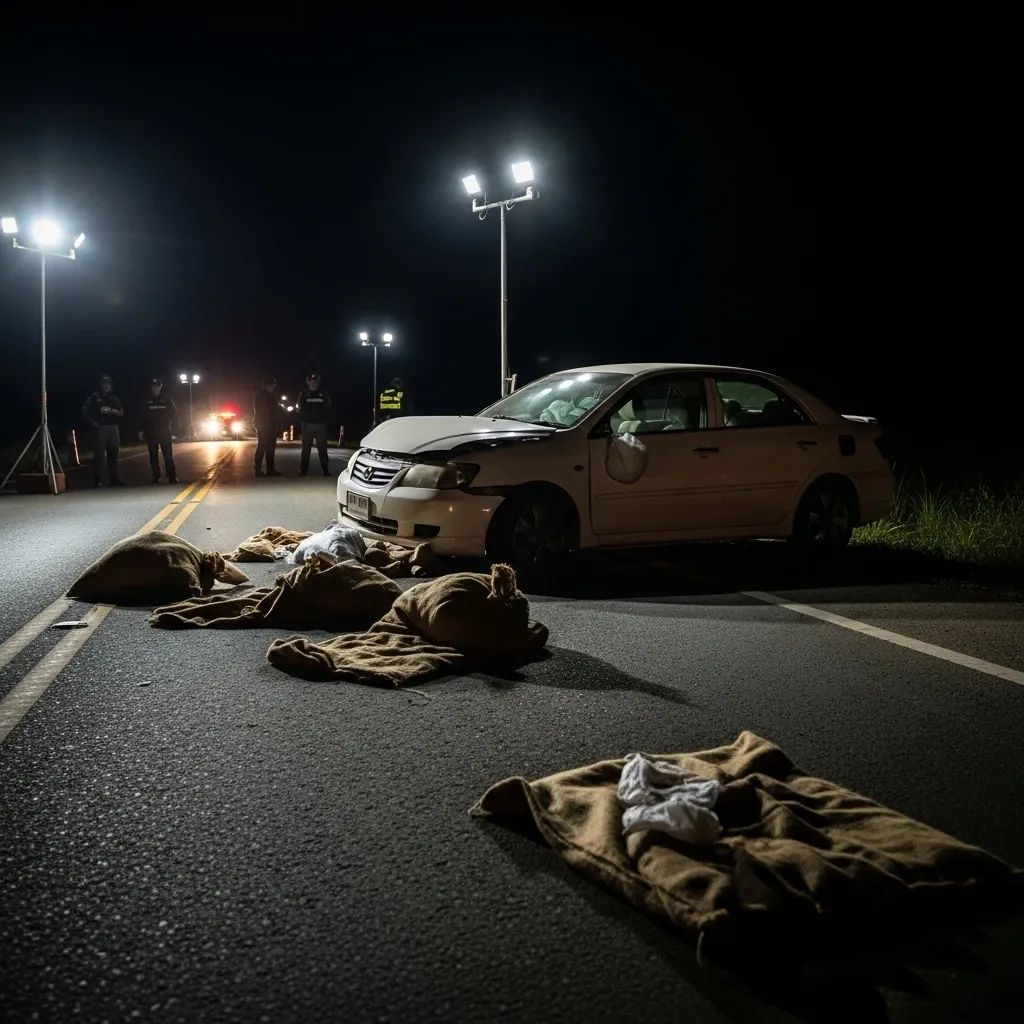
A high-speed chase through Chiang Mai ended with police seizing 2.5 million methamphetamine tablets on August 4. Four male gang members fled on foot, abandoning a young mother and her infant in their crashed vehicle. Royal Thai Police arrested the woman, identified as Ms. Wae, hours later at a worker dormitory. This bust is part of a broader crackdown that has seized over 3.2 million pills and 8.6 kg of heroin across three related cases in recent weeks.
Why This Matters
• Regional trafficking intensifies: Northern Thailand remains a primary corridor for narcotics entering from border regions, with over 417 million pills seized across the north in just seven months.
• Highway safety concerns: Drug gangs increasingly use civilian vehicles and public roads to transport contraband, raising risks for ordinary motorists.
• Enhanced enforcement: The Thailand Provincial Police Region 5 is coordinating with military units and local authorities under Operation 90 Days, a focused 90-day sweep targeting distribution networks.
The Chase and Arrest
Undercover officers tracked the suspect vehicle—a pickup truck—through Mae On district in Chiang Mai. When police moved to intercept, the driver accelerated and lost control, crashing into a tree near the Udom Phan Mai nursery. Four male accomplices fled into nearby vegetation, leaving behind Ms. Wae and her infant child. Officers recovered the methamphetamine tablets hidden inside eight fertilizer sacks stacked in the truck bed.
Ms. Wae was apprehended hours later at a worker dormitory where she had attempted to hide. Authorities confirmed she is now in custody facing charges related to trafficking and possession with intent to distribute.
Impact on Residents and Road Users
The bust highlights ongoing drug trafficking risks on highways connecting Chiang Mai to border crossings in Mae Ai and Fang districts. Residents and commercial drivers in the region should be aware that roadblocks and vehicle inspections have increased frequency, particularly on Highway 107 and Highway 1095, as authorities attempt to disrupt smuggling routes.
For those living in northern Thailand, the Operation 90 Days campaign—running from July 1 through September 30—means heightened police visibility and checkpoint activity. Residents traveling through northern provinces should carry their passport or Thai ID, vehicle registration, and driver's license. Checkpoint stops typically last 5-10 minutes for random inspections. Authorities have emphasized that law-abiding travelers face minimal disruption.
Broader Enforcement Campaign
The Thailand Provincial Police Region 5, which oversees law enforcement across the upper northern provinces, announced that the Mae On seizure was one of three major busts concluded within a 48-hour window. In addition to the 2.5 million pills from the highway chase, officers confiscated:
• 700,000 additional methamphetamine tablets from a separate operation in Phrao district, hidden inside a sofa
• 8.62 kg of heroin intercepted in a coordinated checkpoint operation
Combined, these operations represent one of the most significant interdiction successes in Chiang Mai this year. Police attribute the results to improved intelligence sharing between the Office of the Narcotics Control Board (ONCB) Regional Office 5, military assets from the Pha Mueang Task Force, and local administrative officers.
Surge in Seizures Across the North
Chiang Mai has recorded multiple large-scale drug intercepts in 2026. On June 15, the Pha Mueang Task Force seized another 2.5 million pills in Mae Ai district after a suspect vehicle crashed through a checkpoint and abandoned its cargo. On July 21, police in Phrao district discovered 1.78 million tablets concealed in furniture.
From October 2025 through April 2026, northern Thailand authorities collectively seized:
• 417.8 million methamphetamine pills
• 9,457 kg of crystal methamphetamine (ice)
• 62.1 kg of heroin
• 185 kg of raw opium
• 1,629 kg of ketamine
Officials have also begun monitoring for fentanyl, a synthetic opioid that has not yet appeared in significant quantities but is considered an emerging threat.
Trafficking Tactics Evolve
Law enforcement sources report that smuggling networks have adapted to tighter border controls by employing "ant army" tactics—using groups of three to five carriers who move smaller quantities to reduce detection risk. Contraband is frequently hidden in commercial goods, parcels, and agricultural shipments to evade x-ray and canine inspections.
In response, the Royal Thai Police and allied agencies have deployed artificial intelligence systems at select checkpoints to analyze vehicle behavior patterns and flag suspicious movements. Community informant networks in the five border districts of Chiang Mai—Mae Ai, Fang, Chai Prakan, Chiang Dao, and Mae Taeng—have also been expanded, encouraging residents to report unusual activity.
Legal Consequences and Asset Seizure
Ms. Wae faces life imprisonment under Thailand's Narcotics Act if convicted. Authorities can also seize her property, vehicles, and bank accounts linked to trafficking. Conviction for trafficking more than 20,000 methamphetamine tablets in Thailand carries a mandatory minimum sentence of life imprisonment and potential forfeiture of all assets linked to the offense.
Public Safety and Prevention Programs
Beyond enforcement, Chiang Mai provincial authorities have launched the "Community Embrace" pilot program across nine districts, providing rehabilitation and social support for users to reduce recidivism. Participants are monitored via a mobile application for at least one year, with ongoing counseling and employment assistance.
The initiative is part of a broader harm-reduction strategy designed to separate users from traffickers and dismantle local demand networks that sustain cross-border supply chains.
What Comes Next
The Operation 90 Days campaign is scheduled to conclude at the end of September, though officials have indicated enforcement pressure will remain elevated through the end of 2026. Checkpoints in Chiang Mai and neighboring provinces will continue operating at full capacity, with particular focus on routes connecting to Myanmar's Shan State, the source region for the majority of methamphetamine entering Thailand.
For residents, the operational tempo means continued traffic disruption and a visible police presence on major highways. Authorities emphasize that cooperation from the public—reporting suspicious vehicles, unfamiliar individuals in rural areas, and unusual cargo movements—remains critical to sustaining momentum against organized trafficking groups.
Despite record confiscations, officials say the volume of narcotics transiting the region suggests supply chains remain robust, underscoring the scale of the enforcement challenge facing Thailand as a frontline state in Southeast Asia's drug trade. The seizure of 2.5 million pills in a single stop, while significant, represents less than 1% of the total methamphetamine intercepted across northern Thailand in the past seven months.


