
Why a Family Decision Is Remaking Bangkok's Art Future
When the Chakrabhand Posayakrit Foundation opens its museum doors on March 29, two streams of Thai cultural life converge: the fiercely protected legacy of a National Artist who lived by refusal, and a nation still figuring out how to preserve what matters most before auction houses scatter it across private vaults. This opening isn't a ceremonial ribbon-cutting. It's a family choosing custodianship over inheritance taxes, and that choice carries implications that ripple through anyone investing in, teaching, or simply loving Thai art.
Key Takeaways
• Public access begins March 29, 2026 with operating hours 10 AM–4 PM; advance booking required via +66 2 392 7754, +66 87 332 5467, or the foundation's Facebook page
• Entry fees are modest: THB 300 adults, THB 150 university students, THB 100 school students, free for under-7s—framed as collection maintenance rather than revenue extraction
• The collection locks away roughly 400+ artworks from auction circulation, likely increasing secondary-market prices for signed originals held privately while ensuring 100+ paintings and 300+ puppets remain accessible to students and researchers
The Artist Who Walked Away From Wealth
Chakrabhand Posayakrit (born August 16, 1943) inhabited a specific moment in Thailand's modern art market, when National Artist designations began attracting serious collectors and auction houses started opening regional branches. The financial pressure was real. A single signed work could command millions of baht—enough to secure generational comfort, fund conservation indefinitely, or resolve inheritance complications that plague families managing valuable estates.
He declined nearly every offer.
This wasn't romantic impoverishment. Chakrabhand earned his National Artist recognition in Visual Arts (Painting) in 2000 from the Office of the National Culture Commission, Thailand's highest artistic honor. He taught Princess Ubolratana and Princess Maha Chakri Sirindhorn painting during their youth—a credential that cemented his status as a state-recognized cultural authority rather than merely a talented commercial artist. He held lecturer positions at Silpakorn University, where he'd earned his own Fine Arts degree. The choice to refuse commercialization wasn't from scarcity but from deliberate philosophy: artworks function as public inheritance, not personal wealth accumulation vehicles.
His sons and heirs inherited not just paintings but responsibility. They faced the same pressures every National Artist family confronts: mounting conservation costs, climate threats to aging materials, staffing requirements, and the perpetual temptation to monetize when financial need or opportunity knocks. Opening a public museum meant accepting perpetual operational obligations rather than liquidating assets and passing simplified estates to the next generation.
What Gets Displayed—And Why It Matters
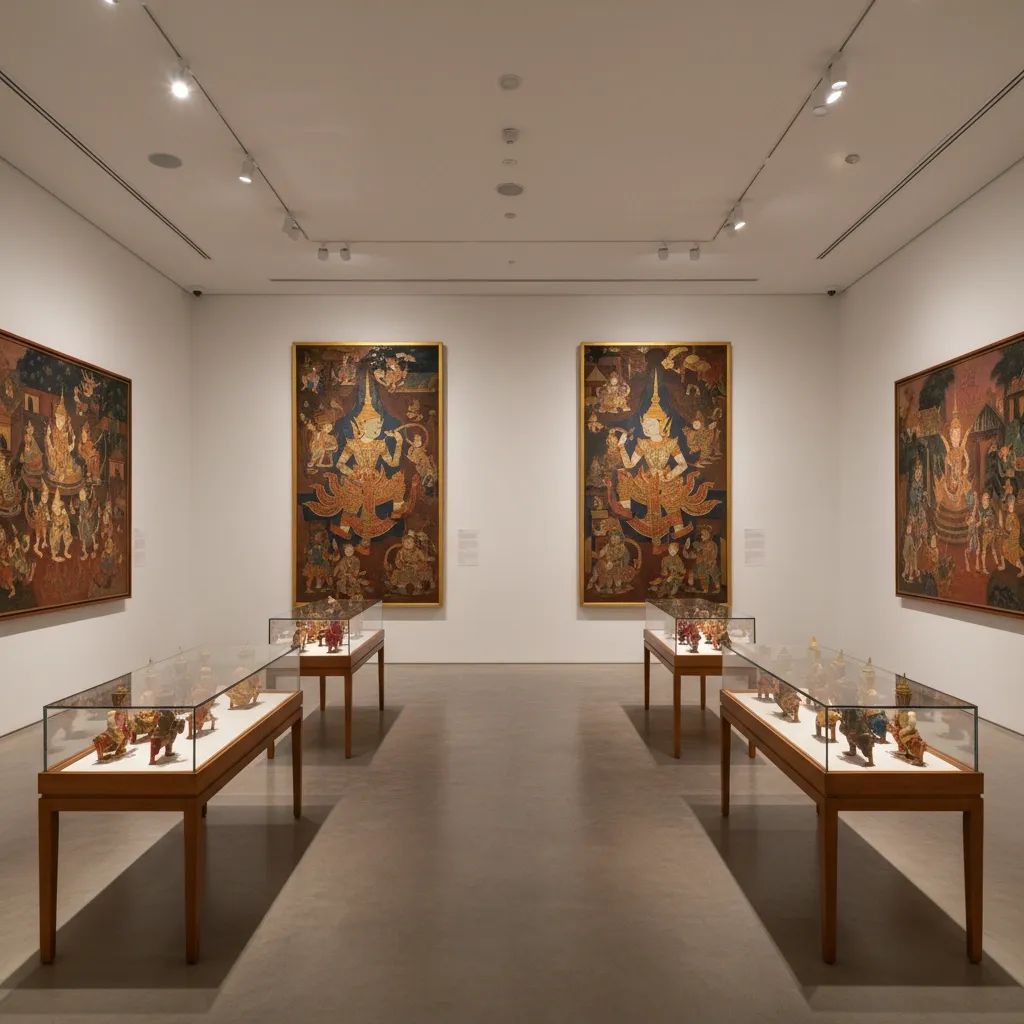
The museum's inaugural exhibition distributes its holdings across thematic galleries that map Chakrabhand's artistic versatility. "The Ideal Beauty" section houses his most celebrated work: delicate portraits of women rendered from Thai literary sources, mythological kinnaree figures, and characters from classical dramatic traditions. These pieces demonstrate technical mastery in portraiture—his manipulation of line, color temperature, and compositional balance created psychological interiority alongside visual elegance. Multiple paintings won national art competitions when originally exhibited, establishing his reputation beyond academic circles into broader public recognition.
Alongside finished works, the museum displays his teaching materials and student sketches from Vajiravudh College and Silpakorn University. These working drawings reveal compositional foundations: perspective studies, anatomical notations, preliminary figure arrangements that show how technical discipline precedes inspiration rather than following it. For anyone training in visual arts, encountering this progression—from foundational studies to mature mastery—offers pedagogical value that reproduction-based education simply cannot provide.
His mural philosophy occupies distinct wall space with photographic documentation and preparatory drawings from significant commissions. Wat Trithosathep Worawihan in Bangkok and Wat Khao Sukim in Chanthaburi Province display his permanent installations. Temple murals demand technical constraints absent from canvas work: specialized pigments that survive tropical humidity and seasonal temperature fluctuations, theological accuracy in iconographic placement, structural understanding of wall surfaces and application methods. The museum presents this translation from sketch to permanent installation, allowing visitors to grasp how scale, permanence, and religious context reshape artistic decision-making.
"The Living Art" section houses over 300 puppets—perhaps the world's most comprehensive assembly of this particular craft form. European and Asian museums hold isolated examples; few institutions possess 300+ pieces spanning decades of creation, experimental design, and performance documentation. These puppets aren't decorative toys but intricate mechanisms combining wood carving, leather work, textile embroidery, jewelry fabrication, and mechanical engineering. Each required weeks of construction. Chakrabhand spent years researching traditional Thai rod puppets (hun krabok) and royal puppets (hun luang) under master craftspeople before establishing the Chakrabhand Posayakrit Puppet Troupe to stage elaborate performances.
His troupe became known for ambitious productions of Phra Aphai Mani, Ramakien, and Romance of the Three Kingdoms—performances lasting 6+ hours with meticulously choreographed movements requiring performer-technicians of exceptional skill. The puppet collection represents technical mastery, artistic innovation, and cultural preservation intertwined at scales most contemporary artists never attempt.
A Family's Institutional Gamble
Vallapbhit Sodprasert, foundation chairman, oversees operations that extend beyond museum management. The foundation functions simultaneously as archive, workshop, and incubation space for artisan training. This mirrors practices increasingly common across Southeast Asia where artist estates transform into apprenticeship centers rather than static collections. Silpakorn University and other cultural institutions may eventually develop educational partnerships here, expanding the museum's reach from passive spectatorship into active skill transmission.
The Sai Mai district location deliberately sits outside tourist gallery corridors. It's accessible via BTS extensions and local buses but requires intentional navigation—likely discouraging mass tourism while welcoming serious students, neighborhood residents, and researchers prioritizing genuine engagement over convenience. This positioning signals educational missions over revenue maximization, though it also reflects practical constraints: limited physical space demands controlled visitor flows to protect fragile textiles, puppets, and aging pigments from accelerated deterioration.
The advance-booking requirement illustrates these conservation tensions. Whether capacity limits stem from physical space constraints, climate-control fragility, or staffing shortages remains publicly unspecified. Thailand's art preservation ecosystem remains underfunded relative to collection size. Government cultural budgets concentrate on tourism infrastructure rather than private museum operations. Budget constraints and personnel shortages plague temple mural conservation; secular art collections face even steeper challenges. Tropical humidity, seasonal flooding, and insect damage demand specialized expertise that many domestic institutions lack.
Ripples Through Thailand's Art Market
Chakrabhand's refusal to commercialize has indirect economic consequences. Approximately 400+ artworks now locked in permanent public stewardship effectively removes them from circulation. Collectors hunting signed originals will find them scarcer and consequently pricier. Earlier government tax incentives designed to stimulate collector interest—offering deductions for purchasing National Artist artwork—benefit private buyers far more than public institutions. This creates policy incentives for dispersal rather than consolidation, essentially pushing valuable works toward wealthy private vaults while public access recedes.
Other National Artist families navigate comparable terrain with varying outcomes. The descendants of Thawan Duchanee operate the Baan Dam (Black House) Museum in Chiang Rai, displaying sculptures and architectural installations in a family-managed setting. The heirs of Angkarn Kallayanapong established the "Art and Archive of Angkarn Kallayanapong," preserving literary works, paintings, and traditional murals. These private-family-operated institutions succeed where public funding gaps exist—but they inherit all administrative, conservation, and operational burdens without guaranteed institutional stability. Funding dries up. Staffing turnover destabilizes continuity. Buildings age. When private operators lack endowments or sustainable revenue models, collections deteriorate or eventually disperse through sale or neglect.
Chakrabhand's foundation has established modest entry fees that explicitly frame themselves as collection maintenance rather than profit maximization. This transparency matters. It signals honest accounting rather than exploitative pricing. It also means the museum operates on threadbare operational margins—sustainable only if visitor volume, conservation costs, and staffing align precisely. Any deviation threatens viability.
Impact on Bangkok's Educational Landscape
For students, particularly those training in visual arts, design, or traditional crafts, the museum represents genuine rarity. Most Thai students encounter Chakrabhand's work through reproductions or exhibition catalogs, if at all. Direct encounter with finished paintings, original puppets, and preparatory studies engages different learning mechanisms than photography-based study. Museum hours running 10 AM to 4 PM position the collection within reach of school schedules and part-time workers rather than restricting access to weekend tourists. This scheduling choice prioritizes educational utility over tourism revenue.
The museum's function as an active workshop—not just a display venue—potentially transforms how traditional skills transmit across generations. Formal apprenticeship systems in Thai puppetry, mural painting, and portrait technique have contracted significantly as younger generations pursue more financially predictable careers. A living workshop operated by a National Artist's foundation signals that these skills remain economically viable and culturally valued. If the foundation eventually partners with universities or secondary vocational schools, the museum could become a de facto training center rather than remaining isolated in Sai Mai.
The Philosophical Fork Thailand Faces
Chakrabhand's decision illuminates a choice increasingly common in Thailand's contemporary art world: whether cultural legacy constitutes heritage or commodity. As international collector interest grew and auction houses established regional presence, National Artists confronted genuine financial pressure. Their heirs face even steeper temptation when inheritance taxes, conservation costs, and operational expenses compound. Selling a single major work could fund decades of preservation or facilitate generational wealth transfer.
He chose differently. That decision now ensures roughly 400 artworks remain permanently accessible rather than scattered across climate-controlled private vaults. It establishes precedent—however fragile—that National Artist designation carries custodial obligation, not merely market prestige. It demonstrates that a family can prioritize cultural stewardship over financial optimization, though doing so requires accepting perpetual operational responsibility without guaranteed institutional support.
The museum opened formally on March 16, 2026, with public access beginning March 29. This timing creates operational cushion before anticipated increased visitation, allowing staff to refine systems and test conservation protocols. The foundation maintains a Facebook page for booking and updates, recognizing that most Thailand-based audiences navigate digital appointment systems rather than telephone-only reservations.
For collectors monitoring Thai art prices, educators planning museum visits, students beginning visual arts training, or anyone observing how cultural legacy gets managed in contemporary Thailand, this museum represents a decisive institutional moment. One family subordinated personal financial interest to public cultural stewardship. Whether that choice proves economically sustainable—whether staffing, funding, and community support remain adequate across years or decades—remains the question pressing forward.


