
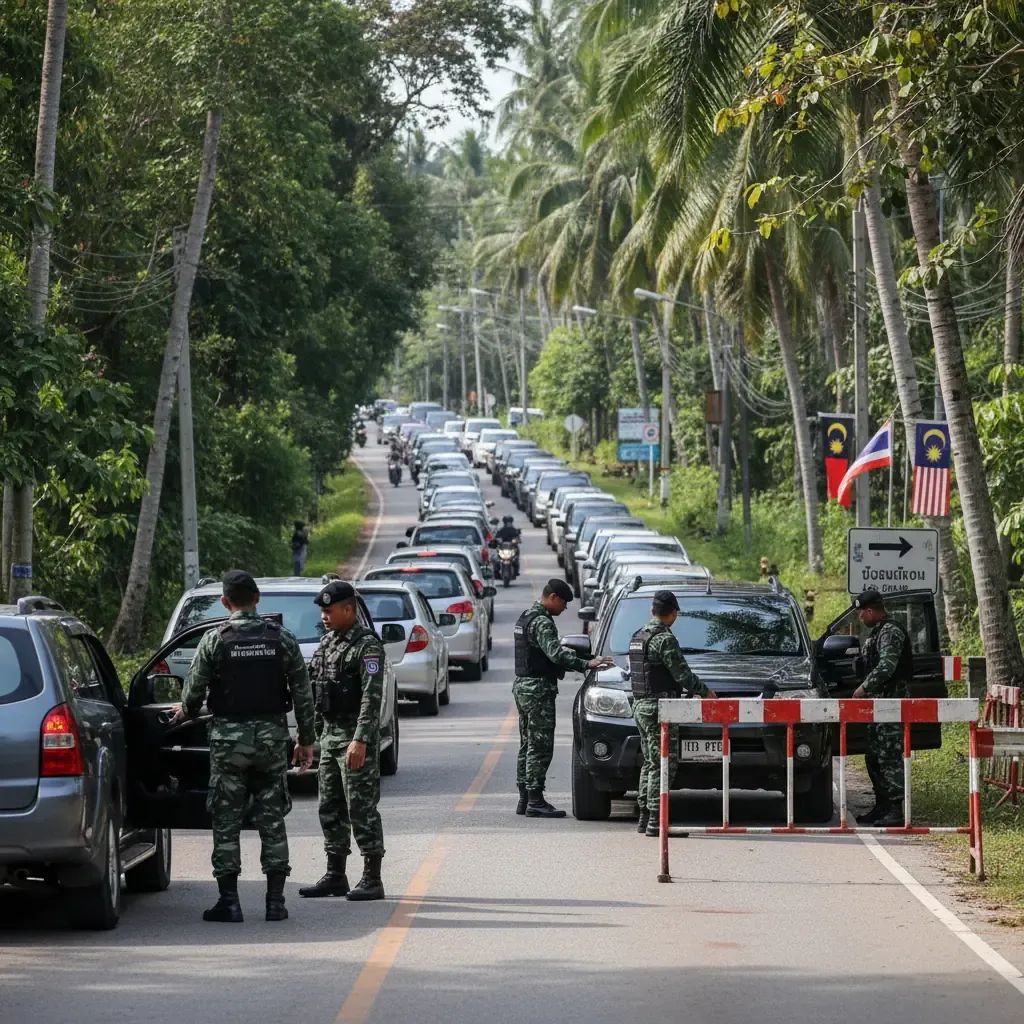
Cambodia's National Assembly has enacted the country's first dedicated anti-fraud legislation. The move targets the sprawling online scam industry that has made the kingdom notorious as a cybercrime hub. The development comes as international pressure mounts on Phnom Penh to act against criminal networks suspected of extracting billions of dollars from victims worldwide—and trafficking tens of thousands of foreign workers into forced labor. For residents and investors in Thailand, the legislation signals a potentially transformative shift in regional security, cross-border crime enforcement, and economic stability along the shared border.
Why This Matters
• Regional crime networks: Cambodia-based scam centers have targeted Thai nationals and others across Southeast Asia, with operations tied to trafficking rings that recruit through fake job ads.
• Border security implications: The crackdown could displace criminal operations into neighboring countries, including Thailand, or trigger a wave of repatriations and deportations.
• Economic stability: Scam centers have undermined Cambodia's investment climate and tourism sector, with spillover effects on regional trade and financial systems.
A Legislative Response to a $2B Criminal Economy
Cambodia's parliament unanimously approved the Anti-Technology Fraud Law on March 30, with the Senate ratifying it on April 3. The legislation now awaits final signature from King Norodom Sihamoni. Justice Minister Koeut Rith framed the statute as a definitive message: Cambodia will no longer serve as a sanctuary for fraud operations. The government has pledged to shutter all remaining scam compounds by the end of this month.
The law introduces graduated penalties based on the severity of offenses. Individuals found guilty of operating or managing a technology fraud site face 5 to 10 years in prison and fines ranging from 500M to 1B riel (approximately $125,000 to $250,000). When fraud operations involve human trafficking, violence, detention, or forced labor, sentences escalate to 10 to 20 years with fines up to 2B riel ($500,000). If a victim dies during an operation—whether from attempted escape or abuse—penalties climb to 15 to 30 years, or life imprisonment.
Lesser fraud charges carry 2 to 5 years and fines up to $125,000, but penalties double for those acting as part of organized gangs or targeting multiple victims. The law also criminalizes money laundering, data harvesting for fraud, and recruitment into scam networks.
The Scale of the Problem
Between mid-2025 and March 2026, Cambodian authorities identified 250 suspected fraud sites and closed approximately 200 of them. In the final six months of 2025 alone, law enforcement raided 118 operations across 18 provinces, arresting 4,983 suspects—including 979 women—from 23 nationalities. Nearly 10,000 workers repatriated from these centers.
Between 100,000 and 150,000 people worked in Cambodian scam compounds at the industry's peak, many of them trafficked under false employment offers. Victims report torture, sexual assault, forced abortions, food deprivation, and solitary confinement. Some complexes resemble fortified mini-cities, complete with perimeter defenses and internal surveillance.
Since the current government took office in 2023, Cambodia has deported more than 48,000 foreigners linked to fraud operations, with an additional 210,000 leaving voluntarily. In early 2026 alone, authorities expelled 110,095 foreign nationals and arrested 173 key figures tied to cybercrime.
Impact on Expats and Cross-Border Workers
The crackdown carries immediate consequences for foreign workers and entrepreneurs in Thailand. Scam networks have long recruited Thai nationals through Facebook groups and Telegram channels offering high-paying remote work in Cambodia. Many end up trapped in compounds, unable to leave without paying exorbitant "release fees."
Thai nationals have been among the most frequently victimized, both as scam workers and as targets of romance scams, cryptocurrency fraud, and investment schemes run from Cambodian bases. The new law's harsh penalties—and the government's public commitment to eliminating scam sites—suggest that trafficking routes may shift or criminal syndicates may attempt to relocate operations closer to the Thai border or into Laos and Myanmar.
For Thai investors and businesses, Cambodia's legislative pivot could stabilize the investment climate. Prime Minister Hun Manet has acknowledged that scam operations damaged the kingdom's economy, reputation, and foreign direct investment. In 2025, Cambodia ranked 17th on the Global Organized Crime Index, a sharp deterioration that spooked tourism and capital inflows. The cleanup may restore confidence, but only if enforcement proves credible.
How Thailand's Framework Compares
Thailand has pursued its own legislative strategy to combat online fraud. The Emergency Decree on Measures for the Prevention and Suppression of Technology Crimes (No. 2) B.E. 2568, effective April 13, 2025, holds financial institutions and mobile operators liable for damages if they fail to implement preventive measures. The decree accelerates reimbursement processes for victims and increases penalties for misuse of personal data and illegal SIM card trading.
Thailand's Cybersecurity Act B.E. 2562 (2019) focuses on protecting Critical Information Infrastructure (CII), mandating risk assessments, data protection, and incident reporting. However, critics warn that the law's broad language enables surveillance and content restrictions.
Cambodia's approach differs by targeting the fraud operations themselves rather than infrastructure or service providers. The new law imposes criminal liability on site operators and participants, but does not yet establish a comprehensive data protection or cybersecurity governance framework—gaps that could limit long-term effectiveness.
Regional Lessons and Coordination Challenges
Vietnam's approach to cybercrime enforcement emphasizes international cooperation and multi-sector collaboration. In October 2025, Vietnam hosted the signing of the UN Convention Against Cybercrime with over 60 countries participating. For Thailand and Cambodia, this international framework offers a pathway to coordinate efforts and prevent criminal networks from simply shifting operations across borders—a critical lesson as Cambodia enforces its new anti-fraud law.
The key challenge for the region: whether countries can move beyond individual legislation to establish shared intelligence-sharing protocols and synchronized enforcement. Without regional coordination, Cambodia's crackdown could simply displace scam operations into Thailand, Laos, or Myanmar rather than eliminate them entirely.
What Comes Next
Cambodia's government has set an ambitious deadline: all scam sites closed by end of April 2026. Whether authorities can meet that target—and prevent criminal networks from simply relocating—will depend on enforcement capacity, regional cooperation, and willingness to hold powerful individuals accountable.
For Thailand, the spillover effects are unpredictable. Border provinces may see an influx of deportees, or displaced crime rings may attempt to establish new bases. Thai law enforcement and financial regulators should prepare for increased cross-border coordination requests and heightened vigilance against mule account schemes and fake job recruitment targeting Thai workers.
The Cambodia law represents a landmark shift in how the region addresses transnational cybercrime. But laws alone do not dismantle entrenched criminal economies. The real test will be whether Cambodia can translate legislative intent into sustained enforcement—and whether regional neighbors can coordinate to prevent the fraud industry from simply migrating across borders.
Key Takeaways for Residents
Cambodia's anti-fraud statute introduces the region's most severe penalties for online scam operations, with life imprisonment possible in cases involving death. The law's passage reflects growing recognition that scam networks threaten not only individual victims but also national economies and regional stability. For those living in Thailand, the implications extend beyond border security: the crackdown may reshape cross-border labor dynamics, financial crime patterns, and investment flows across mainland Southeast Asia. Vigilance remains essential, particularly for job seekers evaluating opportunities in Cambodia and for investors monitoring regional regulatory trends.


