
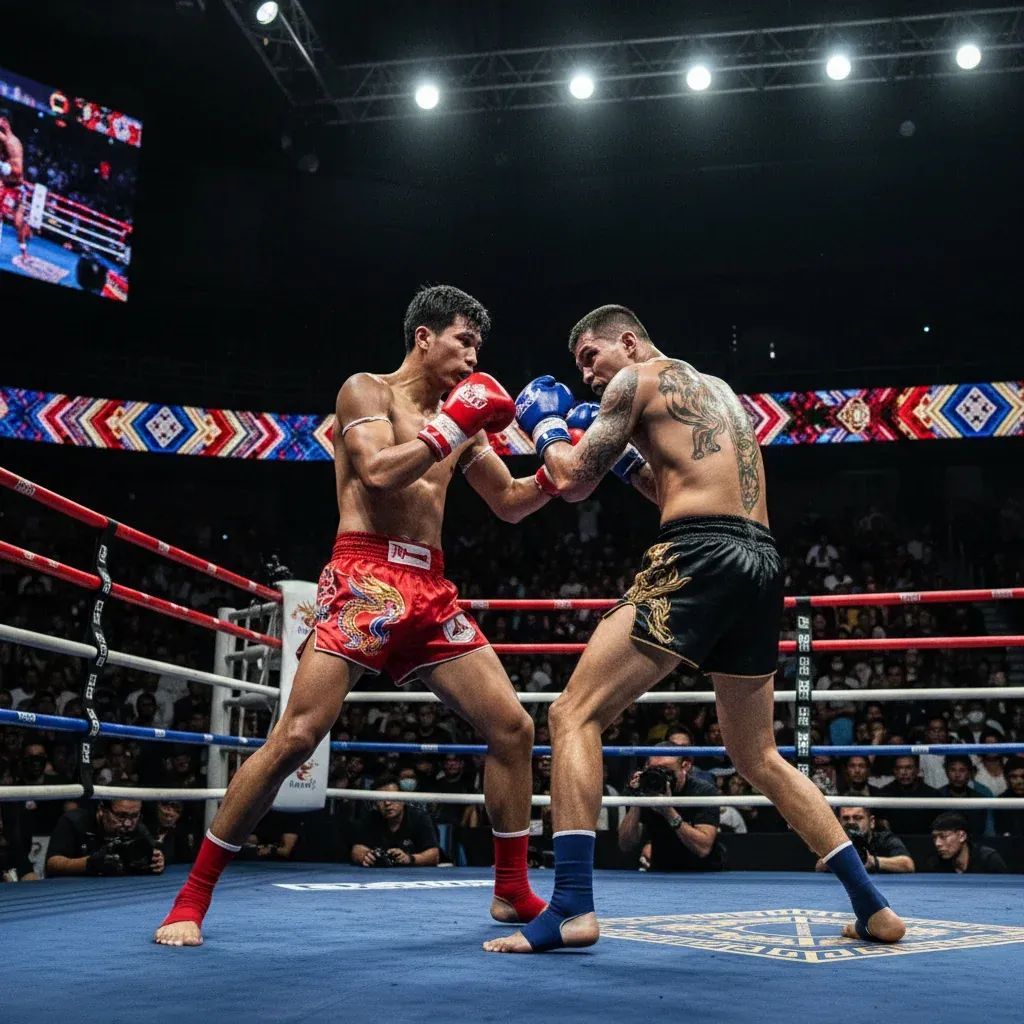
Fight Tonight: Key Details
Buakaw Phetchyindee faces Meng Gaofeng tonight at Titiwangsa Stadium in Kuala Lumpur. The 43-year-old Thai legend takes on the 29-year-old Chinese challenger in a headline kickboxing bout that captures a critical moment in Southeast Asian combat sports.
Event Details:
• Time: 8:00 PM to midnight Thailand time (April 24, 2026)
• Venue: Titiwangsa Stadium, Kuala Lumpur
• Rule Set: Kickboxing at 70kg
• Where to Watch: Live PPV streaming (200–500 baht for Thailand viewers)
This neutral-ground bout eliminates home-ring advantages and forces both fighters onto equal footing—a rarity in international combat sports.
Who Is Buakaw and Why This Matters
Buakaw is Thailand's most internationally recognized striking athlete, having popularized Muay Thai globally through K-1 World MAX championships in the 2000s and becoming a household name across Southeast Asia. Over a 284-fight career, he built a 243-25-14 professional record—one of combat sports' most extensive resumes. He represents the traditional Thai pathway: decades of ring experience, accumulated tactical wisdom, and adaptation across multiple fighting styles.
Tonight's significance lies in what he faces. After 21 months away from kickboxing competition, Buakaw confronts a fighter trained entirely within China's systematic, state-supported combat sports infrastructure—a model fundamentally different from Thailand's decentralized, gym-based apprenticeship system.
The Core Question: Can decades of accumulated fighting knowledge compete against a younger opponent from a newer, better-funded development program?
Buakaw: The Experienced Challenger
At 43 years old, Buakaw remains active but inconsistent. Since April 2021, he has fought 12 times across different rule sets—winning seven, losing once, drawing three times, and recording one no-contest. His recent wins came against solid regional opponents (Dmitry Varats, Kota Miura, Erkan Varol, Yoshihiro Sato) and notable names like Saenchai, but not championship-caliber fighters.
His most recent kickboxing assignment revealed his ceiling. In July 2024, he lost a points decision to Russian specialist Stoyan Koprivlenski at K-1 World MAX—a tournament that also features Meng, creating shared competitive ground between tonight's opponents.
Buakaw's Advantages:
• Nearly 300 fights' worth of ring intelligence and distance management
• Proven ability to absorb punishment without psychological deterioration
• Strong clinch work and positional awareness developed over decades
• Experience recognizing when to elevate intensity and when to conserve energy
Buakaw's Challenges:
• 21-month layoff from kickboxing-specific competition
• At 43, he faces natural cardiorespiratory limitations that affect reflexive speed and sustained high-intensity pressure
• Kickboxing's continuous-action scoring system favors relentless pace—different from Muay Thai's clinch-heavy framework
Meng Gaofeng: The Systematic Challenger
Born December 9, 1996, Meng turned professional in 2017 through China's Wu Lin Feng promotion—the country's premier kickboxing platform, equivalent to Thailand's stadium circuit or Japan's K-1 system. His career trajectory reflects systematic development rather than haphazard progression.
Meng holds multiple titles: the Wu Lin Feng China belt at 65kg (claimed in 2020 with three knockdowns inside 100 seconds), the IPCC China title, and the Wu Lin Feng World Championship, which he defended against Serhiy Adamchuk via decision in November 2023. His official record stands at 36 wins, 12 losses, with 10 knockouts.
Recent fights demonstrate ambition beyond purely domestic competition. In March 2025, he defeated Yodkhunpon Weerasakreck—a Thailand-based veteran with decades of provincial and international experience—via decision. Earlier this year, he secured two victories on the same card in Guangxi province, signaling both recovery capacity and systematic conditioning. His 177cm frame at 65-67kg provides reach and mobility advantages.
Meng's Advantages:
• Superior reflexes and power output at 29 years old
• Superior recuperative capacity—can sustain high-intensity aggression across four rounds without severe oxygen debt
• Documented fighting strategy: continuous-pressure aggression that forces opponents into reactive postures
• Systematic training within organized infrastructure with regular high-level competition
Meng's Uncertainties:
• International ceiling remains untested; his only high-profile international loss came to Tomás Aguirre at K-1 World MAX 2024
• Less accumulated tactical vocabulary against elite-level varied opponents
What to Expect: The Tactical Preview
Tonight hinges on tempo control. If Buakaw manages the fight's pace through economical footwork, precise clinch work, and distance management early, he can potentially fatigue Meng's aggression or accumulate cleaner scoring across the first two rounds.
If Meng sustains offensive pressure into rounds three and four, Buakaw's cardiorespiratory capacity—dormant for 21 months—becomes the critical variable. Kickboxing judges reward continuous offensive pressure more heavily than Muay Thai judges, who reward clinch dominance and ring control.
The weight class slightly favors Meng. He competes comfortably at 65-67kg with less severe hydration stress, while Buakaw's natural fighting weight historically fluctuates between 68-72kg depending on opponent and rule set.
What's at Stake
For Thailand, tonight carries cultural and economic implications. Buakaw remains the country's highest-profile combat sports export, with social media reach, endorsements, and brand partnerships that distribute revenue through provincial gyms and coaching staff.
A decisive loss—particularly by stoppage—would accelerate sponsorship and attention migration toward Chinese venues and fighters. Conversely, a Buakaw victory would affirm that accumulated fighting intelligence and cultural continuity remain globally competitive assets.
For Meng, a triumph over a figure as storied as Buakaw would likely generate invitations from European and Japanese promotions, accelerating his transition from regional champion to global-tier contender.
For Southeast Asia broadly, this bout tests whether the region's traditional striking monopoly remains competitive when confronted by organized, well-funded, systematically executed development programs.
The Broadcast
The T Fight All-Stars card runs from 8:00 PM to midnight Thailand time. Pay-per-view access via official streaming partners allows Thai-resident viewership at 200–500 baht—making the event economically accessible beyond elite sports bars and resort venues where international bouts typically cluster. Provincial viewers can engage in real-time rather than waiting for highlights.
Watch tonight and witness a test that extends beyond sport into culture and infrastructure competitiveness.


