
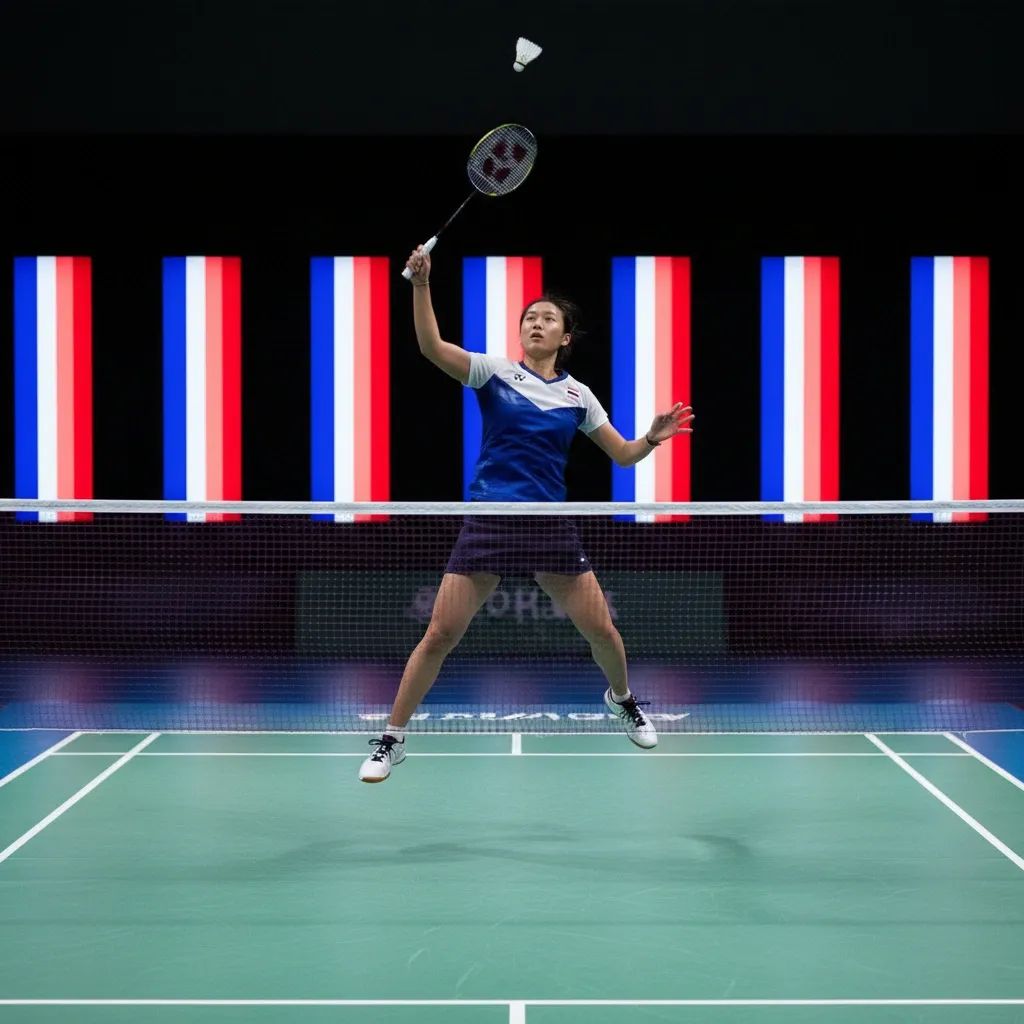
Thailand's Title Defense Collapses Against Underdog at Asian Championships
The script everyone expected to write—Kunlavut Vitidsarn becoming only the second player in decades to successfully defend the Badminton Asia Championships crown—came to an abrupt end on Saturday in China. The Thailand shuttler and world No. 1 fell to Ayush Shetty, a 25th-ranked Indian underdog who methodically dismantled the favorite in three absorbing games: 10-21, 21-19, 21-17. This marked not merely a tournament defeat, but the second crushing semi-final loss in rapid succession for a player once considered unstoppable.
Why This Matters
• Back-to-back Asian titles impossible: Vitidsarn can no longer achieve consecutive Badminton Asia Championships victories, a milestone that would have solidified his legacy and validated Thailand's investment in elite training systems.
• Rising vulnerability pattern: Two semi-final exits in rapid succession—here against Shetty and previously against another high-level opponent—suggest systematic fragility in high-pressure moments, not random upsets.
• Implications for Thai badminton hierarchy: The nation's highest-ranked player struggles to convert elite status into titles, raising uncomfortable questions about competitive depth and preparation protocols.
The Upset No One Anticipated
Shetty's opening 21-10 demolition set the tone: the underdog came to compete, not merely participate. The Indian player built immediate pressure through controlled net play and aggressive court positioning, establishing early dominance that suggested a potential rout.
Yet Vitidsarn recalibrated. Rather than surrendering to the onslaught, the world No. 1 demonstrated the resilience that built his reputation. The second game stretched into a tense battle where both players exchanged opportunities. Vitidsarn seized momentum at crucial moments, converting at 21-19 and forcing the decisive third set—a tactical revival that suggested a potential comeback.
What transpired next crystallized an uncomfortable reality. Rather than sustaining his newfound rhythm, Vitidsarn faltered. Shetty's persistence—unusual for a player 24 rankings positions below him—channeled the momentum into strategic precision. The final game saw Thailand's defender repeatedly miss narrow margins at net and fail to capitalize on service breaks. Shetty closed 21-17, advancing to the final and eliminating the tournament's top seed.
The loss echoes a troubling template: dominant early pressure from opponents that prevents Vitidsarn from establishing control, followed by a fighting second response that nonetheless proves insufficient to seal victory. Both defeats feature similar architecture: opponent takes early commanding advantage, Vitidsarn recovers partially but cannot complete the comeback.
Path to the Semi-Finals Revealed Vulnerability
Vitidsarn's journey to face Shetty displayed moments of genuine brilliance shadowed by alarming fragility. Against Hong Kong's Ng Ka Long Angus in the Round of 32, he progressed without drama. The Round of 16 confrontation with Japan's Yushi Tanaka, however, exposed cracks.
Facing an 8-21 deficit in the opening game—a position few would recover from—Vitidsarn demonstrated the grit that defines his playing style. He clawed back to 21-18, then dominated 21-5 in the second game. The quarterfinal clash against China's Weng Hongyang required another 2-1 triumph. These victories seemed to restore narrative order: the world No. 1 battling through adversity, as champions do.
Yet those comebacks masked a deeper issue. Vitidsarn needed rescue twice to reach the semi-finals. Against Shetty, the comeback proved incomplete.
The Performance Gap Between Ranking and Results
For a player holding the world No. 1 ranking, Vitidsarn faces mounting pressure to validate that status through major titles. His ranking suggests unquestionable supremacy, yet tournament results tell a different story: semi-final exits at critical moments despite occupying the sport's highest individual position.
For a nation with legitimate badminton heritage and multiple world-class players, this situation carries symbolic weight. Vitidsarn's rise to world No. 1 was supposed to inspire the next generation and demonstrate that Thai training infrastructure could produce sustained excellence. Instead, lower-ranked challengers—hungry, tactically flexible, mentally fresh—are capitalizing on opportunities in high-pressure moments.
This represents a potential shift in competitive dynamics. If lower-ranked players increasingly succeed in semi-finals, the question becomes whether Thailand's elite development systems adequately emphasize the psychological and tactical elements that separate world-class individual performance from championship tournament performance.
What Comes Next
Vitidsarn retains time to recalibrate before the next major tournaments. His technical abilities remain unquestioned. His fitness level appears intact. The deficiency appears to center on consistency in high-pressure match situations rather than fundamental skill or conditioning.
Can he maintain momentum after establishing it? Will he find the tactical adjustments necessary against opponents willing to absorb his attacks and construct extended rallies? The Thai badminton community will scrutinize his response carefully. Players of his caliber typically rebound quickly from setbacks. Yet patterns carry weight in sport. Whether Vitidsarn reverses this trajectory during the remainder of 2026 will determine both his immediate trajectory and his longer-term legacy as a player.


