
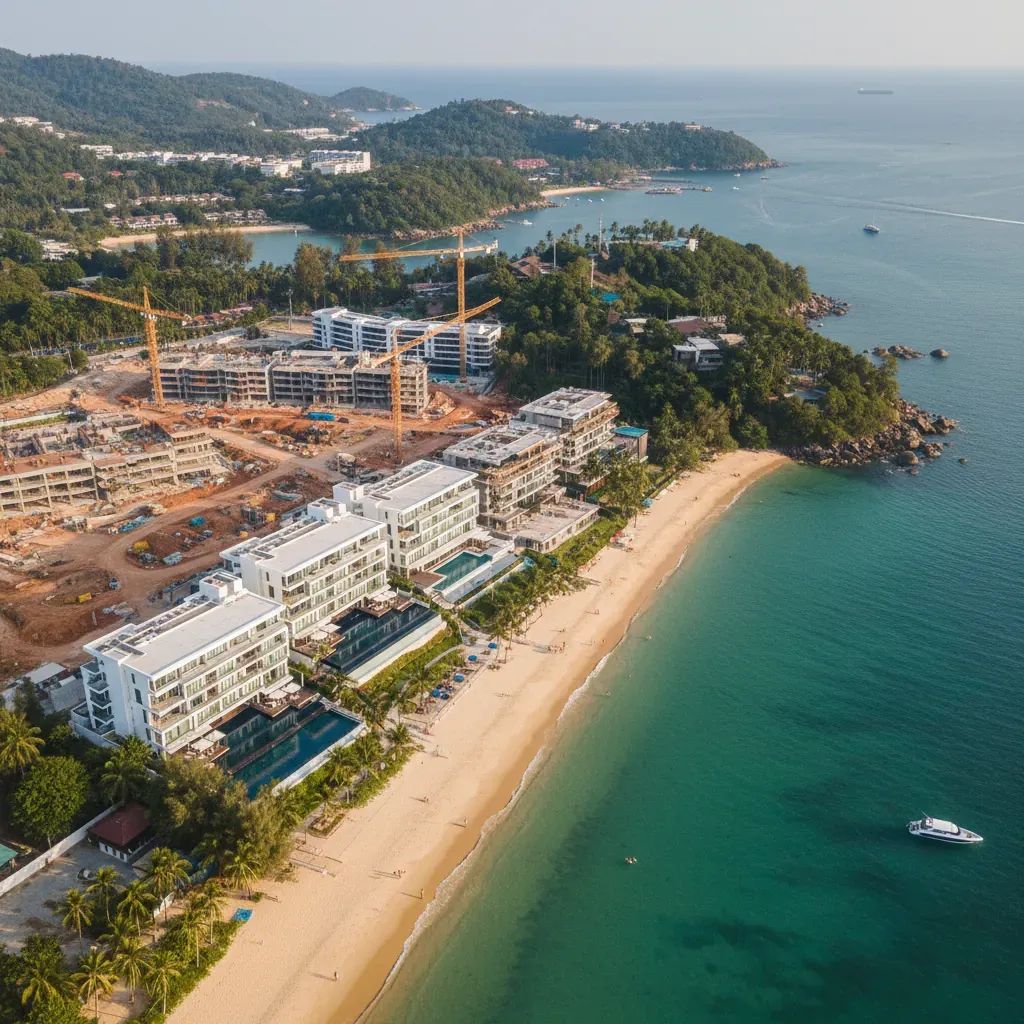
Thailand's foreign condominium market has contracted sharply in early 2026, with property transfers to international buyers falling 17.3% in the first quarter — marking the sector's first annual decline since the post-pandemic rebound. The downturn hits hardest in Bangkok, where a 35% plunge in foreign ownership transfers signals a structural shift in investor appetite, driven primarily by a 38.8% collapse in purchases from Chinese nationals, historically the market's largest overseas buyer group.
Why This Matters
• Market Share Shrinking: Foreign buyers now represent just 13.6% of all condo ownership transfers, down from higher historical levels, with total transaction value dropping 17.9% to 13.5B baht in Q1 2026.
• Chinese Retreat Accelerates: Economic headwinds and liquidity constraints in China have caused individual buyers to postpone overseas real estate decisions, cutting their Bangkok market share from nearly 50% in 2018 to just over 20% by mid-2025.
• Full-Year Outlook Uncertain: The Thailand Real Estate Information Center (TRI) projects foreign condo transfers could contract up to 20% for all of 2026, while Kasikorn Research Center forecasts modest 1.8% growth to 15,200 units, reflecting deep uncertainty in market sentiment.
The Chinese Factor: From Dominance to Caution
For nearly a decade, Chinese investors anchored Thailand's foreign property market, snapping up high-rise units in Bangkok, Pattaya, and Phuket as lifestyle purchases and yield plays. That era is ending. In Q1 2026, the value of condominium ownership transfers to Chinese buyers fell 42.9% year-over-year, a decline analysts attribute to three converging pressures: domestic economic slowdown in China, tighter capital controls limiting overseas fund transfers, and a structural re-rating of risk fueled by viral social media content depicting kidnappings and scams in Thailand.
Safety concerns have emerged as a decisive factor. Videos circulating on Chinese platforms in 2025 portrayed Thailand as a higher-risk destination, directly impacting both tourism arrivals and residential investment decisions. This negative perception shift has proven sticky, eroding confidence even as Thai authorities work to counter the narrative through enhanced security measures and targeted communication campaigns.
Meanwhile, the profile of remaining Chinese buyers has changed. Where wealthy individuals once sought luxury penthouses and beachfront villas, today's purchasers favor smaller, lower-ticket units bought primarily for rental yield rather than personal use or speculative appreciation. The era of the aspirational Bangkok sky villa, it seems, has cooled.
Bangkok Bears the Brunt
The Bangkok metropolitan area absorbed the sharpest impact, with foreign property transfers dropping 35% in early 2026. The capital faces a daunting oversupply of unsold condominium units estimated at 235,000 units — a glut that developers are now racing to clear before launching new projects. Elevated household debt, rising living costs, and stricter mortgage lending standards have simultaneously eroded domestic purchasing power, leaving the market without a natural absorption mechanism.
Yet the picture is not uniformly bleak. Phuket's luxury and resort-focused segments continue to demonstrate resilience, supported by European buyers and recovering international tourism. The southern island province has seen solid growth in new condominium projects, with foreign activity concentrated in higher-end segments priced above 100,000 baht per square meter. Provincial markets outside Bangkok are increasingly viewed by developers as safer bets, offering diversification away from the capital's oversaturated core.
How Developers Are Adapting
Faced with the steepest downturn in decades — some analysts draw parallels to the 1997 financial crisis — Thai property developers are deploying a multi-pronged survival strategy.
Geographic and demographic diversification sits at the core. Developers are intensifying outreach to Russian, Indian, Australian, European, and Taiwanese buyers to compensate for the Chinese shortfall. Marketing budgets have shifted toward these emerging source markets, with some success: demand from Russian and Indian nationals has shown measurable growth in recent quarters.
Product strategy is bifurcating. One camp is pivoting toward luxury and super-luxury projects, targeting high-net-worth individuals seeking wellness-oriented residences near international schools, healthcare facilities, and lifestyle amenities. Another is doubling down on affordability, particularly in the 1M to 3M baht segment, using "financial engineering" — extended payment terms, developer financing — and incorporating energy-efficient, solar-powered designs to lower long-term living costs and broaden buyer access.
Inventory management has become existential. Developers are prioritizing clearance of existing stock over new launches, conducting meticulous demand assessments before breaking ground. Some are abandoning the traditional "build-to-sell" model entirely, shifting to "build-to-manage" strategies focused on long-term leasing, serviced residences, and asset management to generate recurring revenue streams and reduce exposure to sales volatility.
Government Stimulus and Visa Incentives
Thailand's Cabinet has rolled out targeted fiscal relief to stimulate transactions. Through June 2026, buyers of properties valued up to 7M baht benefit from reduced transfer fees (slashed from 2% to 0.01%) and mortgage registration costs (cut from 1% to 0.01%). The measures aim to unlock demand from middle-income domestic buyers and cost-conscious foreign investors.
More strategically, authorities are exploring Long Stay Visa programs linked to property investment, with proposals floating a minimum purchase threshold of 3M baht to qualify for extended residency. If implemented, such schemes could attract a new cohort of foreign buyers seeking not speculative gains but long-term residency and lifestyle migration — a more stable demand base less vulnerable to short-term sentiment swings.
What This Means for Residents and Investors
For expats and long-term residents eyeing property purchases, the current environment presents a rare buyer's market. Oversupply and weakened foreign demand have shifted negotiating power decisively toward purchasers, particularly in the resale market where completed units offer immediate yield potential and eliminate construction risk. Prices in mass-market segments are softening, while luxury downtown properties maintain relative stability due to limited new supply and sustained interest from high-net-worth individuals.
Investors should exercise caution on off-plan purchases in saturated zones. The resale market increasingly favors ready-to-occupy units with established management and rental track records. Those considering entry should prioritize locations with genuine demand drivers — proximity to mass transit, international schools, or employment hubs — rather than speculative "emerging" districts with unproven absorption.
For developers and industry participants, the message is clear: the era of easy foreign capital is over. Success will hinge on operational discipline, market diversification, and capital preservation. Firms over-leveraged or dependent on a single buyer nationality face acute pressure. Bond issuance for real estate projects has become more challenging, tightening liquidity and forcing a shift toward risk management over growth.
The Broader Southeast Asia Picture
As Thailand's condo market cools, foreign buyers are scanning alternative Southeast Asian destinations. Vietnam's residential market, structured around renewable 50-year leaseholds for foreigners, is gaining traction amid the country's rapid economic growth and supply chain diversification. Malaysia offers freehold condominium ownership with minimum price thresholds starting at 1M ringgit in key areas, while its industrial property sector and emerging data center market attract institutional capital. The Philippines allows foreigners to own individual condo units (up to 40% of a project), with Metro Manila and Cebu benefiting from strong rental demand. Even Bali remains attractive despite complex leasehold structures, thanks to high rental yields.
Outlook: A Market in Transition
Thailand's foreign condominium market is undergoing a painful but perhaps necessary correction. The 20% contraction forecast by TRI would mark the fourth consecutive year of overall real estate market decline, driven by both external shocks and domestic structural weaknesses. Yet within the turbulence lie pockets of resilience — Phuket's luxury segment, demand from diversified buyer nationalities, and a government willing to deploy fiscal tools to stabilize the sector.
The Chinese buyer retreat is unlikely to reverse quickly. Domestic economic challenges, capital controls, and lingering safety perceptions will constrain outflows for the foreseeable future. Thai developers must adapt to a new normal: smaller volumes, more diverse buyer bases, and a shift from speculative construction to yield-focused asset management.
For those living in or investing in Thailand, the current downturn offers both risk and opportunity. The market is recalibrating, and those who navigate it with patience, due diligence, and realistic expectations may find value in a sector that, despite its challenges, remains central to the country's economic landscape and urban development trajectory.


