
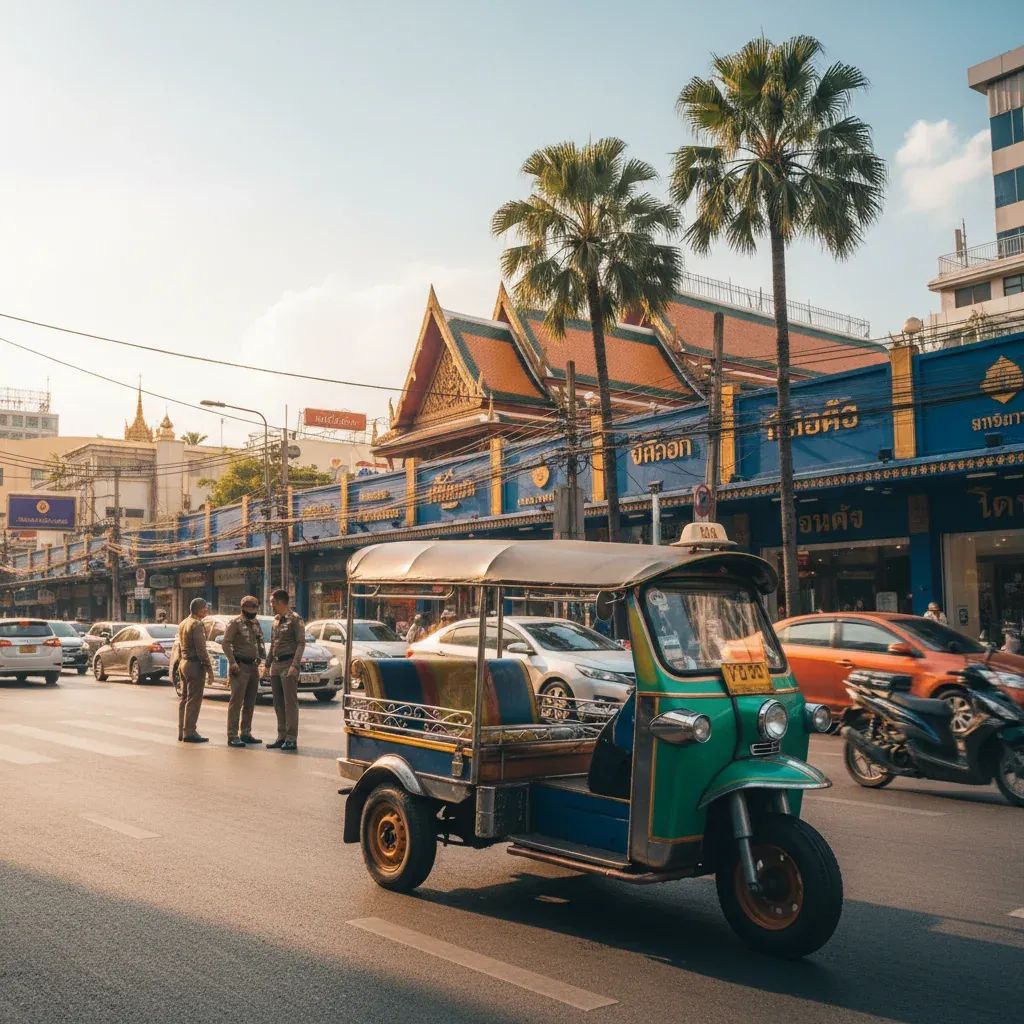
Inner Bangkok's oldest transport icon is facing a regulatory challenge: the Thailand Department of Land Transport has opened a public consultation on draft regulations that would effectively partition the city—permitting electric three-wheelers in heritage zones while restricting combustion engines to outer districts or specific operating windows.
The consultation window runs from July 28 to August 27, 2026, a pivotal moment that will determine the future of Bangkok's iconic tuk-tuk industry. The real question driving Bangkok's tuk-tuk operators is far more immediate: can they afford the transition before policy turns profitable turf into restricted territory?
Why This Matters
The proposal addresses a genuine environmental concern. Bangkok's inner districts—the zones sheltering Wat Phra Kaew, the Grand Palace, and dozens of national monuments—concentrate high tourist volumes and significant vehicular traffic in narrow lanes designed for pedestrians and palace processions. Air quality in these areas regularly spikes above health advisory thresholds, affecting worshipping families, school groups, and residents.
The regulation being proposed creates a straightforward divide: electric tuk-tuks would operate without restriction inside central Bangkok. Gasoline and diesel models would face exclusion, except during limited windows when traffic authorities authorize entry.
The Thailand Ministry of Transport frames this as environmental protection in culturally significant space. Skeptics view it as an economic squeeze—potentially forcing informal-sector drivers into a capital-intensive transition before adequate assistance programs materialize.
The Scale and Affordability Challenge
Bangkok's tuk-tuk industry represents a significant portion of informal-sector employment. Drivers depend on short-distance tourist routes through congested central zones for their primary income. A replacement electric vehicle represents substantial capital investment—far beyond what most informal-sector operators have accumulated. Commercial loans require credit histories many drivers lack. Family savings rarely accumulate at that scale.
The Thai government has committed substantial financial resources to electrification across transport sectors, including dedicated support for tuk-tuk operators. However, bureaucratic processes for disbursement can take weeks or months—timelines that don't align with drivers facing immediate regulatory changes.
Private Enterprise Solutions Emerging
Where government procurement moves slowly, private operators are developing alternatives. Ride-hailing platforms and commercial vehicle lease companies are expanding electric vehicle offerings, providing drivers options that avoid ownership risk, credit scrutiny, and maintenance liability. These private-sector initiatives are scaling more rapidly than government programs, offering immediate pathways for drivers seeking compliance.
Multi-stakeholder partnerships between energy companies, technology platforms, and logistics operators are building charging infrastructure and driver support networks. These collaborations layer financing options, charging access, and training into an emerging ecosystem—though infrastructure remains unevenly distributed across the city.
Bangkok's Broader Electrification Campaign
The tuk-tuk regulation is not isolated policy—it is one component of a capital-wide transport transformation. The Bangkok Metropolitan Administration is pursuing expanded electric bus fleets, upgraded public transit infrastructure, and integrated transport strategies designed to reduce emissions and car dependency.
These initiatives target PM 2.5 particulate matter and greenhouse gas emissions. The 2024–2025 dry season brought hazardous air quality, school closures, and health warnings concentrated among children and elderly residents. Thailand's government has positioned electric transport as central to climate commitments while addressing one of Asia's most visible air crises.
The national target is ambitious: increased electric vehicle penetration across vehicle classes supported by tax incentives, reduced import duties, and public procurement mandates. Domestic battery manufacturing and vehicle assembly is scaling within Thailand's industrial base.
For tuk-tuk drivers, the challenge reduces to a critical question: can replacement vehicles become accessible quickly enough to sustain employment once regulations take effect?
International Precedents: Lessons for Bangkok
London's Ultra-Low Emission Zone, launched in 2019, imposed daily charges on older vehicles in central districts. By 2021, roadside nitrogen dioxide concentrations had fallen substantially. However, the social cost proved visible and concentrated among tradespeople and residents from outer areas who faced operational friction and increased expenses. The policy succeeded environmentally but generated sustained political tension.
Similar programs in other major cities reveal a consistent pattern: financial support and phased timelines matter as much as regulatory ambition. Cities offering upfront capital, guaranteed charging access, and transition windows of 18 to 24 months generally saw smoother adoption. Compressed deadlines or abrupt restrictions generated displacement, informal-sector evasion, and concentrated economic hardship among affected workforces.
Immediate Consequences for Different Groups
Residents and families in inner Bangkok will experience potential improvements: quieter streets, reduced air pollution, and health benefits near temples and heritage sites—particularly relevant for children and elderly residents who frequent these areas.
Tourists may encounter higher transportation costs if electric operators pass capital and maintenance expenses to passengers. The cultural dimension also matters: Bangkok's iconic hand-painted tuk-tuk is a tourism symbol, and some observers worry that vehicle transitions could affect the authentic experience that prompts visitors to use them.
Business owners near tourist zones express concern that reduced tuk-tuk availability during transition could suppress casual visits to peripheral temples, galleries, and restaurants dependent on accessible informal transport. Employment ripples extend beyond drivers to repair shops, fuel vendors, spare-parts traders, and informal financing networks.
Drivers themselves confront the starkest choice. Operators' associations are lobbying for extended phase-in periods, arguing that compressed timelines will force closures before replacement affordability materializes. Some tourism industry groups have proposed alternatives: permit combustion-engine tuk-tuks on weekdays or during lower-pollution periods. The Thailand Ministry of Transport has not publicly responded to these proposals.
The August 27 Threshold: What It Actually Determines
The August 27 consultation deadline is procedurally significant. The Thailand Department of Land Transport will compile feedback, identify implementation obstacles, and potentially revise the draft before submission to the Cabinet for formal approval. The agency has already signaled environmental commitment, yet the consultation provides opportunity for stakeholders to present implementation concerns.
If approved, a notice-and-comment period would precede enforcement. The government intends to coordinate subsidy programs and charging infrastructure development during that interval.
The actual regulatory outcome—whether the rule survives intact or emerges modified by political pressure—will crystallize during the consultation and Cabinet review process, as competing constituencies (drivers, operators, tourism businesses, environmental advocates) present their cases.
The Real Timeline: Between Now and Implementation
For Bangkok's tuk-tuk operators, August 27 is less of a regulatory deadline than a clock starting. How quickly they access replacement vehicles, financing, and charging infrastructure will determine whether transition resembles managed evolution or economic displacement.
Government support programs are real. Private-sector alternatives are operational now, not theoretical. Multi-stakeholder partnerships are building infrastructure simultaneously. International precedent suggests managed timelines are operationally feasible if support mechanisms activate immediately.
Yet timing uncertainty remains structural. A driver without capital cannot remain idle awaiting bureaucratic processes. If regulations take effect before assistance programs reach operational scale, displacement begins immediately—drivers pushed to outer districts where income opportunities are limited, shifted to other roles with inferior economics, or exiting the profession altogether.
The paradox is that Bangkok's most emblematic transport may become invisible not through explicit prohibition, but through economic compression in a transition that was intended to address legitimate environmental concerns but may move too fast for informal-sector participants to navigate safely. Environmental policy and livelihood protection are moving at different speeds. Closing that gap by September remains technically possible. Whether it happens is a political choice that will crystallize during the consultation period ahead.


