
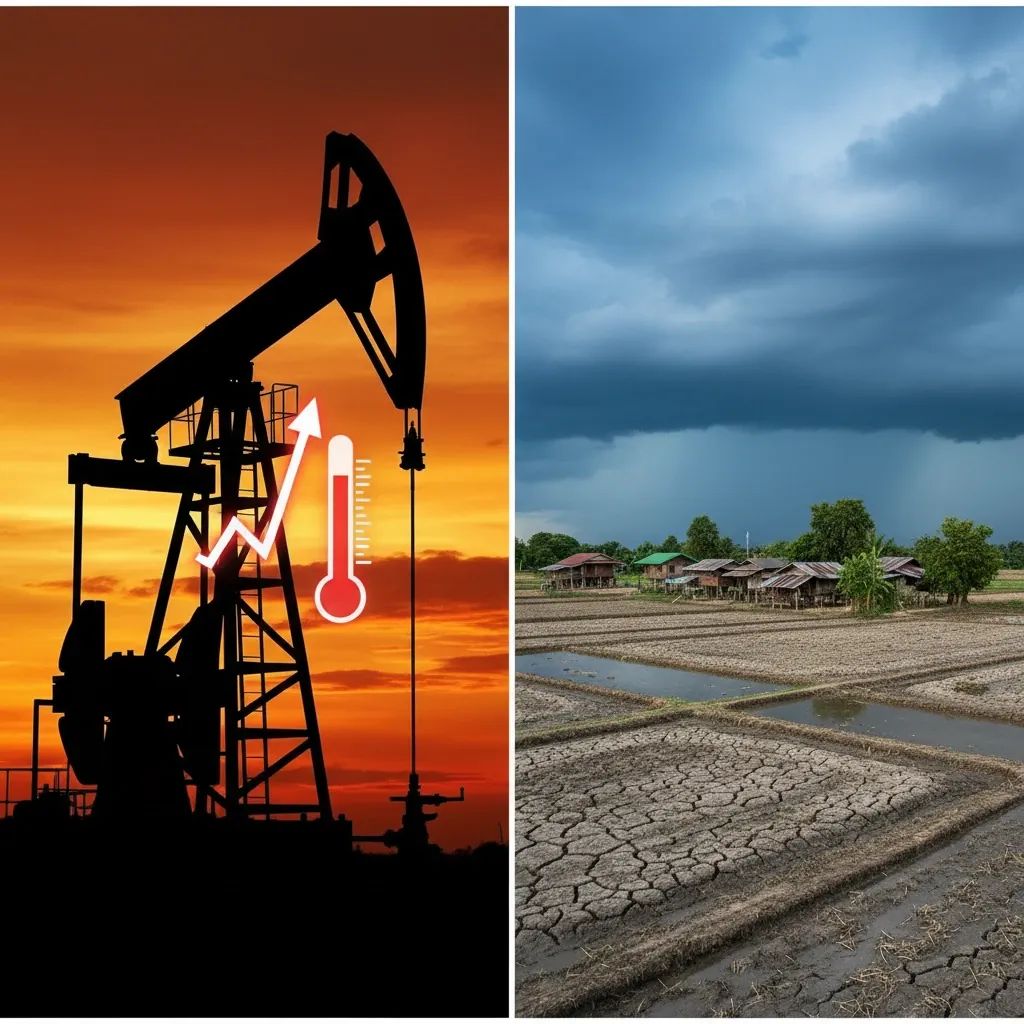
Bangkok and neighboring cities rank among the globe's most at-risk urban heat zones according to new research, prompting government responses across Thailand and Vietnam to prepare for the potential 2026-2027 El Niño cycle. The combination of El Niño intensity, rapid urbanization, and coastal vulnerability has prompted concrete, actionable initiatives across government, agriculture, and infrastructure sectors to manage risks effectively.
Why This Matters
• Heat exposure is quantifiable and actionable: The University of Oxford's 2026 heat-risk framework ranked Ho Chi Minh City, Bangkok, and Samut Prakan as the planet's three most at-risk urban heat environments. For outdoor workers, elderly residents, and families in these cities, this designation unlocks policy-driven interventions—cooling centers, adjusted work schedules, targeted health warnings.
• Water scarcity has known timelines and mitigation pathways: According to the Thailand National Water Resources Office, nationwide reservoir storage stands at 42,000 million cubic meters as of late June—55% capacity. That figure drops to 30% in central provinces, but the government has allocated ฿196.1 billion across 10,127 projects to strengthen supply chains through 2027.
• Agricultural adaptation is increasingly practical: The Thailand Ministry of Agriculture is distributing drought-resistant seed programs and processing low-interest loans for drip irrigation retrofits through district offices now. Early adopters may reduce water consumption by 20-40% and secure processor contracts before potential price volatility in Q4 2026 and Q1 2027.
The Anatomy of Urban Heat: Why These Three Cities Face Greatest Risk
When the University of Oxford assessed 10,000 cities across climate, humidity, population density, and outdoor-labor concentration, the ranking identified Bangkok as the second-highest global heat-risk zone. This classification was driven not by raw temperature alone. Researchers identified a significant public health challenge: the combination of heat, humidity that prevents human sweat evaporation, urban concrete that traps energy, and millions of delivery workers, construction crews, and agricultural laborers operating in peak-heat hours with minimal shade or respite.
Thailand's capital faces a concerning trajectory. Models project Bangkok's average daily maximum may climb to 38.1°C by 2050, with days exceeding 35°C becoming potentially three times more frequent than historical patterns. The 2026 El Niño event, formally confirmed in June and increasingly likely to intensify, is creating conditions—prolonged heat, reduced rainfall, peak dry season timing—that will test urban infrastructure and human adaptation simultaneously.
The challenges are layered. Motorcyclists and construction crews cannot pause work during 11 AM to 3 PM heat peaks without income loss. Public cooling infrastructure remains limited. The Bangkok Metropolitan Administration has recently begun considering whether to designate extreme heat as an official disaster category—a status that would unlock emergency funding for cooling centers in every district. Currently, such refuges do not exist despite the city's No. 2 global ranking. Addressing this gap between risk classification and infrastructure response is essential for protecting vulnerable populations.
Water: The Challenge That Will Shape 2027
While heat captures headlines, water management poses significant concerns for household stability and economic output.
The Thailand National Water Resources Office released weekly public reporting beginning July 2026, marking a transparency shift. The numbers warrant attention. According to their data, nationwide reservoir storage stands at 42,000 million cubic meters—adequate only if rainfall remains near-normal through the remainder of 2026 and into early 2027. Climate forecasts instead suggest potential 10-40% below-normal rainfall for the next six months. Central region dams are especially exposed, with some at 30% capacity, approaching warning-threshold territory.
The Thailand Royal Irrigation Department has shifted operational doctrine toward "Dynamic Operation Curves"—flexible dam release schedules that prioritize capturing monsoon water over fixed discharge protocols. This tactical adjustment provides additional time but cannot guarantee sufficiency if rain volumes fall below current forecasts.
Groundwater expansion becomes important. The government has fast-tracked 858 community-level well projects to provide local supply resilience, with capital disbursement beginning through district agriculture offices in August and September. For fiscal 2027, ฿196.1 billion has been allocated to an integrated water infrastructure program encompassing irrigation upgrades, storage expansion, and distribution modernization. However, most projects are not expected to deliver capacity additions until mid-2027—potentially after peak demand periods. The Eastern Economic Corridor, Thailand's industrial anchor, will add 909 million cubic meters of storage capacity once 39 development projects are completed—again, supply arriving after peak demand windows.
For urban households in Bangkok and provincial centers, water rationing has shifted from speculation to contingency planning. The Metropolitan Waterworks Authority has not announced mandatory cuts, but preparation for managed supply reduction is underway. Agricultural areas—rice paddies, sugarcane plantations, cassava fields—may face rationing first and most severely, creating cascading pressure on rural incomes already stressed by potential crop losses.
Agricultural Damage and the Food Price Outlook: Numbers That Matter
Thailand produces one-third of global rice exports. When El Niño combines with weak water reserves and heat stress, the potential effects warrant serious attention.
Krungthai COMPASS, research arm of Thailand's largest bank, projects potential rice sector losses at ฿43 billion, with sugarcane and cassava contributing another ฿19 billion in combined potential damage. This translates to estimated farmer household income potentially contracting 8% year-over-year in 2026—the steepest decline since the 2015-2016 El Niño cycle, when rural debt spiked and farm abandonments accelerated for years afterward. Rural Thailand has not fully recovered economically from that cycle; compounding stress now creates multi-year household vulnerability.
The downstream effect may ripple outward with predictable patterns. Rice prices are forecast to potentially climb 5-15% in Q4 2026 and Q1 2027. For urban households spending 20-30% of income on staples, this may translate to genuine purchasing power concerns. Industrial processors relying on local cassava, corn, and sugar feedstock may face higher raw-material costs precisely when domestic supply tightens—a margin squeeze with potentially limited relief.
The Thailand Ministry of Agriculture and Cooperatives has ordered provinces to implement three-tier drought protocols. For farmers, the tactical response is available now:
• Pivot to drought-tolerant crop varieties: Short-cycle vegetables and water-efficient rice cultivars reduce input risk. District agriculture offices are distributing seed programs targeting 25-40% water reduction per unit of output.
• Invest in drip irrigation retrofits: The government is offering low-interest loans for system installation. Adoption rates are historically uneven—wealthier farmers may move faster, subsistence farmers often lag—but the window to retrofit before planting decisions are finalized is now, in August and September, not December.
• Lock in forward contracts with processors: Secure pricing agreements before potential harvest volatility drives costs upward. Cooperatives are facilitating bulk negotiations to provide broader access for smaller producers.
The government's extension services are emphasizing urgency. Delay until dry season onset may result in missed opportunity and higher borrowing costs when capital is most constrained.
Rural income inequality may widen over the cycle, as larger, capitalized producers typically adopt technology faster and access credit easier than subsistence households. This is not inevitable inequality—it is predictable from historical patterns—but the Ministry of Agriculture's targeted support for smaller producers through agricultural cooperatives is designed to mitigate this dynamic, though execution and uptake remain variable.
Vietnam's Situation and the Mekong's Vulnerability
Across the border, Vietnam's Ministry of Agriculture and Rural Development has issued drought warnings for the central highlands, central coast, and Mekong Delta, regions where rainfall has already declined 25-50% below seasonal norms since January 2026. The Red River system may experience 10-25% water deficits between May and July. Ho Chi Minh City—globally ranked as the highest heat-risk zone—is managing water supply concerns alongside elevated heat indices.
This matters to Thailand because supply chain effects flow bidirectionally. If Vietnam's rice harvest declines significantly, global prices may spike faster and international competition for Thai exports could intensify. If the Mekong's water levels fall, it affects downstream fisheries and irrigation in northeastern Thailand, where millions of smallholder farmers depend on dry-season seepage and coordinated dam releases. Vietnam's shift toward proactive management—adjusting planting schedules and coordinating dam releases with World Bank advisers—signals the scale of regional preparedness efforts. The Mekong River Commission, binding both nations, is convening coordination sessions to synchronize water releases and agricultural planning.
One notable consideration: warmer sea surface temperatures typically reduce typhoon frequency but may intensify storms that do form. Both Vietnam and Thailand could experience contradictory hazard patterns—prolonged drought punctuated by potential flash floods when storms materialize. This variable risk pattern requires adaptive management approaches.
Wildfire and Transboundary Haze: A Historical Risk Returns
El Niño combined with peatland forests creates conditions similar to 2015-2016, when transboundary haze significantly impacted air quality.
Indonesia, Malaysia, and peatland regions within Thailand contain vast wetland forest areas. When dry conditions persist, wildfire risk increases substantially. Peat burns slowly and produces dense smoke—not occasional seasonal haze but sustained air quality degradation. The ASEAN Specialised Meteorological Centre forecasts above-average temperatures across 80-100% of the region through September 2026, with highest probability over Indonesia, Malaysia, and northern Vietnam. Peatland fire risk rises accordingly.
Thailand experienced severe air quality issues in 2015-2016, when PM2.5 levels in Bangkok regularly exceeded 200-300 micrograms per cubic meter—more than six times the World Health Organization guideline. Schools closed. Hospital respiratory admissions increased 20-30% above baseline. Outdoor workers faced significant challenges. A repeat cycle would combine heat stress with air quality concerns, creating compound health risks for vulnerable populations.
The ASEAN region lacks fully integrated monitoring and early-warning systems for transboundary haze at operational scale. Malaysia has deployed cloud-seeding aircraft in drought zones—a tactical intervention that delivers limited precipitation. Real prevention requires sustained commitment: controlled burns in preceding years, peatland restoration, enforcement against illegal clearing, and cross-border monitoring. Budget cycles rarely sustain such multi-year horizons, which is why prevention typically lags behind crisis response.
Practical Steps for Thai Residents
Water conservation shifts from suggestion to necessity. The National Water Resources Office publishes weekly reservoir levels and drought risk maps by province at www.rbd.go.th. Residents in central and northeastern provinces should establish baseline consumption patterns immediately:
• Shorten shower duration and run full-load laundry cycles. These reduce supply consumption during lean months without requiring significant lifestyle changes—just efficiency adjustments.
• Garden watering should transition from daily to every-other-day cycles, or pivot to drought-tolerant landscaping. Gray-water recycling—reusing shower water for plants—transitions from environmental consideration to practical household resource management.
• Households in Bangkok and peripheral districts should prepare for potential rationing notifications. Maintaining backup storage containers (bathtubs, clean containers) in advance provides resilience without panic purchasing.
Health precautions become important. The Thailand Department of Disease Control is monitoring heat-related health risks, with neighboring Philippines and Malaysia having activated health guidance. Outdoor workers—construction crews, farm laborers, delivery personnel—should coordinate with employers now:
• Limit outdoor activity between 11 AM and 3 PM when heat indices peak.
• Increase water intake systematically. Heat exhaustion symptoms—dizziness, nausea, weakness, confusion—develop quickly; prevention through hydration is more effective than treating collapse.
• Request shaded rest areas or modified schedules from employers. Many construction firms in Bangkok are experimenting with 6 AM to 11 AM work schedules to reduce afternoon exposure.
Vulnerable populations (elderly, children, those with chronic conditions) face increased risk. Hospital admissions for heat-related illness typically increase 20-30% during severe hot seasons. Healthcare systems are preparing for increased demand, but capacity remains finite. Early intervention and prevention are the most reliable protections.
Food prices require strategic household planning. Bulk purchasing of staples—rice, cooking oil, sugar, canned vegetables—in September and October, before potential Q4 price increases, provides household budget protection. For households dependent on fixed incomes (retirees, government workers on stable salaries), this is practical budget planning. A 5-15% food price increase compounds significantly for fixed-income households in ways wage earners may not experience as acutely.
Farmers should act now. District agriculture offices are distributing drought-resistant seed programs and processing loan applications for drip irrigation systems. Applications submitted in August and September will disburse before peak dry season when capital access is most constrained. Waiting until December typically results in missed opportunity and higher borrowing costs when demand removes negotiating flexibility.
The Infrastructure Response Underway: Investment and Timeline
The Thailand government's response reflects serious commitment. The fiscal 2027 water infrastructure budget of ฿196.1 billion represents significant capital allocation across 10,127 projects. Scale matters in relation to demand. Thailand faces a water management challenge that no single project can solve completely. The solution is distributed: multiple complementary interventions create systemic resilience.
The Eastern Economic Corridor's 39 development projects are expected to deliver 909 million cubic meters of new storage capacity, supporting industrial water security and agricultural supplementation. These projects are on accelerated timelines, though completion spans through mid-2027, meaning peak demand periods may arrive before all relief capacity is available.
Urban planners are exploring passive cooling—designs that reduce building temperatures without energy-intensive air conditioning. Reflective roof coatings can potentially cut cooling demand by 35-70%. Tree canopy expansion and deliberate "wind corridors" between high-rises channel sea breezes inland; Tokyo has successfully deployed this strategy, integrating urban forest management into building codes and district planning. These incremental improvements compound across citywide implementation.
The Bangkok Metropolitan Administration's consideration of extreme heat as an official disaster category is potentially consequential. Designation would unlock emergency funding for cooling centers in every district, providing refuge during peak heat hours. Schools, temples, community centers, and public buildings can serve this function with minimal retrofit. Operationalizing these spaces before peak heat periods in 2027 represents an important policy priority.
For the agricultural sector, the Thailand Ministry of Agriculture's recommendations provide practical guidance:
Adopt water-efficient crops and drought-tolerant rice varieties to reduce input dependency.
Improve irrigation efficiency via drip systems to reduce per-unit water consumption and cost.
Negotiate forward planting contracts with processors to secure pricing and reduce harvest-time uncertainty.
Participate in government drought-assistance programs for accessible capital and seed access.
These measures do not prevent losses; they reduce impact and preserve farmer viability through the cycle. The key variable is timing—early-cycle adoption maximizes benefit; late-cycle adoption minimizes returns.
Regional Coordination and Food Security: The ASEAN Perspective
No single government contains El Niño effects completely. The ASEAN Food Security Reserve Board is monitoring strategic commodities—rice, corn, soybeans, sugar—as member states prepare for potential supply adjustments. Malaysia and the Philippines have already increased rice import quotas to build emergency stockpiles. Indonesia may adjust its rice trade position if domestic conditions warrant, potentially shifting global price dynamics and Thailand's export circumstances.
South Korea is supporting ASEAN in developing a real-time food security information system, enhancing early warning and policy coordination. This reflects recognition that a strong El Niño could generate inflation pressures across Asia's rice-dependent economies, affecting currency markets and supply-chain stability. Information-sharing at regional scale supports more coordinated policy response.
The Mekong River Commission, binding Thailand, Vietnam, Cambodia, and Laos, is convening coordination sessions to synchronize water releases from upstream dams and coordinate agricultural planning. Thailand's northern dams significantly influence Mekong flow; coordinated management reduces destabilizing effects on downstream regions.
2027 Outlook: Uncertainty and Preparedness
If the current El Niño reaches significant intensity, scientists estimate it could contribute to 2027 potentially ranking among notably warm years globally. For Thailand and Vietnam, this may translate to agricultural stress, elevated electricity demand as hydropower output potentially falls due to lower reservoir levels, and public health concerns from heat-related illness concentrated among outdoor laborers and older populations.
Uncertainty remains substantial. The Thailand Meteorological Department and Vietnam's National Hydro-Meteorological Service update forecasts weekly as Pacific Ocean data refine El Niño intensity projections. Forecast confidence windows remain wide—the difference between manageable stress and severe stress depends on rainfall timing and volume between now and November 2026. No forecast model can predict this with certainty.
Residents and businesses cannot wait for certainty. The adaptive measures outlined above—water conservation, health preparedness, crop adjustments, food stocking, infrastructure investment—operate on the assumption that current forecasts are directionally accurate. If forecasts prove incorrect and 2026-2027 emerges wetter and cooler, these measures impose only marginal cost. If forecasts prove accurate, delay is difficult to reverse and consequences compound into challenges that advance preparation could have reduced.
Preparation is more efficient than reactive response. Adaptation is more cost-effective than recovery. The gap between these two states is action, and the window for action is now—August 2026 through December 2026—before peak dry season forces reactive scrambling.
The Convergence of Risks Requiring Coordinated Response
The combination of El Niño, rapid urbanization, coastal vulnerability, and climate baseline warming has created systemic risks that no single agency or border can address alone. Thailand's water infrastructure investments, Vietnam's early-warning systems, and ASEAN's coordinated food monitoring represent necessary and collectively significant responses. They are not sufficient—sufficiency would require global emissions reductions that remain politically challenging—but they represent the difference between managed difficulty and uncontrolled disruption.
What is certain: the months ahead will test infrastructure, policy, and community resilience simultaneously. The tools to navigate that test are available, the cost of deploying them is known, and the cost of delay is measured in household income affected, farm viability at risk, and human welfare concentrated among those least able to absorb additional stress. Whether 2026-2027 emerges as effective crisis management or demonstrates climate adaptation will depend on decisions made now—decisions that communities, policymakers, and farmers have the capacity to influence through immediate action.


