
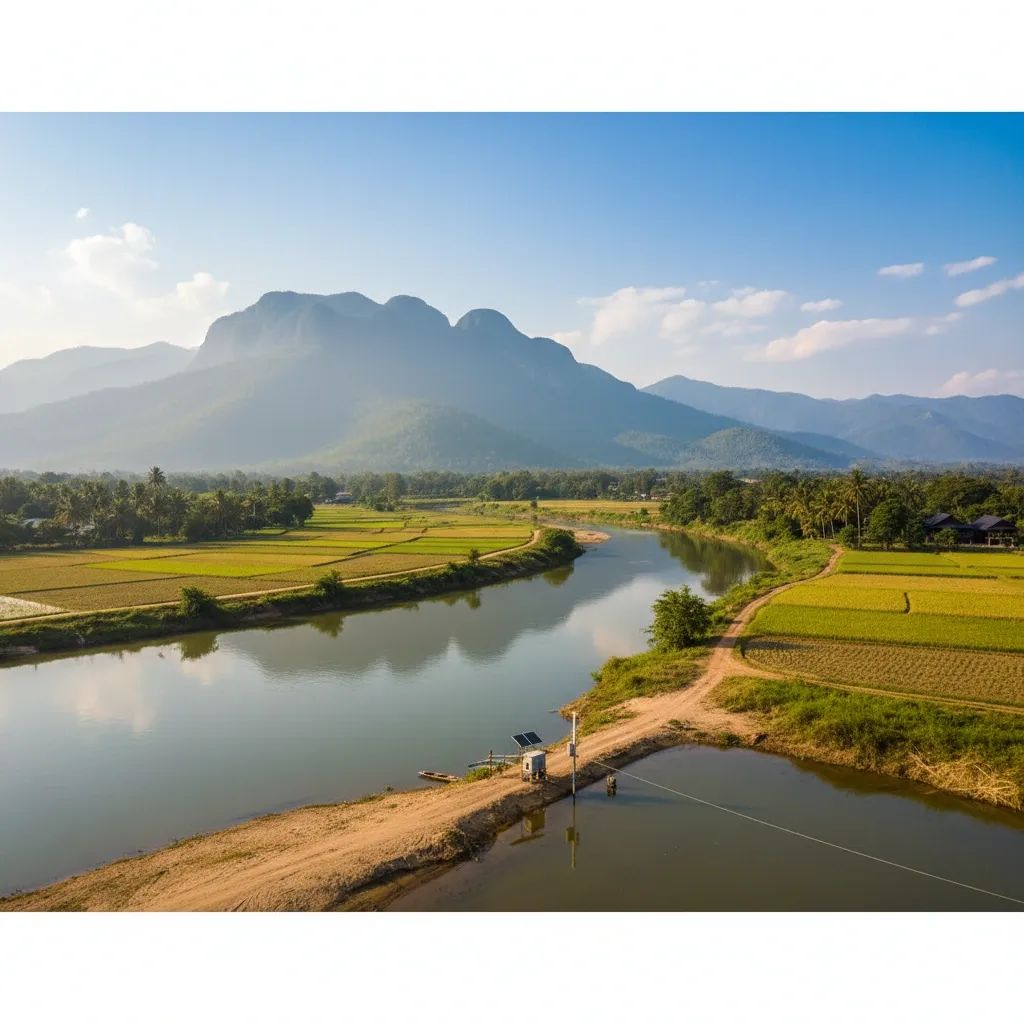
The Thailand Pollution Control Department and Chiang Rai provincial administration are deploying advanced water monitoring infrastructure across the province's four main river systems, a response to persistent arsenic contamination traced to unregulated mining operations across the border in Myanmar's Shan State. The initiative combines satellite surveillance, real-time sensors, and sophisticated laboratory analysis to safeguard drinking water, agriculture, and the region's tourism economy.
Why This Matters
• Arsenic levels in the Kok, Sai, and Mekong rivers have exceeded the safety threshold of 0.01 mg/L, with some readings reaching 0.016 mg/L during recent monitoring rounds.
• Residents along the Kok River are showing elevated arsenic in their bodies, with symptoms including numbness, muscle weakness, and skin irritation.
• The province is fast-tracking underwater sediment trap weirs designed to filter arsenic-rich particles before water reaches communities.
• A three-year monitoring program will track heavy metal accumulation in the regional food chain.
The Contamination Crisis
Chiang Rai's water safety concerns center on four major rivers—the Kok, Sai, Mekong, and Ruak—though the Ruak has consistently met safety standards. Recent water quality analyses have revealed troubling patterns. The Kok River showed arsenic concentrations of 0.011–0.012 mg/L between Tha Ton Bridge and the Mae Nawao–Tha Ton Friendship Bridge during earlier monitoring. All monitoring stations along the Sai River registered elevated arsenic, averaging 0.011–0.014 mg/L. Meanwhile, smaller tributaries like the Fang, Korn, and Lao rivers maintained acceptable heavy metal levels during recent periods.
Subsequent monitoring rounds have shown concerning trends. The Kok River recorded arsenic levels from 0.013-0.016 mg/L at multiple points, while the Sai River consistently showed elevated readings of 0.011-0.015 mg/L across all checkpoints. The Mekong River also exceeded standards at the Golden Triangle permanent border crossing and the Provincial Waterworks Authority's Mae Sai branch water intake, with concentrations reaching 0.014-0.015 mg/L.
Environmental investigators have identified the suspected source: gold and rare earth mining operations in Myanmar's Shan State, where waste materials containing arsenic and cyanide reportedly flow into waterways that cross into northern Thailand. The rivers have exhibited unusual turbidity and a murky red-brown color, particularly near border areas, even during the dry season when clarity normally improves.
High-Tech Response Infrastructure
Rather than building a single centralized facility, Chiang Rai authorities are upgrading multiple specialized laboratories and deploying cutting-edge monitoring systems throughout the watershed. The Medical Sciences Department and Chiang Rai provincial administration now utilize Atomic Absorption Spectroscopy (AAS) and Inductively Coupled Plasma Mass Spectrometry (ICP-MS) for precise detection of arsenic and other heavy metals at parts-per-billion concentrations.
The Provincial Waterworks Authority Regional Office 9 operates an accredited testing facility at the Wang Khum Water Treatment Plant in Mueang Chiang Rai, ensuring potable water meets World Health Organization standards. Mae Fah Luang University and the Medical Science Center are being developed into primary local reference laboratories, reducing the need to send samples to Bangkok for analysis and cutting turnaround times from weeks to days.
The Department of Water Resources is implementing the most ambitious technological upgrade. Satellite imagery and geospatial technology now pinpoint pollution sources in real time, while plans call for CCTV cameras along riverbanks to monitor flow and turbidity continuously. Acoustic Doppler Current Profiler (ADCP) units will be installed at multiple locations, integrated with a central cloud service to track water velocity, depth, and sediment movement.
Most significantly, engineers are fast-tracking the installation of underwater sediment trap weirs in the Kok River. These specialized structures are designed for subsurface sediment filtration, capturing arsenic-laden particles before water reaches downstream communities. The technology represents a proactive engineering solution rather than relying solely on monitoring and warnings.
What This Means for Residents
Chiang Rai authorities have established a coordination center to centralize data collection and eliminate duplicated efforts among government agencies, universities, and private laboratories. Researchers and the Pollution Control Department are conducting environmental and biological sampling following strict protocols, with ongoing analysis to track contamination trends.
For residents and visitors, the practical implications are important. The Pollution Control Department has advised anyone using river water for household purposes to process it through quality improvement systems before consumption.
Current Water Safety by District:
Mae Sai District: Tap water supplied through municipal distribution is considered safe due to treatment protocols at the Provincial Waterworks Authority facility. However, direct contact with the Mae Sai River should be minimized.
Other Districts (Chiang Rai Mueang, Chiang Khong, Wiangpapao): Tap water from municipal supplies meets safety standards. However, households relying on private wells or direct river water intake should have their water tested immediately.
Rural and Agricultural Areas: If your home or farm relies on untreated river water, install a water filtration system before consumption.
Recommended Actions for Residents:
For Drinking Water:
• If using municipal tap water: Continue normal use—it undergoes treatment to remove arsenic
• If using well water or private sources: Have your water tested by the Provincial Waterworks Authority (contact: Provincial Waterworks Authority Regional Office 9, Wang Khum Water Treatment Plant, Mueang Chiang Rai)
• Consider installing home water filtration: Reverse osmosis (RO) systems are effective against arsenic and are widely available in Chiang Rai
• Bottled water is a safe interim option while testing is arranged
For Household Use:
• Minimize direct contact with river water for bathing, laundry, or gardening
• If using river water for any purpose, filter it through a quality improvement system first
• Keep children and pets away from direct river contact
For Water Testing:
• Residents can submit water samples to: Provincial Waterworks Authority Regional Office 9, Wang Khum Water Treatment Plant, or Mae Fah Luang University Laboratory
• Testing typically takes 3-5 working days
• Cost is nominal for basic arsenic analysis
For Restaurants and Food Establishments:
Food businesses should verify their water source and have it tested if sourced from wells or river intakes. Municipal tap water is safe for use in food preparation. If your establishment uses untreated water, installation of appropriate filtration is recommended.
Agriculture presents a more complex challenge. Farmers who rely on river water for irrigation face potential contamination of crops, though the full extent of food chain accumulation remains under study. The province is developing a risk map to distinguish whether arsenic originates from agricultural runoff, mining discharge, or natural geological sources—critical information for determining long-term mitigation strategies. Farmers drawing irrigation water from the Kok and Sai rivers should:
• Have their water source tested
• Consider installing sand filtration or settling ponds to reduce sediment and potentially reduce arsenic levels
• Consult with provincial agricultural extension officers (available in all districts) about crop-specific risks and monitoring
Tourism operators should note that Chiang Rai officials have emphasized avoiding public panic that could damage the regional economy. However, activities involving direct water contact, such as river swimming or white-water rafting, carry heightened risk until monitoring confirms sustained improvement in water quality. Operators are encouraged to use alternative activities or ensure proper safety protocols with clients.
Regional Best Practices and Long-Term Strategy
Thailand's approach to river management in other provinces offers potential models for Chiang Rai. Bangkok employs automated real-time monitoring stations with self-cleaning sensors that measure dissolved oxygen, turbidity, pH, electrical conductivity, and both Chemical and Biochemical Oxygen Demand. Saraburi province uses pontoon buoys equipped with water quality sondes that trigger alarm systems when parameters exceed safe thresholds.
The Thachin and Bang Pakong River Basins have implemented integrated basin-wide management that considers water quality, aquatic resources, land development, and stakeholder participation. This holistic approach contrasts with Chiang Rai's current emphasis on monitoring specific contamination hotspots, suggesting room for strategic expansion.
Chiang Rai's three-year monitoring commitment will track heavy metal accumulation through the ecosystem, from sediment to aquatic life to human consumption. Academics have expressed particular concern about long-term health impacts for communities along the Kok River, where some individuals already exhibit symptoms consistent with chronic arsenic exposure.
The transboundary nature of the contamination complicates resolution. While Thai authorities can upgrade monitoring and filtration infrastructure within national borders, addressing the root cause requires diplomatic coordination with Myanmar to regulate mining operations in Shan State. The Department of Water Resources is leveraging satellite technology to document pollution sources, creating evidence that could support international negotiations or regional environmental agreements.
The Agriculture and Export Angle
Chiang Rai's agricultural sector—known for rice, tea, coffee, and specialty crops—depends on reliable water quality for both irrigation and international market reputation. Heavy metal contamination jeopardizes export certifications that require compliance with stringent food safety standards in markets like the European Union, Japan, and the United States.
Provincial authorities have not yet issued comprehensive guidance on which crops or growing regions face elevated risk, though the ongoing risk-mapping initiative should provide clarity within the three-year study period. Farmers in watersheds downstream from the Kok-Sai river confluence face the highest potential exposure, while those irrigating from smaller tributaries that tested within safety standards may continue operations with standard monitoring.
The province's famous tea plantations, primarily concentrated in higher elevations with independent water sources, appear less vulnerable than lowland rice paddies that draw directly from major rivers. However, processors and exporters should anticipate increased scrutiny from international buyers and potentially more frequent testing requirements for heavy metal content in finished products.
For Thailand's northern tourism economy, water quality directly impacts activities ranging from river cruises on the Mekong to agritourism experiences that highlight the region's agricultural heritage. Prolonged contamination could shift visitor perceptions of Chiang Rai from pristine mountain landscapes to an environmentally compromised destination, making swift resolution both an environmental and economic imperative.
Current Status and Next Steps
Is it safe to drink tap water? Yes, municipal tap water in Chiang Rai meets safety standards and undergoes treatment. Direct river water use is not recommended without filtration.
When might the situation improve? The three-year monitoring program is designed to track trends and implement long-term solutions. The underwater sediment trap weirs on the Kok River should help reduce contamination levels within the next 12-18 months, pending completion of installation and testing.
Where to find updates and official guidance:
• Chiang Rai Provincial Administration: Provincial Government Building, Muang District
• Pollution Control Department Regional Office: Available through the provincial administration
• Provincial Waterworks Authority: Wang Khum Water Treatment Plant, Mueang Chiang Rai
• Contact the provincial hotline or visit local district offices for specific concerns
Who to contact with concerns:
• For water quality testing: Provincial Waterworks Authority Regional Office 9
• For health concerns related to arsenic exposure: Chiang Rai Hospital or provincial health office
• For agricultural impact questions: Provincial Agricultural Extension Office (available in all districts)


