
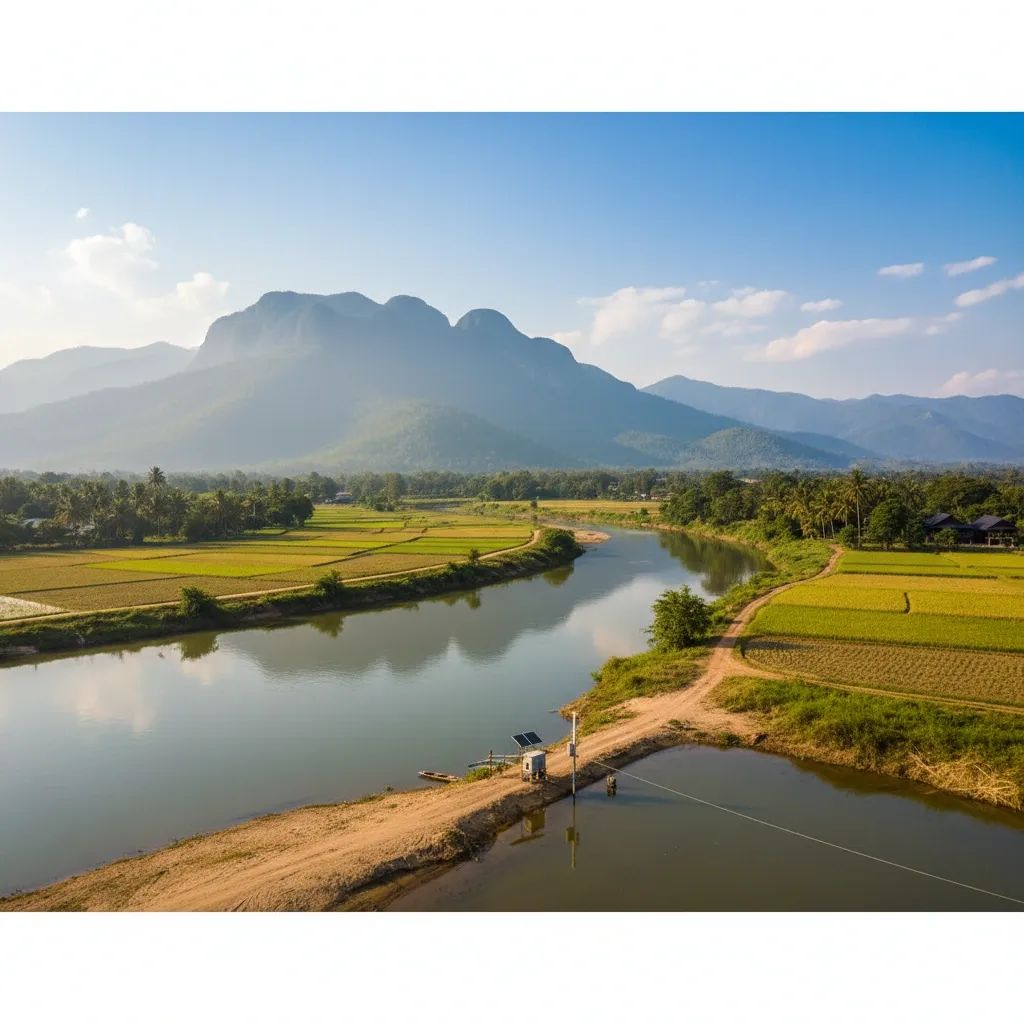
Northern Rivers in Crisis: How Industrial Mining Far Away Is Poisoning Thai Waters
[As of March 2026]
The Thailand Ministry of Public Health has confirmed elevated arsenic in the bloodstreams of riverside residents in Chiang Rai, marking the first documented cases where upstream mining operations have measurably contaminated local populations. This development transforms what was previously framed as an environmental monitoring issue into an immediate public health emergency requiring direct intervention on wages, property values, and daily consumption patterns.
Immediate Guidance for Those Living in Affected Watersheds
For residents and expats in affected areas, practical action steps should take priority:
Water ConsumptionResidents in Muang Chiang Rai, Chiang Saen, and surrounding townships served by municipal supply systems can safely consume tap water—filtration systems remove heavy metals. Those relying on private groundwater should commission independent testing through the provincial public health office at household expense. Direct river draws are categorically unsafe.
Agricultural UseThe Department of Agriculture Extension explicitly advises against using untreated river water for irrigation. Drip systems fed by municipal or tested groundwater offer safer alternatives. Crops in flood zones receiving direct river inflow carry quantified risk. Farmers uncertain about their water source should consult extension officers before planting, particularly for leafy vegetables and rice.
Food SafetyThe Ministry of Public Health has issued formal warnings against consuming freshwater fish from the Kok and Sai rivers. Aquaculture substitutes or compensation applications through provincial disaster relief funds represent practical alternatives for fishing-dependent households.
Property and Real EstateRiverside properties within 500 meters of affected rivers have experienced informal valuation reductions. Buyers now demand environmental due diligence reports, and lenders impose elevated scrutiny. If selling, expect extended negotiation periods. If purchasing, commission an independent environmental assessment and verify water source provenance.
Economic PivotingTourism and hospitality operators dependent on river-based revenue should consider marketing reorientation toward Doi Tung, Wat Rong Khun, highland trekking, and local cultural experiences. Hill tribe tourism and agritourism ventures have successfully offset water-dependent revenue losses in pilot areas.
For Expats: Legal and Residency ConsiderationsExpats should verify whether property insurance covers environmental contamination claims—many policies exclude such damage. Consult with insurance brokers familiar with cross-border pollution liability. Long-term visa holders should confirm that relocation due to health emergencies may qualify for extension documentation with immigration authorities. Lease agreements signed before contamination disclosure may contain termination clauses; review lease terms with legal counsel familiar with Thai property law regarding force majeure circumstances.
Why This Matters
• Residents using private wells or direct river draws face unquantified health risks — municipal tap water remains compliant with safety standards, but groundwater testing falls on individual households at their own expense.
• Riverside property values have experienced informal declines, with mortgage lenders now imposing stricter criteria within 500 meters of contaminated rivers, extending sales timelines.
• Fishing, agriculture, and tourism revenue streams are affected — buyers show reluctance toward local produce and river bookings have declined as residents adapt to contamination awareness.
• Sediment cores show contamination nine times above safety thresholds, indicating a persistent "time bomb" that will resurface during monsoon floods when toxins redistribute downstream.
The Transboundary Extraction Machine
Who Controls the Mines
More than 20 active rare-earth and precious metal mining operations dot the headwaters of rivers feeding Thailand's northern provinces. These sites operate primarily in Myanmar's Shan State, where Chinese-backed investment consortiums and local armed militia extract minerals using methods explicitly prohibited under Thai law: in-situ leaching (injecting solvents directly into ore deposits) and heap leaching (stacking ore and washing it with chemicals). The by-products—cyanide, mercury, and heavy metals—percolate directly into aquifers and surface flows.
The Jurisdiction Problem
The core problem is jurisdictional collapse. Armed militia control most major mining zones in Shan State, placing them beyond the regulatory reach of Myanmar's central government. Thailand cannot negotiate with groups that are not state actors, and China has no legal obligation to enforce environmental standards on investments made abroad. The result: an industrial apparatus operating in a governance vacuum, releasing contaminants that affect downstream populations without regulatory oversight.
Contamination Documentation
Testing by Chiang Mai University and Mae Fah Luang University traced arsenic along the entire Kok River corridor from Mae Ai district in Chiang Mai to Chiang Saen in Chiang Rai. The Sai River, a tributary system feeding the Kok, recorded peak arsenic readings of 0.05 milligrams per liter—five times the ecosystem safety threshold. The Ruak River, which drains into the Mekong, shows similar patterns in both water and riverbed sediment.
Health Signals and Bioaccumulation
Initial health screenings conducted by the Thailand Ministry of Public Health in February 2026 flagged 17 residents with elevated urinary arsenic levels above comparative standards. One individual recorded dangerously high concentrations; the remaining 16 exceeded baseline thresholds. Symptoms reported across affected communities include skin rashes, peripheral numbness, hyperpigmentation (colloquially termed "black fever"), gastrointestinal distress, and severe abdominal pain. Children, pregnant women, and elderly populations face heightened vulnerability.
A spike in diarrhea cases—1,555 logged in January 2026 across Muang Chiang Rai and Chiang Saen—has not been formally linked to heavy metal exposure by the Ministry of Public Health, though timing and geography suggest correlation. Non-human populations show visible stress: fish kills have recurred since March 2025, and elephants at sanctuaries near the Kok River developed skin infections consistent with heavy metal dermatitis.
The biological pathway is indirect but cumulative. Fish tissue samples from April 2025 showed bioaccumulation of arsenic and lead, particularly in bottom-feeding species. Farmers irrigating with contaminated water deposit metals into soil, where they concentrate in root systems of leafy greens and rice. The food chain amplification occurs silently, over months.
Government Response: Monitoring Without Resolution
The Thailand Cabinet has not declared contamination a national emergency, a designation that would unlock rapid-response funding and administrative streamlining. Instead, the Ministry of Natural Resources and Environment launched a five-year surveillance program in early 2026, involving biweekly water sampling and monthly sediment analysis at 23 monitoring stations across northern river basins.
Pilot Interventions Underway
The Pollution Control Department is piloting a silk-fabric filtration system in the Kok River adapted from Japanese water treatment technology. The six-month test period aims to capture suspended sediment and prevent toxic particle re-suspension during monsoon season. Expansion to other rivers depends on pilot success—a timeline that may stretch years.
The Department of Water Resources installed real-time CCTV monitoring at border crossing points to detect water discoloration events as they occur, providing early warning for downstream communities. This is a detection mechanism, not a remediation strategy.
The Sediment Trap
Building Structural Risk
Beneath the surface, a critical problem is building. Riverbed sediment cores extracted from the Kok Basin in September 2025 revealed arsenic concentrations nine times higher than aquatic ecosystem safety standards. This "legacy contamination" poses severe re-suspension risk during monsoon floods when river currents stir bottom deposits and redistribute toxins downstream.
Remediation Challenges
Full sediment remediation in the Kok basin would cost upwards of 5 billion baht over a decade and requires dredging operations currently unfunded and unscheduled. Without large-scale intervention, contamination will cycle through seasonal flare-ups tied to rainfall intensity. Academic models indicate that without upstream source control—halting or fundamentally reforming mining practices—sediment contamination will accumulate faster than natural attenuation can reduce it.
The Ministry of Natural Resources and Environment has not disclosed whether it is exploring legal action against upstream operators or trade restrictions targeting mineral imports linked to polluting operations. The institutional silence suggests neither option is being actively pursued.
The Diplomatic Impasse
Thailand's Ministry of Foreign Affairs has engaged Myanmar and China through bilateral channels and the Mekong River Commission (MRC) framework. In January 2026, Thai officials requested access to mining sites in Shan State for joint environmental audits—a proposal that remains pending. The fundamental obstacle persists: armed groups operate the mines, and Myanmar's government lacks enforcement authority over militia-controlled territory.
Civil society organizations including Greenpeace Thailand and Ecological Alert and Recovery – Thailand (EARTH) have called on ASEAN to adopt a binding ASEAN Environmental Rights Convention (AER) establishing legal liability for cross-border pollution. The ASEAN Ministerial Meeting on Minerals in February 2026 prioritized critical mineral supply chains and investment promotion over transboundary pollution concerns. The convention remains unsigned.
The Senate Committee on Environment held hearings in late February 2026, with Chiang Rai senators urging emergency budget allocation for sediment removal, alternative water infrastructure, and expanded health monitoring. No funding has been announced as of early March 2026.
Community-Led Accountability Efforts
The Network to Protect the Kok, Sai, Ruak, and Mekong Basins—18 community organizations across Chiang Rai and Chiang Mai—staged a 1,500-person rally in June 2025 demanding an immediate moratorium on upstream mining and establishment of a community-managed water quality monitoring center in Chiang Rai. The coalition argues that official testing is infrequent and opaque, proposing instead to train local volunteers using low-cost field kits for independent sampling.
The Chiang Rai Health Assembly adopted Health Impact Assessment (HIA) tools to document illness patterns and correlate them with contamination hotspots. Preliminary findings, expected in April 2026, are designed to support potential class-action litigation or compensation claims against upstream operators.
Several villages along the Kok River have implemented community rainwater catchment systems and shared water tanks to reduce river dependence. In Ban Saeo subdistrict, where elevated urinary arsenic was documented, the district health office distributed reverse-osmosis water filters to at-risk households as a temporary measure. These represent grassroots adaptation—residents engineering their own safety infrastructure in the absence of upstream remedy.
The Path Forward
Thailand faces structural powerlessness over extraterritorial pollution sources, particularly when those sources operate in conflict zones beyond effective state control. Myanmar cannot regulate what armed groups control. China has no legal duty to police investor behavior abroad. ASEAN has institutionally chosen investment promotion over environmental enforcement.
Without binding regional mechanisms or credible enforcement capacity, contamination will persist and expand as mining activity scales. The near-term focus for residents must be personal resilience: securing safe drinking water, avoiding high-risk foods, participating in health screening, and preparing for ongoing uncertainty.
Meaningful government relief depends on three critical conditions: escalated diplomatic pressure penetrating conflict zones, substantial funding for remediation and alternative infrastructure, and empowered communities with transparent, real-time data access. Until those conditions are met, residents will continue adapting through community-led solutions and individual precautions.


