
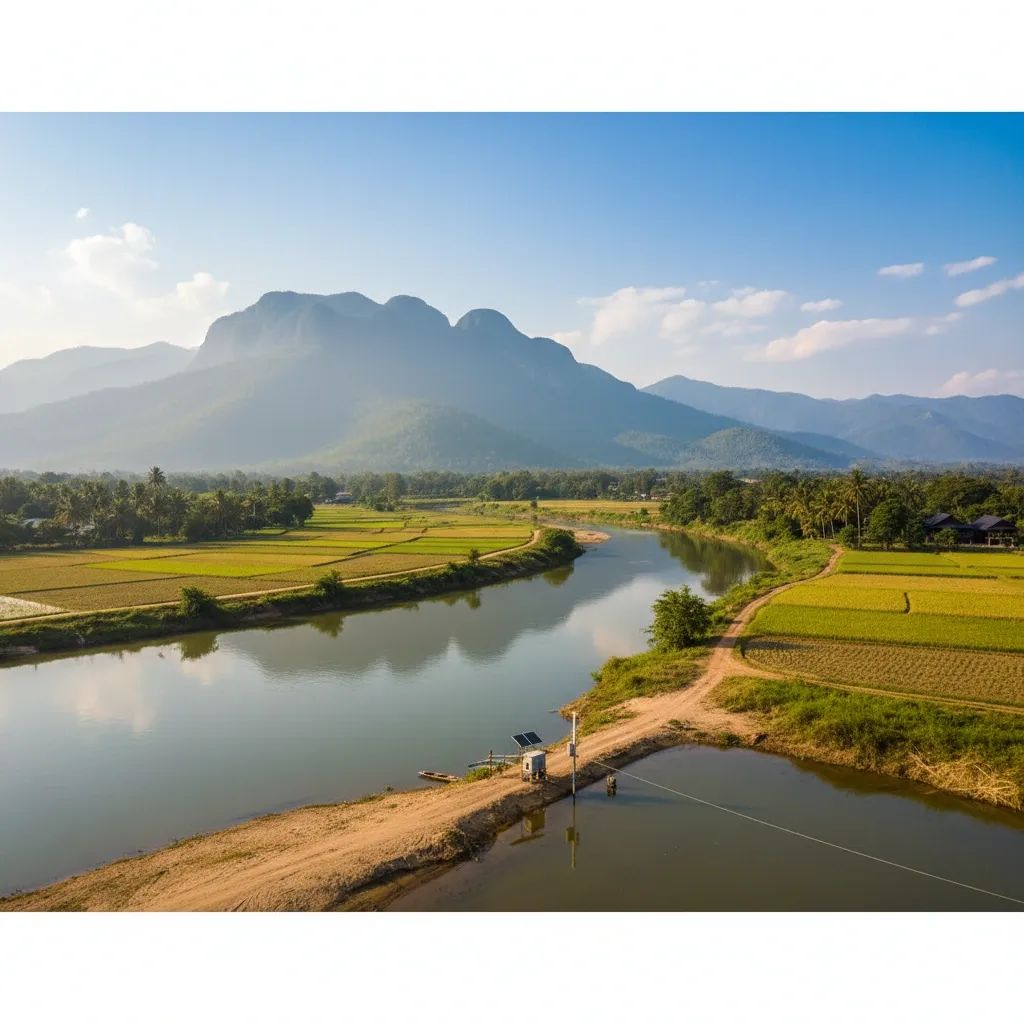
The Thailand Ministry of Public Health has confirmed that current water quality readings along the Kok River corridor remain within internationally recognized safety thresholds, yet the underlying anxiety among residents tells a different story. While residents can continue daily routines without immediate risk, the government's decision to expand health screenings and pursue a five-year monitoring framework signals something harder to dismiss: the contamination problem is neither simple nor temporary.
What You Need to Know Right Now
For drinking water: Residents should rely on Provincial Waterworks Authority municipal supply or certified village treatment systems. For those with immunocompromised family members, pregnant women, or chronic illness, bottled water remains the prudent choice, though this imposes financial burdens on lower-income households.
For food: Consuming fish is permissible if internal organs are systematically removed. Vegetables irrigated with river water should be washed thoroughly and peeled when feasible. Dairy products and meat sourced locally carry minimal risk.
For recreation: Kayaking and riverside walking are safe; swimming and wading carry documented risk, particularly for anyone with cuts, abrasions, or dermatological conditions.
For farmers: The Thailand Land Development Department offers free soil testing to assess arsenic accumulation in cultivated plots. Rotating irrigation sources when possible can reduce chronic exposure. Using personal protective equipment when handling agrochemicals is equally important.
Why This Matters
• Tap water is safe—for now: The Thailand Pollution Control Department's most recent measurements show arsenic concentrations below the 0.01 mg/L World Health Organization standard, though localized hotspots in Mae Ai district occasionally exceed this by a thin margin.
• Preventive screening kicks into high gear: The Thailand Public Health Ministry will conduct health checks on 1,400 residents in high-risk zones, seeking evidence of chronic arsenic accumulation in hair, nails, and urine samples.
• Recreation requires caution: Swimming and wading remain discouraged, particularly for anyone with cuts or open skin. Fish consumption is permissible if internal organs are discarded, but confidence in local catch has visibly eroded among consumers and businesses.
The Upstream Reality: What's Actually Happening
Tracing arsenic contamination upstream leads squarely to Shan State in Myanmar, where at least four Chinese-operated mining enterprises have extracted gold and rare earth minerals along the Kok River's headwaters since 2020. These operations intensified dramatically following Myanmar's 2021 military transition.
The extraction process uses the river itself—drawing water, processing ore, then discharging untreated wastewater containing arsenic, cyanide, and heavy metals directly back downstream. Critically, 2024's catastrophic flooding magnified the problem exponentially. Massive sediment surges carried contaminated soil particles hundreds of kilometers, stratifying arsenic and other toxins in riverbeds, tributaries, and the irrigation channels that feed agricultural communities.
Arsenic also occurs naturally in certain geological formations across both Myanmar and Thailand. Agricultural land erosion—whether from hill-tribe farming, deforestation, or intensive cultivation—adds another sourcing pathway. The result is contamination that blends human-induced mining pollution with geological background levels, making simple cause-and-effect attribution complicated.
What Health Research Shows
Research conducted by Mae Fah Luang University and Chiang Rai Rajabhat University planned for February 2026 will examine riverside residents and test for elevated arsenic concentrations in hair and fingernail samples—markers of sustained exposure over months or years. This expanded epidemiological investigation is designed to distinguish between exposure pathways, including whether detected arsenic may reflect occupational agricultural exposure rather than direct water contamination.
Farmers in the region routinely handle pesticides, herbicides, and fertilizer formulations that contain arsenic compounds. Soil contact, inhalation during application, and inadequate hand hygiene could account for detected concentrations. This hypothesis raises a secondary concern: occupational health protections for farmers remain minimal across northern Thailand's agriculture sector.
Economic Impact on Local Communities
Tourism and hospitality operators along the Kok River have already absorbed visible losses. River raft companies report canceled bookings; waterfront restaurants cite reduced foot traffic; and fishing operations have downsized catch volumes as consumer demand softened. While the Thailand Pollution Control Department insists water safety permits normal recreational activity, market psychology operates independently of official reassurances.
Fishing families adapted by adopting a harm-reduction practice—removing fish heads, livers, and internal organs before sale, since heavy metals concentrate in these tissues. Yet this adaptation masks a deeper erosion: trust in the resource itself has fractured. Some fishmongers report difficulty selling locally caught fish even at discount prices.
Thailand's Response: A Five-Year Blueprint
The Thailand Cabinet has endorsed a comprehensive intervention spanning four strategic pillars.
Expanded surveillance infrastructure represents the most immediate commitment. The Thailand Department of Medical Sciences will process urine samples from at-risk populations monthly; village water systems will undergo systematic testing; and a new regional heavy metals laboratory serving Chiang Rai and Chiang Mai provinces will accelerate processing. Researchers will establish baseline health metrics among the 1,400-person cohort, creating an epidemiological dataset for measuring future trends.
Water infrastructure redesign tackles the contamination distribution problem. The Thailand Department of Water Resources is engineering sediment traps designed to slow heavy-metal migration downstream. The Provincial Waterworks Authority is identifying alternative raw water sources—boreholes, mountain springs, or tributary diversions—to reduce reliance on the main Kok River channel during high-contamination periods. Engineers are retrofitting 30 village water treatment plants across both provinces with advanced filtration technologies, including reverse osmosis membranes and DMI-65 catalytic media, systems capable of reducing arsenic from 78 parts per billion to below 1 PPB.
A preliminary 2 billion baht budget has been proposed for source relocation and infrastructure upgrades, though final parliamentary approval remains pending.
Public education campaigns represent the critical community component. The Thailand Government Public Relations Department is producing instructional materials—posters, radio spots, video guides in Thai and local dialects—emphasizing safe water use, food handling, and recreational boundaries.
International scientific collaboration aims to build pressure through transparency. If independent testing confirms that mining operations in Shan State are the primary contamination source, diplomatic isolation becomes harder for Myanmar to absorb internationally.
Diplomatic Challenges and Regional Governance
Pressuring Myanmar to halt or reform mining operations presents Thailand with a diplomatic challenge. Myanmar's military junta exercises authority over Shan State, where armed ethnic organizations and Chinese-backed commercial interests also operate. The Thailand Ministry of Foreign Affairs has raised the issue through bilateral channels and via the Mekong River Commission (MRC), but enforcement mechanisms are virtually nonexistent.
The MRC—comprising Thailand, Laos, Cambodia, and Vietnam—has no binding authority over Myanmar, which participates only as a "dialogue partner." This means contamination control depends entirely on goodwill and diplomatic persuasion. Japan's involvement adds a multilateral dimension. The Thailand Pollution Control Department is coordinating with Japanese environmental specialists to conduct independent sediment sampling and analysis within Shan State territory—a technical workaround to circumvent sovereign sensitivities.
The Road Ahead
By mid-2026, the health screening initiative will yield epidemiological clarity on whether detected arsenic correlates with water exposure or occupational contact. Diplomatic overtures to Myanmar, supported by independent testing, may either pressure mining reform or confirm that Naypyidaw views the issue as externalized.
For residents of Chiang Rai and Chiang Mai provinces, the immediate outlook is stable. Tap water remains usable; the food supply is not catastrophically compromised; and recreational access persists with sensible precautions. The five-year infrastructure investment, if sustained, will meaningfully reduce exposure pathways.
Yet this stability masks a sobering reality: transboundary water pollution remains largely beyond any single nation's unilateral control. Thailand can filter its own water, monitor its own population, and invest in treatment infrastructure. It cannot compel Myanmar to cease mining or mandate upstream environmental standards.
As industrial extraction accelerates across the Mekong region and climate volatility amplifies sediment transport, Southeast Asia's shared water basins will face escalating contamination challenges. Whether Thailand, Myanmar, and regional partners develop the collaborative architecture to manage transboundary pollution—before crises metastasize—remains the essential question.


