
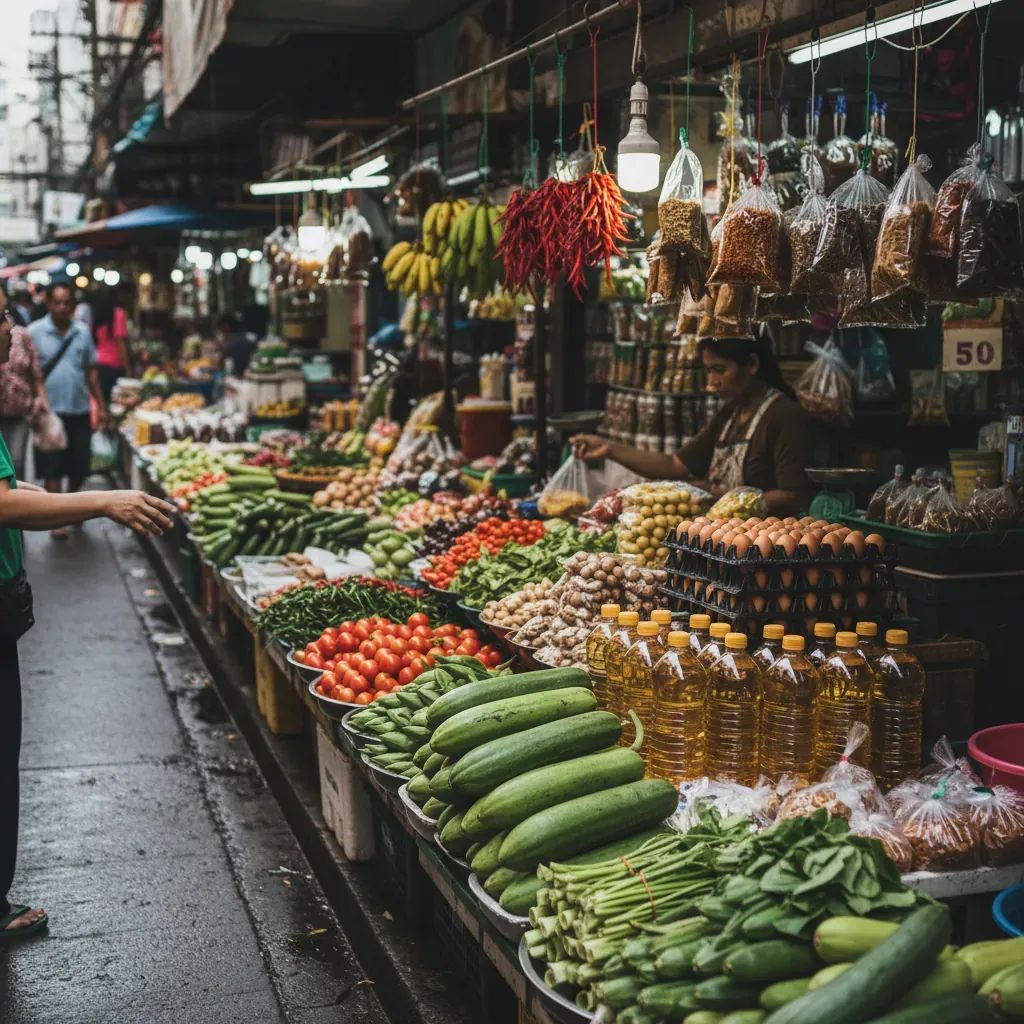
The Thailand Central Bank has held its benchmark interest rate at 1% through June, even as the Thai baht slipped past 33 per US dollar—its weakest level since May 2025—pressured by surging oil imports, a hawkish Federal Reserve, and persistent capital outflows. For residents, businesses, and investors in Thailand, this currency slide translates into higher costs for fuel, imported goods, and foreign currency debt repayments, offsetting some of the baht-denominated gains exporters might otherwise enjoy.
Why This Matters
• Energy costs are climbing: Oil imports now cost significantly more as Dubai crude hit $115/barrel in March 2026, directly raising electricity, transport, and production expenses.
• Inflation is returning: Headline inflation is projected to breach the Bank of Thailand's 1-3% target range in 2026, driven by energy and supply-side pressures.
• Capital is leaving: Interest rate differentials between Thailand (1%) and the US (3.5-3.75%) are encouraging outflows to dollar-denominated assets, further weakening the baht.
• Trade deficits persist: Despite record export growth, Thailand posted its largest-ever monthly trade deficit of $10B in April 2026, driven by surging imports—particularly from China.
Oil Shock Compounds Currency Pressure
Thailand's heavy dependence on imported energy—equivalent to roughly 5-6% of GDP—leaves the baht acutely vulnerable to global crude price swings. The US-Iran conflict that erupted in late February 2026, culminating in Iran's closure of the Strait of Hormuz, choked off approximately 20% of global oil supplies and sent Brent crude soaring above $120/barrel from pre-conflict levels of $60-72.
By mid-March, Dubai crude had reached $115/barrel, drastically increasing Thailand's energy import bill. Because oil is priced in US dollars, the Thailand Ministry of Finance now projects the baht will average 32 per dollar across 2026, with some analysts forecasting near-term weakness toward 33.90 before a potential year-end recovery to 31.
The broader economic impact is twofold: elevated oil prices narrow Thailand's current account surplus—historically a buffer for the currency—and fuel domestic inflation. Manufacturers face higher production costs, households pay more at the pump, and electricity tariffs inch upward. The Bank of Thailand acknowledges that while the conflict's impact on manufacturing and tourism has been less severe than initially feared, overall economic expansion remains "low and uneven," with small and medium-sized enterprises and households squeezed by intense competition, decelerating income growth, and rising living costs.
Fed Policy Divergence Widens the Gap
While the Bank of Thailand prioritizes domestic recovery with its accommodative 1% policy rate, the US Federal Reserve has maintained a hawkish posture. The Fed held rates steady at 3.5-3.75% in June 2026, but officials are signaling further hikes later in the year due to persistent inflation above the 2% target and a resilient labor market. Some forecasters, including Bank of America, anticipate three 25-basis-point increases in 2026, while others like J.P. Morgan and UBS expect a hold until September 2027.
Regardless of timing, the divergence is stark. The interest rate differential—ranging from 2.5 to 2.75 percentage points—incentivizes capital to flow out of Thailand and into higher-yielding dollar assets. Reports confirm that capital outflows have accelerated, with investors seeking stronger returns elsewhere. This dynamic strengthens the US dollar and exerts downward pressure on the baht, creating a feedback loop: as the baht weakens, the cost of dollar-denominated oil imports rises further, widening the trade deficit and fueling more outflows.
What This Means for Residents and Businesses
For everyday life in Thailand, the baht's slide translates into tangible friction:
• Higher fuel and electricity costs: Petrol stations and utility providers are passing through elevated crude costs, raising household expenses.
• Imported goods get pricier: Electronics, machinery, and consumer goods—many sourced from China—are more expensive in baht terms, contributing to inflationary pressure.
• Foreign currency debt becomes costlier: Businesses and individuals with dollar-denominated loans face higher repayment costs in baht, straining cash flow.
• Mixed blessings for exporters: While a weaker baht theoretically boosts competitiveness, many Thai manufacturers rely on imported inputs (components, raw materials) that now cost more, muting the practical benefit.
Exchange rate volatility is creating both opportunities and risks. Exporters with low import content can capitalize on stronger baht-denominated profits, but sectors heavily dependent on foreign inputs—such as electronics assembly and auto manufacturing—find their margins squeezed.
Export Boom Meets Import Surge
Despite currency headwinds, Thailand's export performance in 2026 has been remarkably robust. January saw a 24.4% year-on-year surge to $31.6B, marking the 19th consecutive month of expansion. By March, exports hit a record $35.2B, driven by strong global demand for electronics and electrical appliances, particularly AI-related technology and data center components. Computers, telephones, automobiles, machinery, and high-potential agricultural products like fresh durian and pet food have all posted significant gains.
Through May 2026, exports rose 17% year-on-year, extending the growth streak to 23 consecutive months. However, imports have outpaced exports by an even larger margin. April 2026 recorded a historic $10B monthly trade deficit—the largest on record—as imports surged 45% to $41.6B. For the first five months of 2026, imports jumped 35.7%, driven by machinery, electronic components, and industrial inputs, particularly from China.
The cumulative trade deficit through May stands at approximately $25B, a sharp reversal from Thailand's historical current account surpluses. This widening gap reflects both the oil price shock and the structural reality of Thailand's manufacturing base: the country imports substantial intermediate goods to assemble and export finished products.
Diplomatic Progress Offers Modest Relief
By late June 2026, diplomatic efforts have yielded encouraging progress in US-Iran peace talks, mediated by Qatar and Pakistan. A memorandum of understanding initiated a 60-day negotiation period covering Iran's nuclear program, sanctions relief, and access to frozen assets. The US allowed Iranian oil sales for 60 days as part of the interim deal, and shipping activity through the Strait of Hormuz has gradually resumed.
As a result, oil prices have retreated sharply: US crude dropped below $70/barrel, and Brent fell to around $72, down from the March peak above $120. Markets are pricing in a gradual normalization of Middle East energy flows, reducing the geopolitical risk premium. Analysts predict ongoing downward pressure on crude prices due to recovering supply.
This easing has provided modest relief for the baht, though the currency continues to face pressure from the interest rate differential and capital outflows. The situation remains fragile: US President Donald Trump has threatened further strikes if Iran-backed Hezbollah continues to destabilize Lebanon, and Israel's defense minister has stated there is no US demand for withdrawal from Lebanon, where fighting has intensified.
Central Bank Holds Steady
The Bank of Thailand has maintained its policy rate at 1% for the second consecutive meeting in June 2026, aligning with market expectations. The central bank's accommodative stance contrasts sharply with global peers: the European Central Bank raised rates by 25 basis points in June, the Bank of Japan hiked to 1%—its highest since 1995—and the Reserve Bank of Australia, along with central banks in Indonesia and the Philippines, have all tightened policy to combat inflation.
The Bank of Thailand's rationale centers on domestic priorities: weak demand, high household debt, and subdued credit growth necessitate supportive financial conditions. While headline inflation is projected to accelerate through 2026, the central bank anticipates it will gradually return to the 1-3% target range in 2027 as supply-side pressures ease. The BOT's upgraded GDP growth forecast of 2.3% for 2026—up from an earlier 1.5%—cites strong exports, government stimulus measures, and easing geopolitical tensions. However, other institutions like the OECD and World Bank project slower growth of 1.6-1.7%, citing the normalization of export growth and ongoing challenges in trade and domestic demand.
Outlook: Recovery Conditional on External Factors
For residents and investors in Thailand, the baht's trajectory hinges on three external variables: sustained de-escalation in the Middle East, a Federal Reserve pivot toward rate cuts or an extended hold, and continued export momentum. The Ministry of Commerce anticipates full-year export growth of 3-5% for 2026 but warns of a slowdown in the second half due to global economic deceleration, geopolitical tensions, and trade policy uncertainty.
In the near term, exchange rate volatility is likely to persist. Businesses should hedge foreign currency exposure where possible, while consumers can expect inflationary pressure to remain elevated through year-end. The Bank of Thailand is monitoring inflation developments and medium-term expectations closely, balancing the need to support growth against the risk of runaway price increases.
The silver lining: if peace talks succeed and oil prices stabilize in the $70-75 range, and if the Fed adopts a more dovish tone in the latter half of 2026, the baht could recover toward 31 per dollar by year-end, as analysts project. Until then, residents should brace for higher costs and continued currency fluctuation.


