
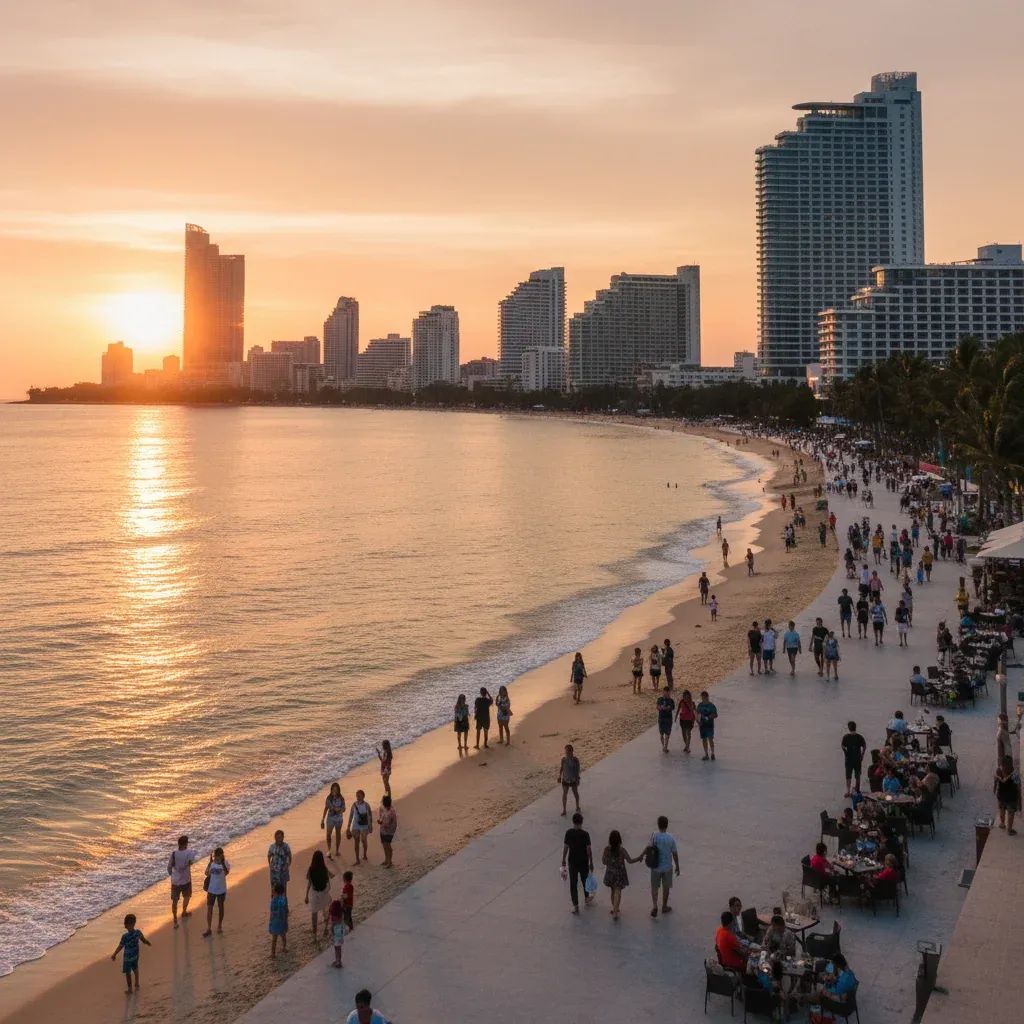
Pattaya's dining sector has discovered an uncomfortable truth: in a market saturated with thousands of food establishments competing for the same wallet, pricing power is a luxury most operators cannot afford. While ingredient costs, utilities, and rent pressures mount, restaurants and street vendors are absorbing the squeeze rather than passing it to customers—a deliberate trade-off between thin margins and market survival.
Why This Matters
• Restaurant economics: Pattaya dining remains affordable relative to other Southeast Asian tourist destinations, making it a draw for both long-term residents and international visitors seeking value.
• Hidden cost absorption: Owners are navigating rising operational expenses quietly through menu redesign and efficiency measures rather than visible price hikes.
• Market fragility: Competition is so intense that even modest menu increases risk redirecting foot traffic to neighboring establishments, forcing restaurants to find creative cost management strategies.
The Economics of Extreme Competition
Pattaya's economy is woven into tourism, and the food sector serves as both its visible attraction and economic foundation. Walk from Jomtien Beach to Walking Street, and you encounter not just restaurants but a fierce ecosystem where thousands of operators compete for finite dining dollars. This density of choice has created what industry analysts describe as a pricing suppression environment—one where demand management through volume matters far more than margin expansion through higher prices.
"If people think your food is expensive, they walk to another place," explained one restaurant operator working in the city. "There's always another option nearby." This reality shapes every business decision, from menu construction to sourcing strategy.
Thailand's Kasikorn Research Center projects national inflation at just 0.4% for 2026, with deflationary pressure in early months due to energy price softening and government subsidies on essential commodities. That headline figure, however, masks highly localized pressures. Individual businesses—especially those competing in Pattaya's restaurant sector—face distinct cost trajectories that differ sharply from the national average.
The Cost Architecture
Behind stable menu prices lies a more complex operational reality that most diners never see. Rental rates for food service spaces in Pattaya vary dramatically by microlocations, ranging from ฿35,000 monthly for a compact 89-square-meter townhouse setup to ฿300,000 for a 400-square-meter venue positioned in high-traffic zones. Those figures reflect real-time February 2026 market listings and reveal that property owners have largely held the line on rent despite cyclical tourism fluctuations. For operators, this means annual lease obligations consuming 30-50% of revenue before a single ingredient is purchased.
Ingredient procurement follows its own volatile trajectory. The Thailand Ministry of Commerce monitors agricultural commodity prices, and while shrimp and poultry have not spiked uniformly, seasonal vegetables and temperature-sensitive produce have drifted higher. Current forecasts warn that above-normal temperatures predicted for the next quarter could further constrain supply for climate-vulnerable crops, adding unpredictability to kitchen planning. A sudden scarcity of Thai chilies, morning glory, or fresh seafood can force difficult choices: absorb the cost spike, reduce portion size, or find a substitute ingredient.
Utilities remain a relentless drain on profitability. Electricity and water bills have not declined, and for establishments running air conditioning during 12+ hour service days or maintaining refrigerated display cases for fresh seafood, those fixed expenses compound month after month. A medium-sized restaurant operating 6 days weekly can easily face ฿20,000-40,000 monthly in combined utility costs.
Adaptation Over Adjustment
Rather than raise menu prices uniformly, Pattaya restaurants have deployed a toolkit of operational adjustments that preserve price perception while nudging unit economics toward sustainability. Portion sizing represents the most common tactic—servings shrink imperceptibly while prices hold steady, allowing operators to maintain margin without triggering visible dissatisfaction. The adjustment is subtle enough that most diners notice only after repeated visits.
Menu architecture has also shifted. Increasingly, restaurants feature core ingredients across multiple dishes, allowing better inventory turnover and reduced waste. A kitchen that builds 5-6 entrées around a high-quality protein like tilapia or mackerel minimizes procurement complexity and maximizes freshness, compared to a diverse menu requiring 15+ distinct ingredients daily.
Bundled promotions and fixed-price sets have proliferated across the sector. By combining a main dish, beverage, and side into a single value package, operators create the psychological impression of generosity while controlling per-transaction cost. Pre-made sauce blends and semi-prepared components—once viewed as compromises on authenticity—now feature prominently in kitchens as tools for standardizing flavor, minimizing labor hours, and reducing on-premise waste.
The Thailand Restaurant Association frames the landscape starkly: the national food service market, valued at approximately ฿700 billion in 2026, faces sustained headwinds from weakening consumer purchasing power and relentless new entrant competition. Smaller establishments without diversified revenue streams—those without delivery partnerships, catering divisions, or corporate contracts—are especially vulnerable. In Pattaya, where competition density is amplified, the margin for operational error has narrowed to near-zero.
Tourist Spending and Demand Volatility
Tourism remains the ultimate variable in Pattaya's restaurant equation. The city attracts a deliberately mixed clientele: short-stay beach vacationers, digital nomads operating on local budgets, and long-term expatriate residents. Each demographic carries distinct spending patterns. When airline schedules shift, exchange rates move, or global economic sentiment softens, demand can shift suddenly. A weak British pound or Japanese yen directly translates to fewer international diners, forcing restaurants to compete harder for local and regional customers.
Culinary tourism—travel motivated primarily by food exploration—has grown as a segment, and Thai cuisine ranks consistently among the most sought-after globally. For Pattaya, this represents both opportunity and pressure. The city must deliver authentic, technically competent meals at prices competitive against Bangkok, Chiang Mai, or international alternatives. Fail that test, and reputational damage spreads rapidly through online review platforms and travel forums, which wield outsized influence on booking decisions for first-time visitors.
Analytics from TTB Analytics underscore the structural challenge: Thailand's restaurant sector is characterized by exceptionally high establishment density relative to population, with new operators continuously entering the market despite macroeconomic uncertainty. This constant churn ensures that pricing power remains perpetually limited and forces incumbents toward continuous innovation.
What This Means for Long-Term Residents
For expatriates, retirees, and long-term foreign residents living in Pattaya, the industry's pricing discipline translates directly into sustained personal economic advantage. Daily dining-out remains genuinely affordable—a bowl of authentic pad Thai from a street vendor runs ฿40-50, while a fresh seafood platter at a mid-range seafood restaurant costs ฿150-200. That affordability is rare in comparable international tourist cities and represents a significant quality-of-life factor for residents on fixed or modest incomes.
The competitive environment also drives quality improvement over time, as underperforming operators exit the market and survivors refine their operations. A result is that sustained diners benefit from gradually improving food quality, service standards, and menu creativity—not from lower absolute prices, but from better value for stable prices.
However, this equilibrium is not guaranteed to persist indefinitely. External shocks—a sustained global energy price spike, significant Thai baht weakness against major currencies, or a severe regional tourism downturn—could force operating costs beyond what restaurants can absorb through internal adjustment alone. If that threshold is breached, price increases will become unavoidable. Industry observers also warn that demographic consolidation could accelerate, with weaker operators closing entirely and larger chains or franchise operations claiming increased market share, potentially reducing the diversity of dining options that currently defines Pattaya.
For now, the implicit bargain remains intact: restaurants accept compressed margins in exchange for customer volume and loyalty, and diners benefit from stable, affordable meals. It is a model that rewards consistency and punishes complacency—one that will endure only as long as the balance between operational costs and competitive pressure remains roughly stable.


