
Forest Hideout Raid Exposes Ongoing Drug Smuggling Through Northern Thailand
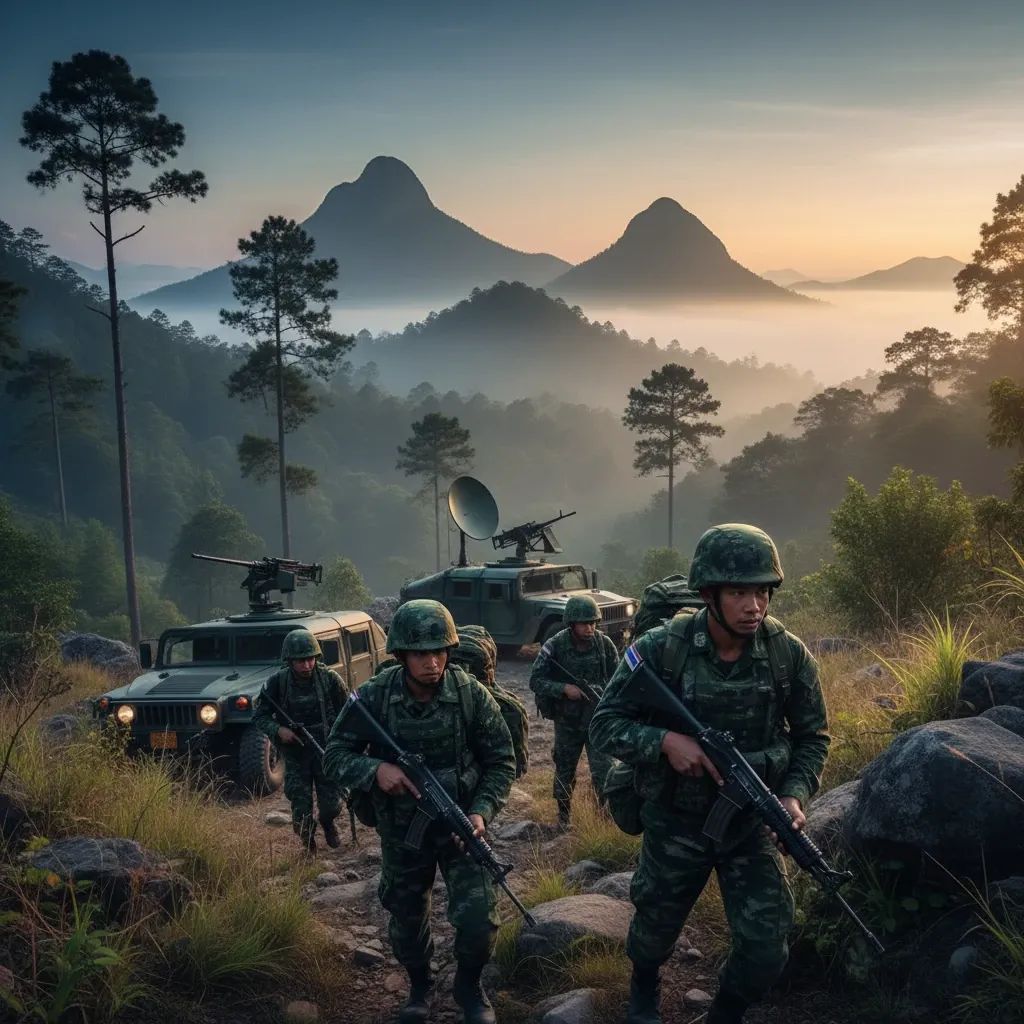
Soldiers discovered a massive stockpile of illegal drugs hidden beneath a remote woodland cottage during a targeted raid in Chiang Rai's northern border region. Two local suspects were apprehended at the scene, guarding what authorities described as a semi-permanent smuggling facility positioned along known trafficking corridors. The seizure underscores how sophisticated criminal networks continue establishing hardened infrastructure within Thai territory despite sustained enforcement efforts.
What Happened in the Raid
The Pha Mueang Task Force operation targeted a forested area where smuggling organizations have historically exploited monsoon season conditions—when rainfall and jungle terrain complicate aerial surveillance and enable large shipments to transit remote corridors before descending toward population centers and onward distribution networks. The facility's construction and equipment suggested extended operational use, indicating that traffickers retain both the capacity and confidence to establish substantial infrastructure for staging shipments.
The two suspects arrested at the hideout face trafficking charges, with authorities conducting investigations into their roles within larger distribution networks. Evidence collection and handovers to local police stations for prosecution represent efforts to maintain investigative continuity from seizure through judicial outcome.
Why This Raid Matters for Residents and Travelers in Chiang Rai
Checkpoint Intensity Will Increase Further
For residents in Chiang Rai's Mae Fah Luang, Mae Chan, Chiang Saen, and Pa Daet districts, raids like this typically trigger expanded military checkpoints along Highway 1 and rural access roads. Officers conducting vehicle inspections can add 30 minutes to several hours to transit times. Freight companies and commercial drivers should expect:
• More frequent stops at weigh stations and border crossings
• Vehicle searches, particularly targeting modified compartments or suspicious modifications
• Documentation requests and cargo verification procedures
• Delays that may add 20-30% to typical delivery windows
Practical Guidance for Travelers
If you're traveling through northern Chiang Rai districts:
• Carry vehicle registration and personal identification documents
• Avoid modified vehicles or unusual cargo configurations that may trigger inspection
• Allow extra travel time, especially during evenings and early mornings when checkpoints intensify enforcement
• Remain calm and cooperative during inspections; military personnel are operating under heightened alert
• Avoid remote rural roads at night; stick to main highways where checkpoints are established and regular
Business and Tourism Impact
Tourism-dependent businesses in Chiang Rai face competing concerns. Enhanced security demonstrates government commitment to law enforcement, potentially reassuring risk-conscious visitors. However, media coverage emphasizing drug seizures can deter travelers unfamiliar with the region, creating short-term booking uncertainty. Property values near the Myanmar border remain suppressed due to persistent security concerns, though areas demonstrating sustained law enforcement activity show tentative price stabilization.
Hospitality operators and business owners report mixed sentiment—enhanced security perceived as both a liability (association with criminal activity visible through checkpoints and military presence) and an asset (demonstrable government order and commitment to safety).
For Expats and Foreign Residents
Expat communities should understand:
• Checkpoints target vehicle-based trafficking; pedestrian movement remains largely unaffected
• Vehicle inspections are routine enforcement, not targeted harassment
• Maintain clean vehicle registration and valid insurance documentation
• Avoid traveling with unfamiliar passengers or cargo
• Understand that residency status and visa validity may be verified during inspections
The Broader Enforcement Context
Thailand's coordinated task force structure—integrating army cavalry units, special forces, DSI investigators, and border patrol officers—represents genuine institutional advancement in disrupting trafficking networks. The integration of Pha Mueang Task Force, Department of Special Investigation (DSI), and Border Patrol Police enables real-time intelligence sharing that has reduced jurisdictional gaps historically exploited by smuggling organizations.
Between October 2025 and May 2026, Thai authorities documented significant enforcement activity across the northern region, with seizures of methamphetamine pills, crystalline ice, and heroin increasing notably. These operations demonstrate sustained pressure on trafficking infrastructure, though criminal networks continue adapting methods faster than countermeasures evolve.
Why Myanmar's Drug Production Remains the Core Problem
Myanmar's emergence as the world's dominant illicit methamphetamine producer ranks among the most consequential shifts in global drug economics. The 2021 military coup triggered political fragmentation and armed conflict, inadvertently creating a regulatory vacuum across Shan State—the epicenter of synthetic drug manufacturing. Myanmar now produces more illicit methamphetamine than any nation on Earth, with the regional supply chain generating an estimated several billion dollars annually for armed groups, corrupt officials, and transnational organized crime consortiums.
This production capacity means that even major seizures like the Chiang Rai forest hideout raid represent a fraction of throughput crossing borders. Methamphetamine pills currently fetch 30–50 baht in Chiang Rai's border districts, rising to 100–150 baht in Bangkok—a price gradient reflecting transport risk. These stable prices despite record seizures suggest that confiscations remain insufficient to constrain availability materially. For Thailand, the fiscal burden manifests in military and police enforcement budgets, judicial resources, and public health spending for addiction treatment.
Cross-Border Realities and Structural Challenges
Thailand participates in multilateral frameworks like the Safe Mekong Operation Project involving ASEAN member states and China, designed to disrupt production and trafficking across the Golden Triangle. However, collaboration with Myanmar remains complicated by its internal conflict and fractured military command structure. Joint patrols with Myanmar military units occur nominally along contested border zones, though effectiveness is limited by governance challenges beyond Thailand's control.
Corruption remains a persistent vulnerability. Despite high-profile dismissals and prosecutions of officers facilitating trafficking, systematic complicity persists at various institutional levels. Whistleblower protections and financial audits represent necessary but insufficient safeguards against organized crime networks' demonstrated capacity to compromise replacement officers.
The Long-Term Outlook
For residents and investors in Chiang Rai, the realistic takeaway is that enforcement will remain visible and occasionally disruptive for the foreseeable future. The forest hideout raid exemplifies both tactical enforcement successes and strategic realities: smuggling organizations will continue adapting methods, Myanmar's governance crisis perpetuates production capacity, and regional demand for synthetic drugs remains robust. Chiang Rai will continue serving as the crucible of Thailand's drug war, with visible security infrastructure and periodic enforcement actions becoming normalized features of daily life in border communities.
Understanding these dynamics—and the practical checkpoint realities they create—is essential for anyone living, working, or traveling through northern Thailand's border regions.


