
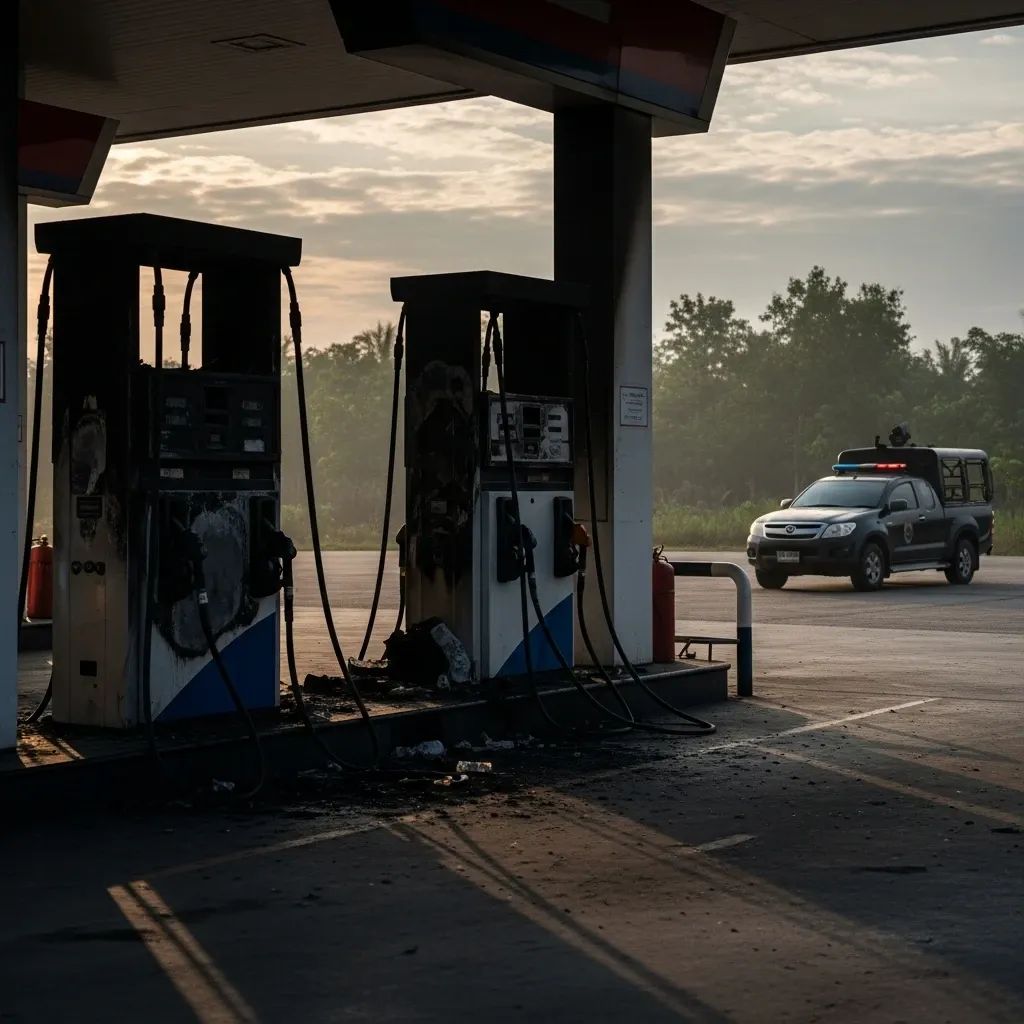
A Petrol Station Crash Exposes Thailand's Blind Spot on Pedestrian Safety
On Friday evening, April 25, a sedan plowed through a KFC outlet at Bangkok's Bangchak station on Sukhumvit Soi 62, injuring six people and reigniting a stubborn debate: Why does Thailand's regulatory framework still treat vehicle-into-building collisions as an anomaly rather than a preventable category of harm?
Why This Matters
• Six injured—staff, customers, and delivery riders—some sustaining fractures and lacerations; one delivery worker was pinned against the service counter.
• No mandatory crash barriers exist at petrol stations or roadside dining outlets despite decades of international safety standards.
• Thailand's current building codes emphasize fire safety and hygiene but explicitly ignore vehicle intrusion risk.
• The incident will likely trigger policy discussions, but enforcement remains an open question.
Inside the Bangchak Incident
Around 7:30–7:50 PM, a bronze-gray BMW M5 exited the fuel pump area on the Bangchak forecourt and accelerated sharply. Witnesses reported the vehicle appeared to be maneuvering between service lanes or attempting an overtake when the driver lost control.
The sedan smashed directly into the KFC storefront, destroying the ordering counter, kitchen equipment, and interior fixtures—roughly 70% of the outlet's operational infrastructure rendered unusable. A Toyota Camry parked at an adjacent pump was also struck in the collision. Emergency crews from the Ruamkatanyu Foundation transported victims to Kluaynamthai, Theptarin, and Ruamjai Rak hospitals. None suffered life-threatening injuries, though injuries ranged from fractures to lacerations.
The BMW driver was identified as Mr. Chen Zhen, a 36-year-old Chinese national (some reports cite age 47). Police from Phra Khanong Police Station say he was also injured. Preliminary investigation focuses on whether he was attempting a rapid lane change without verifying his trajectory, though CCTV footage review remains underway to rule out mechanical failure or impairment. A formal findings report is expected within 30 days.
The Human Cost: Delivery Workers Bear the Risk
For the thousands of food delivery riders who work the Sukhumvit corridor, this crash is less a shocking accident than a daily occupational hazard made tangible. Many staging points—petrol station KFCs, 7-Elevens, Café Amazon branches—sit mere meters from active traffic lanes, separated only by painted curbs and minimal protective infrastructure.
Long-term Bangkok residents and expats know the corridor intimately: dense condominiums, international schools, dense commercial retail. Yet the absence of bollards or crash-rated barriers remains invisible precisely because it is normalized. Riders, staff, and daytime customers navigate this environment without formally acknowledging its structural risk profile.
The Bangchak station remained operational after the crash, though sections of the forecourt were cordoned for forensic work. No announcements have been made regarding future safety retrofits.
What Thailand's Building Code Actually Says (And Doesn't Say)
Under the Thailand Ministry of Energy Regulations (2009), petrol station design specifies minimum clearance distances between fuel pumps, buildings, and access roads. Service buildings must sit at least 5 meters from entry/exit lanes and 20 meters from non-entry boundaries—or install fire-rated walls if closer.
These rules address fire segregation and containment only. There is no requirement for crash barriers, bollards, or vehicle-rated protective posts at commercial outlets inside petrol stations or along high-traffic arterials.
The 2018 Building Control Act and Ministry of Public Health food safety codes focus on fire suppression, ventilation, and hygiene. They remain silent on vehicle intrusion.
Compare this to international practice: The American standard ASTM F3016 governs low-speed anti-ram barriers for storefronts. It tests bollards against a 5,000-pound vehicle at 10–30 mph, ensuring they absorb and deflect accidental collisions. ISO 22343, now adopted across Europe, Australia, and much of Asia-Pacific, sets similar thresholds for vehicle security barriers. Thailand's Council of Engineers has recommended adopting IBC 2006 or AS/NZS 2890.1 standards for parking structures, but legislative adoption has stalled for over a decade.
Protective Measures That Work (And Why Thailand Hasn't Adopted Them)
Fixed Steel Bollards embedded 3–5 feet apart along storefront edges would prevent vehicles from breaching pedestrian zones. They're aesthetically adaptable and proven globally—from sidewalk cafés in Paris to bank ATMs in Seoul to retail strips across North America.
Shallow-mount barrier systems exist for sites where underground utilities restrict deep excavation (common in central Bangkok). These are ASTM F2656-certified, require minimal subsurface footprint, and can retrofit existing stations without extensive civil work.
Wedge barriers and road blockers, already deployed at Bangkok's Suvarnabhumi Airport and key government complexes, can be scaled down. A vehicle-rated system tested to stop a 15,000-pound truck at 50 mph (K12 or ISO Level 1) exists off-the-shelf.
Site redesign—angled or perpendicular parking instead of direct vehicle-to-storefront alignment—creates passive protection. Combined with raised curbs and landscaping, this approach is codified in IBC Section 406 and widely adopted across North America and Australia.
The economic barrier is modest: bollards cost 3,000–15,000 THB each; shallow-mount systems, 8,000–25,000 THB installed. For a petrol station forecourt with 8 pumps and an adjacent café outlet, a protective perimeter might cost 150,000–300,000 THB (equivalent to three months of rent in central Bangkok). For Bangchak or other major chains, this is a rounding error on quarterly maintenance budgets.
The actual barriers are regulatory and bureaucratic. Thailand's Ministry of Energy has issued no directive mandating such measures. The Petrol Retailers Association has made no collective commitment. Individual operators face no liability exposure if they choose not to install barriers—a legal asymmetry that creates no incentive for voluntary compliance.
What Investigators Will Likely Find (And What They Probably Won't)
Police will determine whether Mr. Chen was speeding, distracted, impaired, or mechanically compromised. This is the standard forensic question, and it will be answered.
What investigators almost certainly will not ask: Why did Bangkok's regulatory authority permit a commercial food outlet to operate inside a petrol station forecourt without any physical barrier between customer seating and the zone where refueling vehicles maneuver?
This question falls outside the scope of criminal investigation. It belongs to administrative and regulatory review—which, in Thailand, tends to occur only after an incident generates sufficient public pressure.
The Pattern: Crashes, Then Silence, Then More Crashes
The April 25 Bangchak incident is not the first. Earlier in 2026, a 7-Eleven in suburban Bangkok experienced a similar vehicle-into-storefront collision. A Café Amazon outlet reported damage from an errant vehicle. The Thai Road Safety Center does not yet publish disaggregated statistics on vehicle-into-building incidents at petrol stations—a data gap that itself is revealing.
Without mandatory crash barriers, without enforceable design standards, without even a regulatory category that acknowledges this harm pattern, similar incidents will recur. The geometry remains unchanged: delivery riders and service workers occupy the line of impact. The built environment assumes perfect driver behavior.
What Comes Next: The Policy Vacuum
Phra Khanong Police will conclude their investigation by late May. If negligence is confirmed, Mr. Chen could face charges under Thailand's Criminal Code Section 390 (reckless driving causing injury), carrying penalties of up to 6 months imprisonment and fines of up to 10,000 THB per victim.
The Ministry of Energy has not announced any regulatory review. Industry observers speculate that this incident, combined with prior crashes at convenience store chains, may finally trigger a formal consultation on barrier standards for roadside commercial zones. But speculation is not policy.
For the Bangchak chain and its corporate parent, there is no legal obligation to retrofit existing stations or newly opened branches with crash-rated protection. Station managers must navigate a choice: absorb the cost of voluntary safety upgrades, or wait until a future incident creates reputational pressure.
For delivery riders and petrol station café workers, the situation remains unchanged. They continue to occupy spaces that international building codes would classify as high-risk, unprotected pedestrian zones.
The Regulatory Asymmetry: Why This Matters for Residents
If you live or work along Sukhumvit Road—or use any petrol station café as a staging point for food delivery work—you are operating in an environment that Thai law treats as adequately safe despite international evidence to the contrary.
This is not a controversy that divides experts. There is no legitimate debate about whether bollards reduce collision severity or whether barrier standards improve pedestrian outcomes. The science is settled. The standards are published. The technologies are proven and cost-effective.
The gap is purely regulatory and political. Thailand's building framework has not yet internalized vehicle intrusion as a design priority. This reflects not a lack of awareness but an allocation of bureaucratic attention toward other concerns—fire safety, accessibility, sanitation—that were prioritized through earlier legislation.
Updating the regulatory framework to include crash barrier standards would require the Ministry of Energy or Ministry of Public Health to draft amendments, circulate them for stakeholder feedback, and coordinate with the Bangkok Metropolitan Administration on enforcement mechanisms. This is procedurally straightforward but politically low-priority until incidents accumulate.
International Comparison: A Decade Behind
Singapore's Building and Construction Authority has mandated crash-rated bollards at all petrol station retail outlets since 2015. Malaysia's Building Commission adopted similar requirements in 2018. Vietnam has begun requiring barrier assessments at high-traffic service stations.
Thailand, a major regional economy with comparable construction capacity, has not yet formalized such requirements. The reason is not technical inability but regulatory lag.
The Unresolved Question
Before the April 25 crash, the question was hypothetical: Should Thailand mandate crash barriers at petrol station retail outlets?
After the crash, with six injured and a KFC outlet destroyed, the question is almost rhetorical—yet regulatory action is not automatic. Policy change in Thailand often requires repeated incidents plus sustained media pressure plus industry consensus before legislative movement occurs.
For now, the Bangchak station will be repaired, the BMW will be resolved in courts, and the absence of bollards will remain unremarked upon in the formal record. Until the next incident makes the question impossible to ignore.
For residents and riders along Sukhumvit, the built environment remains as it was before April 25: a zone optimized for commercial throughput, not collision resistance.


