
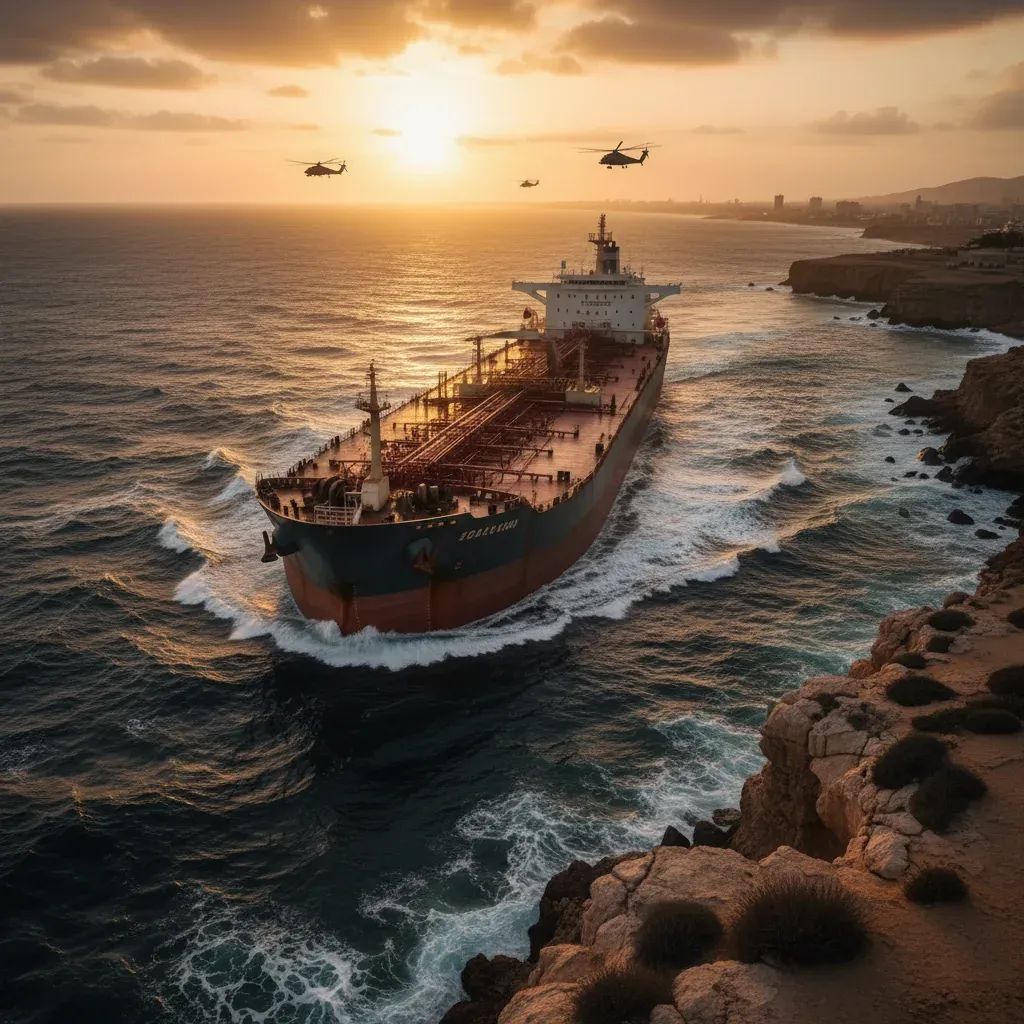
The Thailand economy faces an immediate supply shock as escalating military operations between Washington and Tehran have triggered a closure of one of the world's most critical energy corridors—a development that will affect fuel costs, inflation, and business operations across Southeast Asia within days.
Why This Matters
• Oil prices could surge significantly within weeks if the Strait of Hormuz blockade persists, directly affecting Thai household fuel expenses and manufacturing input costs.
• 20 million barrels daily normally transit the Strait—equivalent to roughly a quarter of global petroleum consumption; any sustained disruption creates immediate shortages for Asia-dependent economies like Thailand.
• Shipping insurance premiums are rising sharply, forcing freight costs higher for Thai exporters and importers relying on Gulf trade routes.
• Thailand's energy security hinges on Hormuz access—the country imports most crude and liquefied natural gas through this narrow waterway, with few viable alternatives available quickly.
• The Strait is uniquely vulnerable: At just 33 kilometers wide at its narrowest point, it cannot be physically bypassed without routing around Africa—a journey that transforms two-week transits into six-week odysseys and multiplies fuel surcharges.
The Conflict at the Chokepoint
Military operations between US Central Command and Iran's Revolutionary Guards have intensified dramatically across the first half of July. Between July 8 and 12, the US conducted three major waves of strikes targeting over 300 Iranian military positions, including missile storage, naval facilities, radar installations, and command centers. Iran responded on July 12 with a coordinated attack involving missiles and drones against multiple Gulf states—hitting targets in Kuwait, Bahrain, Qatar, Oman, Jordan, and the United Arab Emirates.
The escalation follows the collapse of a ceasefire agreement signed in Islamabad in June 2026. US President Donald Trump terminated the accord, citing Iranian violations and attacks on commercial shipping. Iran's government contends the US breached the deal first and has shown no willingness to negotiate from a weakened position.
The immediate trigger came when Iran's Revolutionary Guards fired on the Cyprus-flagged container ship M/V GFS Galaxy off Oman's coast, claiming it used unauthorized shipping lanes. The vessel sustained serious engine damage and caught fire, leaving one Indian crew member unaccounted for. Hours later, Iran announced the Strait of Hormuz would remain closed until what Tehran describes as "American interventions in the region" cease.
Current Market Impact and Price Projections
US Central Command disputes Iran's closure claim, asserting that coalition naval escorts maintain commercial traffic flow. However, shipping insurers have already begun re-rating risk premiums for Hormuz transits, and major container lines have paused new bookings pending clarity on safe passage. In practical terms, this creates a de facto partial closure—available capacity shrinks while premiums and delays accumulate.
During earlier tensions in March 2026, Brent crude climbed past $100 per barrel (approximately ฿3,600), already representing the largest monthly oil price jump in recent memory. Industry analysts now project that a sustained closure could push prices toward $150 per barrel (approximately ฿5,400) within days, with some projections suggesting potential levels of $200 per barrel (approximately ฿7,200) if the standoff extends beyond two weeks. The International Energy Agency warned in July that global oil demand has already contracted by 1 million barrels daily in 2026 due to conflict-driven price volatility.
Consequences Ripple Across Thailand's Economy
Thailand's energy sector faces direct exposure. The country sources most crude oil and liquefied natural gas through the Strait; alternative pipeline capacity in Saudi Arabia and the UAE can offset less than 20% of disrupted flows. The Thailand Ministry of Energy has strategic reserves, but these provide only weeks of supply at normal consumption rates.
Historically, the 2022 oil crisis prompted Thailand's government to implement fuel subsidies aimed at stabilizing domestic prices—measures that may be revisited if crude remains elevated above $100 per barrel for extended periods.
Fuel costs immediately cascade through the economy. Transportation logistics firms will pass shipping surcharges to retailers and manufacturers. Electricity generation, still dependent on natural gas and oil for baseload power, becomes more expensive. Food distribution networks operating on diesel face higher operating costs, pressuring retail prices for produce and processed goods.
Thailand's central bank has already flagged energy price volatility as a material risk to 2026 GDP growth projections. Inflation could accelerate if crude remains elevated, forcing potential monetary policy adjustments that would affect borrowing costs for consumers and businesses.
Regional and Global Responses Stall
Diplomatic efforts to restore the ceasefire have struggled for traction. Qatari mediators traveled to Mashad, Iran, seeking to restart negotiations over reopening the Strait and broader nuclear program discussions. Pakistan's Deputy Prime Minister Ishaq Dar held phone calls with Saudi Arabia's Foreign Minister Prince Faisal bin Farhan Al Saud, reaffirming appeals for restraint. Omani officials hosted Iranian counterparts in Muscat for technical discussions on Strait navigation protocols.
However, initial readouts from these talks indicate minimal progress. Iran's lead negotiator, Mohammad Bagher Ghalibaf, signaled Tehran's refusal to accept what it views as one-sided arrangements, stating bluntly that the era of asymmetrical deals has ended.
The UN Security Council is scheduled to convene for its quarterly Middle East debate in coming days, an agenda slot likely to address both the Iran-US confrontation and the fragile Gaza ceasefire framework. Yet the immediate military escalation threatens to dominate discussion, potentially overshadowing broader peace initiatives.
On-the-Ground Impact and Civilian Cost
Strikes against Gulf states have inflicted measurable harm. Qatar reported three people injured—including a child—from shrapnel when air defense systems engaged incoming missiles. Jordan sustained minor structural damage from three missile impacts but no casualties. Kuwait's military intercepted aerial threats over the capital, with residents reporting loud detonations from Patriot air defense systems.
Oman reported the IRGC targeted the Port of Duqm and the Musandam region, claiming hits on US naval support facilities. Beyond the M/V GFS Galaxy incident, Oman's coast guard rescued 23 personnel from a second attacked vessel. Iran's Ministry of Health stated that 17 people were killed and 115 injured in US strikes on July 8 and 9, though independent verification of casualty figures remains limited.
What This Means for Residents and Investors in Thailand
Immediate fuel price increases: Fuel prices at Thai pumps will rise noticeably if crude remains elevated. Most retail price adjustments occur 2-3 days after crude price spikes. Residents should consider filling vehicle tanks now before prices adjust at the pump. Households relying on personal vehicles should anticipate higher transportation costs; public transit may become increasingly cost-effective during this period.
Supply chain pressures: Motorcycle and truck operators face immediate margin pressure. Businesses dependent on timely imports or exports should urgently review supply chain resilience. Manufacturing firms relying on just-in-time inventory models face disruption risks; evaluating buffer stock and alternative sourcing becomes critical. Shipping costs for Thai exporters will climb, potentially affecting competitiveness for time-sensitive goods.
Employment considerations: Workers with fuel allowances included in employment contracts may need to renegotiate terms if this disruption persists beyond two weeks.
Investment implications: Investors with exposure to Thai energy equities, shipping, or logistics should brace for volatility. Conversely, alternative energy infrastructure and domestic manufacturing plays may benefit if geopolitical risk prompts investment diversification.
The Thailand Energy Ministry and Bank of Thailand are monitoring the situation closely. Official announcements on potential interventions—including strategic petroleum reserve releases, fuel subsidies, or price controls—could come within days if the Strait remains contested.
The Uncertain Timeline Ahead
The immediate outlook depends entirely on whether backchannel negotiations can produce a credible off-ramp. Technical talks between US and Iranian officials reportedly continue, though momentum has stalled. Without a breakthrough, the blockade locks into a prolonged standoff—a scenario that would sustain elevated crude prices, disrupt Asian energy supplies, and place persistent upward pressure on Thai inflation through Q3 and Q4 2026.


