
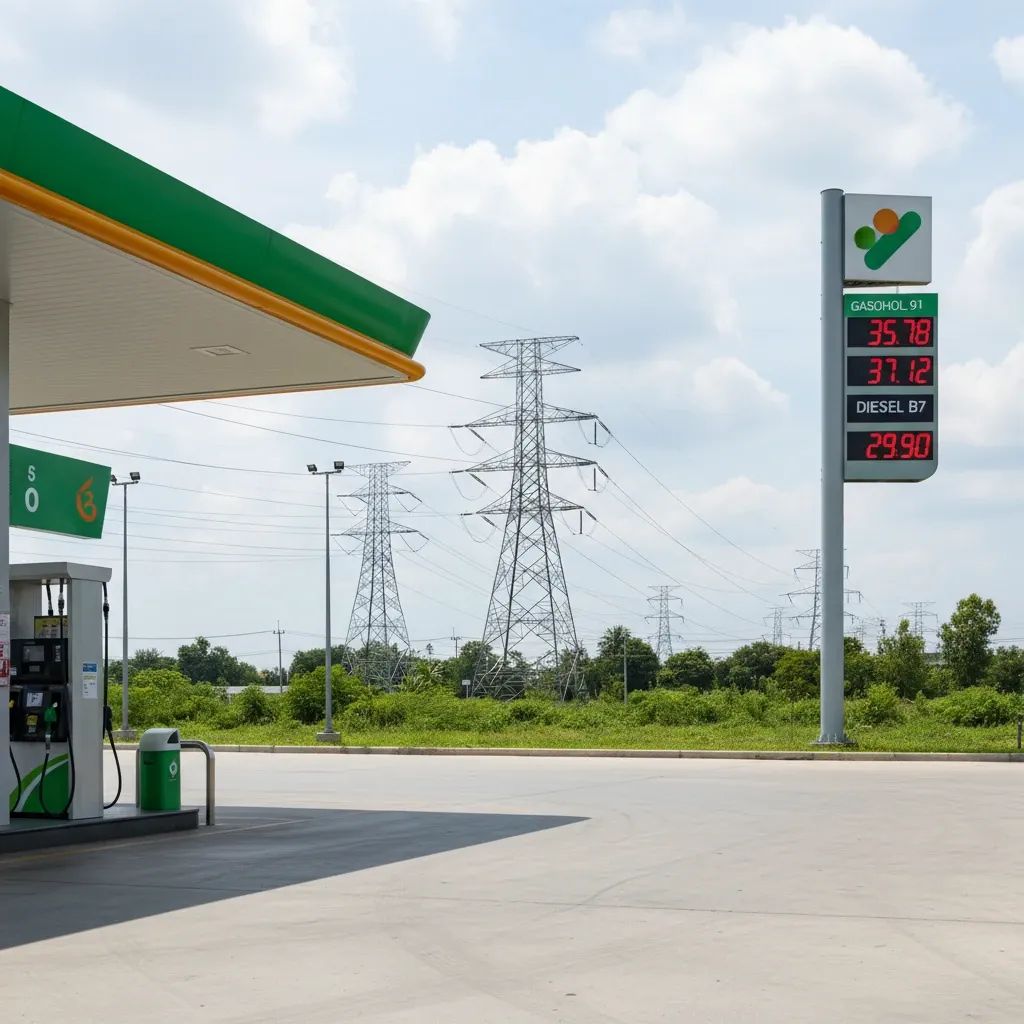
The Thailand United Thai Nation Party (UTN) has thrown its full weight behind leader Pirapan Salirathavibhaga’s promise to cut pump prices by as much as ฿25 per litre, a move that would ripple through transport fares, food costs and household electricity bills within weeks.
Why This Matters
• Cheaper fuel within 6 months if UTN’s draft energy bill survives parliament.
• Electricity tariff capped at ฿3.30 per unit, roughly what Bangkok apartments paid in 2019.
• Border policy could void two Thai-Cambodian MOUs, reshaping offshore gas concessions.
• 10 % levy on Thailand’s largest corporations would seed a national social-welfare fund.
Energy First: From Global Benchmarks to Local Costs
Pirapan’s flagship plan upends the current Singapore-linked oil pricing formula, replacing it with a “Cost Plus” model pegged to domestic production costs. The draft legislation—180 sections long—would also transform the Oil Fuel Fund into a physical strategic petroleum reserve, forcing refiners to keep barrels in Thai tanks rather than cash in a controversial levy. Advocates inside the Thailand Energy Ministry say the shift could shave another ฿5-6 off every litre even before excise tweaks kick in.
In parallel, UTN wants fuel prices adjusted once a month, not daily, giving logistics companies price certainty and curbing pump-side speculation. Critics argue the policy risks under-investment in refining, but Pirapan counters that lower freight costs will spark broader GDP gains.
A Hawkish Line on the Eastern Border
The party’s security plank is equally blunt. Pirapan vows to cancel MOU 43 and MOU 44 with Cambodia, bilateral roadmaps that currently guide maritime boundary talks. He frames the documents as tools Cambodia "uses to stall" while drilling disputed gas blocks. If elected, UTN would boost soldiers’ field allowances to ฿200,000 per combat rotation and raise basic trainee pay to ฿15,000 per month, arguing that professional morale is a pre-condition for credible deterrence.
Thai foreign-policy analysts warn that unilateral withdrawal could trigger international arbitration, but UTN strategists believe a harder posture will force faster negotiations over energy-rich waters near Trat and Chanthaburi.
Zero Tolerance: Treating Corruption as a "National Cancer"
Calling graft a “cancer that metastasises in weak law-enforcement tissue,” Pirapan proposes deadline-driven investigations: small fraud would see indictments filed inside 90 days, while mega-scandals exceeding ฿10 B would trigger court-monitored fast-track procedures. Prison terms, he insists, must be "life-altering, not hotel suites behind bars." UTN pledges a public dashboard allowing citizens to track case progress in real time, echoing South Korea’s anti-corruption portal.
Welfare, Jobs and a Controversial "Sharing Economy" Tax
On the social front, UTN rejects GDP worship, arguing that “empty rice bowls, not empty balance sheets” define poverty. Its proposed 10 % mandatory contribution from Thailand’s 300 largest firms would finance a new National Social Equity Fund—expected to raise about ฿120 B annually. Money would bankroll:
• An interest-free emergency credit line worth ฿50 B for low-income households;
• 300,000 public-sector micro-jobs for seniors and the long-term unemployed;
• Free retraining vouchers to pivot laid-off factory workers into solar-farm maintenance.
Economists remain split. Some hail the plan as “Thai-style universal basic income”; others warn it could nudge multinationals toward Vietnam’s tax corridor.
Classroom to Rice Field: Sector-Specific Pledges
Education policy abandons high-stakes entrance exams in favour of regional quotas and skill portfolios, aiming to cut the ฿13 B private tutoring market that penalises rural families. In agriculture, UTN would classify rice growers as “entrepreneurs” eligible for venture equity, not just subsidies. The state would co-invest in fertiliser plants and village-scale solar micro-grids, targeting a 20 % drop in production costs within 4 years.
What This Means for Residents
Immediate relief at the petrol pump could free up more than ฿1,500 per month for a family driving a 40-litre car weekly—about the cost of a fortnight’s fresh-market groceries in Chiang Mai.
Lower electricity bills would cushion condo service-fee hikes and make home-based SMEs more competitive versus regional e-commerce rivals.
Tightened border rhetoric may translate into a short-term increase in defence spending, potentially crowding out civil-works budgets but boosting job openings for technical graduates in the emerging Thai defence-manufacturing cluster.
The corporate social levy could redirect profits into local micro-loans and elder-care stipends, yet shareholders may seek to offset the cost through smaller dividend payouts.
Coalition Arithmetic and the Road Ahead
Even if UTN’s agenda resonates with motorists and middle-class voters, pre-election polling still places the party in the mid-double-digit seat range, meaning coalition trade-offs are inevitable. Pirapan says any alliance must accept three non-negotiables: energy-price reform, border assertiveness, and institutional loyalty. Observers note that potential partners—from Thailand’s Bhumjaithai Party to the Democrats—have conflicting views on both the Cambodia MOUs and the 10 % corporate levy.
Meanwhile, governance watchdog iLaw reminds voters that large-scale energy overhaul requires not only a new statute but also consent from the Energy Regulatory Commission and the Council of State—processes that could stretch beyond a 4-year parliamentary term.
Bottom Line
If Pirapan’s blueprint survives the legislative gauntlet, residents will feel its impact first at the pump and next on their monthly utility apps. Yet every promise—cheap fuel, cleaner politics, safer borders—hinges on UTN transforming today’s campaign buzz into tomorrow’s enforceable law. For voters weighing their tick on 8 February, the question is simple: do Pirapan’s numbers add up faster than Thailand’s bills come due?


