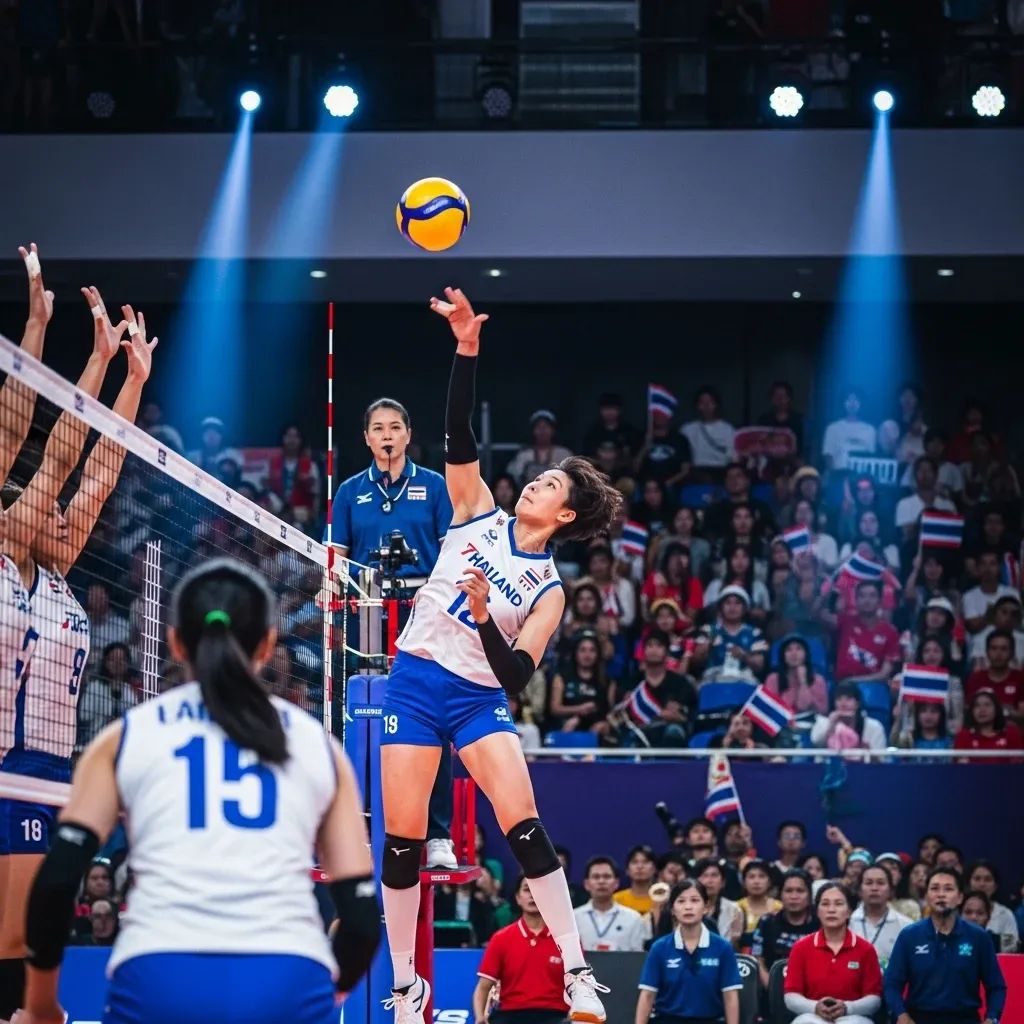
Thailand's women's volleyball team has accomplished something no generation of their predecessors could achieve: they've earned a direct ticket to the Olympic Games. When setter Pornpun Guedpard orchestrated that final rally against China on August 30, 2026 in Tianjin, securing a 3-2 victory and the AVC Women's Volleyball Asian Championship title, they didn't just win another continental medal—they unlocked qualification to Los Angeles 2028, the first time Thailand's women will compete under the Olympic rings.
Why This Matters
• Automatic Olympic entry: As continental champions, Thailand bypassed the brutally competitive World Championship qualification gauntlet that has historically blocked them from Olympic participation for six decades.
• Two-year preparation window: The team now has until July 2028 to refine tactics, develop backup personnel, and rest aging stars like the 33-year-old Guedpard.
• Sponsorship momentum building: Expect increased corporate investment in women's sports infrastructure across Thailand in the coming months, particularly in regional training academies and youth volleyball development.
• Fourth continental crown: This victory extends Thailand's dominance of Asian women's volleyball, cementing their status as a genuine regional power alongside Japan and China.
How a Five-Set Thriller Rewrote History
The arc of the final match told a story that will resonate with Thai sports audiences for decades: early command, a devastating collapse, and then the mental fortitude to claw back at precisely the moment when failure seemed inevitable.
Thailand opened authoritatively. Their serve reception held steady, while their attacking patterns carried precision. At 25-20 in the opening set, they appeared positioned to control the entire match. The crowd of thousands in Tianjin—overwhelmingly backing the hosts—couldn't yet sense what was coming.
China unleashed their response with startling force in the second frame. Thailand's passing discipline fractured almost immediately, gifting their opponents easy rhythms for setting and attacking. China's blocking formation solidified, particularly around their middle defenders, forcing Thai hitters into compromised angles. The scoreline ballooned to 25-11—a swing so dramatic it suggested two entirely different teams playing the same sport. For the first time, China had seized psychological momentum, and the home crowd noise became almost weaponized.
The hosts extended their advantage into set three. Another tight contest saw China edge ahead 25-23, moving within one set of the trophy. Thailand's Olympic dream flickered. The bench grew visibly tense. One more Chinese victory and sixty years of chasing Olympic qualification would extend indefinitely.
What distinguished this team from previous generations wasn't talent alone—it was their refusal to decompose under maximum pressure. In the fourth set, Thailand recalibrated fundamentally. Their serve aggression returned, forcing China's receivers into discomfort. Their counterattacking rhythm snapped back into sync. Thailand controlled tempo sufficiently to dominate 25-18, erasing China's one-set lead and forcing a decider where no team held psychological advantage.
The fifth set became a battle of single-point rallies, each one carrying generational weight. Thailand's players managed their emotions better at critical junctures. When scores reached 9-8, 11-10, and 12-11, they executed when it mattered most. The final sequence saw Thailand close definitively at 15-10, and as the spike landed untouched on the Chinese court, the Thai delegation erupted in tears—the release of sixty years of Olympic exclusion condensed into one instant.
The Architect Behind the Victory
Pornpun Guedpard orchestrated this breakthrough from the setter position, earning tournament MVP honors for her performance. Born in Nong Khai province in 1993, she spent her early volleyball years as an outside hitter before transitioning to setter during secondary school—a positional shift that defined her career trajectory. She joined Thailand's national program in 2012 and has since accumulated an almost surreal medal collection: six Southeast Asian Games golds, three Asian Championship titles, Asian Games medals in both silver and bronze, plus professional stints across five countries including Indonesia, Japan, Romania, South Korea, and the United States.
Her attack trio delivered equally. Sasipapron Janthawisut, the aggressive outside hitter, contributed 28 points in the final—a masterclass in consistency executed under hostile conditions. She earned Best Outside Hitter honors at the tournament. Thatdao Nuekjang, a survivor of the legendary "Seven Angels" generation that includes names like Pleumjit Thinkaow and Wilavan Apinyapong, produced 18 points from middle blocker and secured Best Middle Blocker distinction. Chatchu-On Moksri added 17 points, completing an offensive trio that functioned like a well-synchronized engine.
Defensively, libero Piyanut Pannoy orchestrated back-row coverage while Coach Kiattipong Radchatagriengkai executed tactical shifts between sets with surgical precision—adjusting blocking assignments after China's second-set offensive explosion, tightening serve reception protocols, and identifying counterattack opportunities when margins were thinnest.
What This Means for Thailand's Sports Landscape
For anyone tracking Thai athletics, this extends far beyond medal accumulation. Volleyball ranks as Thailand's second most popular team sport after football, with championship matches regularly pulling millions of television viewers. The women's program has been the primary vehicle of Thai volleyball's global credibility—the men's team has struggled to consistently compete at Asia's highest level, but the women have delivered results that justified massive investments in training infrastructure, coaching salaries, and youth development pipelines spanning decades.
This Olympic qualification signals those investments were sound. A cascade of downstream effects will likely follow: increased sponsorship appetite for women's sports generally, renewed interest in volleyball programs at secondary schools nationwide, and potential government funding increases for sports science support systems. Prime Minister Anutin Charnvirakul publicly congratulated the team, specifically highlighting their "warrior spirit, discipline, unity, and refusal to surrender"—rhetoric that typically signals future resource commitments from government agencies.
The practical window for preparation now extends two years. Thailand's preliminary-round matches at Los Angeles occur in July 2028, providing ample time to rest key aging players, develop backup setters, and integrate emerging talent. The team also secured entry into the 2027 World Championship, another platform to test tactics against global-tier opponents before Olympic competition arrives.
The Decades-Long Road to Recognition
Thailand's volleyball timeline reads like a study in delayed gratification extending back generations. The program first competed internationally at the 1959 Southeast Asian Games, entered the Asian Games in 1966, but Olympic qualification remained locked behind a competitive ceiling only the world's elite could penetrate. For sixty years, Thai players watched their peers from Japan, China, South Korea, and Indonesia compete on sport's biggest stage while they remained spectators.
The foundation shifted in 1998 when Thailand reached their first World Championship under the direction of Coach Kiattipong Radchatagriengkai—the same mentor piloting the current team toward Olympic success. That breakthrough sparked decades of steady climbing. Bronze medals at the 2001 and 2007 Asian Championships preceded their first continental crown in 2009, when they toppled China in Vietnam. Subsequent titles followed in 2013 and 2023. They captured bronze at the 2014 Asian Games and reached the 2018 Asian Games final for the first time, securing silver. Domestically, they've dominated Southeast Asian Games competition with gold medals every cycle since 1995, establishing themselves as the region's undisputed volleyball authority.
But the Olympics eluded them. No matter how many continental titles they stacked, the traditional World Championship qualification pathway remained brutally competitive, forcing Thailand into an endless tournament cycle chasing one of only six available Olympic spots for the entire Asian continent. The 2026 AVC Championship altered that equation fundamentally—continental champions would receive automatic Olympic entry, a rare gift that materializes only once every four years.
Thailand seized the moment.
Recognition of Excellence Across the Squad
The AVC's all-tournament Dream Team selections reflected talent distribution across Asian volleyball, but Thailand's presence dominated. Three players secured honors:
• Pornpun Guedpard (Best Setter, MVP)
• Sasipapron Janthawisut (Best Outside Hitter)
• Thatdao Nuekjang (Best Middle Blocker)
China also placed three selections, while Japan's Yukiko Wada earned Best Opposite. This balance reveals a shifting power dynamic in Asian women's volleyball. Historically, Japan and China monopolized premium positions and Olympic qualification through consistent World Championship performances. Thailand's emergence—built on continuity in coaching philosophy, investment in sports science systems, and tactical sophistication—signals a reconfigured competitive landscape. What was once essentially a two-nation competition for continental dominance has evolved into genuine three-way competition.
Pre-Tournament Preparation and Facility Details
The squad touched down in Tianjin on August 17, 2026, providing a compressed adaptation window before matches began. Under Coach Kiattipong's direction, training emphasized serve reception fundamentals, blocking discipline, and counterattack speed. The Thailand Sports Authority deployed sports science personnel to manage recovery between matches—a logistical detail separating elite programs from aspirants. Quality regeneration prevents cumulative fatigue that derails teams in tournament formats where matches occur on consecutive days.
The venue itself—a sprawling complex housing 12 courts with two courts exclusively configured for Thailand's use—provided ideal conditions. Matches unfolded rapidly through the tournament: Thailand defeated South Korea 3-0, then beat Japan 3-1 in the semifinal before the dramatic final sequence. The trajectory suggested a team reaching peak performance precisely when required—a hallmark of elite coaching and mental conditioning protocols.
The Path Forward to Los Angeles
The 2028 Olympics commence July 14 and conclude July 30, with volleyball preliminaries beginning immediately. Thailand will enter the 12-team tournament among the weakest seeds but carrying something opponents cannot account for: psychological momentum from historic qualification. They'll face established powerhouses like France, Italy, and the Dominican Republic—programs with decades of Olympic participation experience. Medal chances remain remote realistically.
But that was never the central objective. Thailand qualified for the Olympics. After generations chasing that dream, the moment has arrived. For residents watching this sport evolve, for young girls considering volleyball as a career pathway, and for a nation that measures sporting pride carefully, that achievement alone justifies the celebration.