
Thailand's Stock Market Closed February with Its Strongest Rally in Years—What Comes Next
The Thailand Stock Exchange (SET) Index finished February at 1,528.26 points, a level that would have seemed unreachable just months earlier. Since January 1, the benchmark has climbed 21.3%—a stunning move that reflects a fundamental shift in how global investors view the kingdom's assets and economic prospects. For anyone tracking wealth, retirement savings, or exposure to Thai equities, this matters because the psychology of the market is shifting, and the real question is whether gains can stick around or whether recent momentum has already priced in most of the good news.
Why This Matters
• Foreign investors are back after years of absence: Thailand lured a net ฿58.9 billion in foreign buying during the first two months of 2026. Market data shows a single-day record of ฿16.54 billion on February 10—the kind of inflow that suggests conviction, not speculation.
• Trading energy nearly doubled year-over-year: Daily turnover averaged ฿73 billion in February, up 40% from a year prior, indicating the rally is pulling in real capital rather than just algorithmic shuffling.
• Dividend yields remain compelling: At 3.68%, Thai equities offer more income than most regional peers (Asian average: 2.67%) and substantially more than the 1% policy rate now set by the Thailand Central Bank. For Thai residents seeking income from their investments, this is a key consideration.
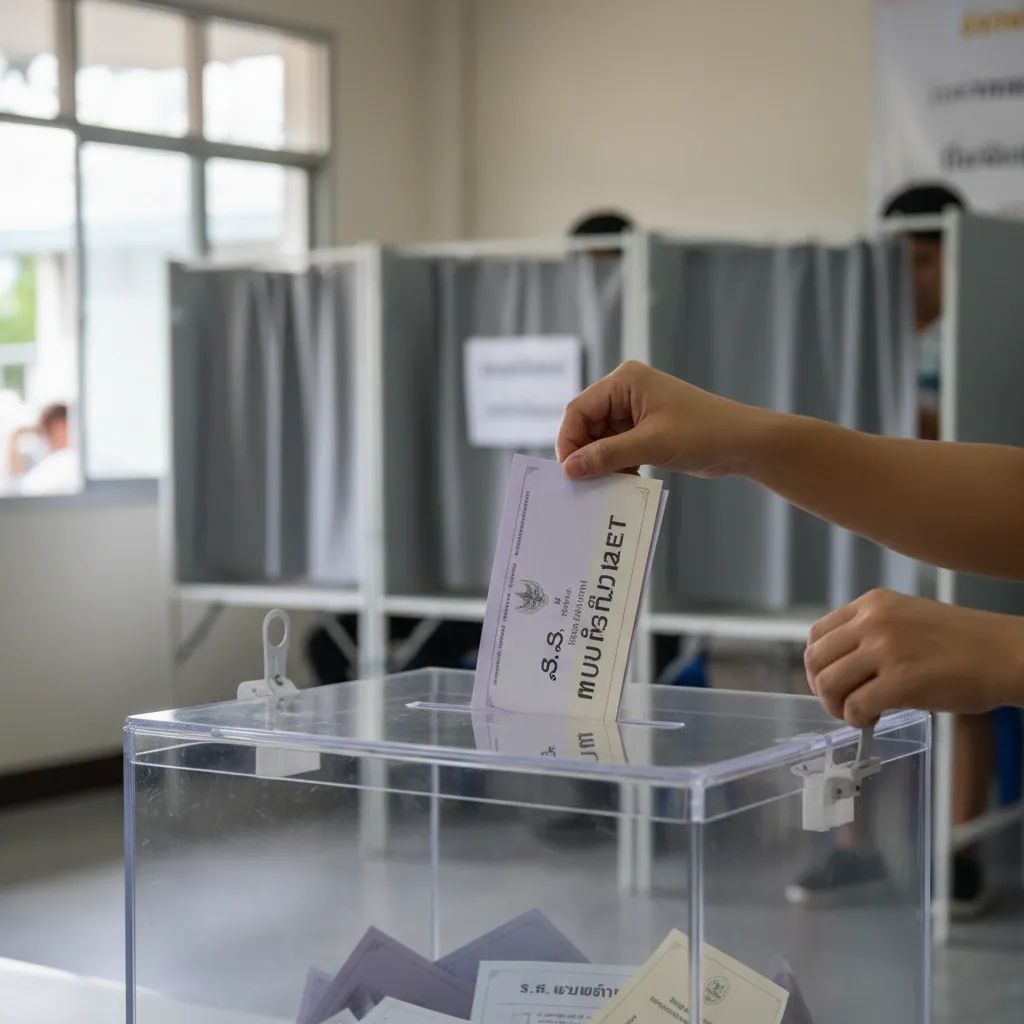
• The critical trigger was political clarity: A new government took office in early February, ending months of coalition uncertainty and unlocking investor capital that had been parked on the sidelines.
What This Means for Residents: A New Calculus
For retail investors, expats, and wealth managers in Thailand holding or considering Thai equities, the landscape has shifted but remains littered with traps.
At a forward P/E (price-to-earnings ratio) of 16.0x, the market has re-rated but is not stretched relative to Asian peers (15.1x average). The 3.68% dividend yield comfortably beats the 1% policy rate, making dividend-focused portfolios mathematically attractive for income. Utilities, telecoms, and real estate investment trusts (REITs) appeal to yield-seeking residents, though analysts warn that property-linked plays are "yield traps"—high payouts masking weak demand and borrower vulnerability in an economy where household debt exceeds 90% of GDP.
Understanding Household Debt and What It Means for You: When household debt reaches 90% of GDP, it means Thai households collectively owe amounts equal to 90% of the entire annual economic output. For residents, this is relevant because it indicates that many Thai consumers are highly leveraged, which can limit their spending power and discretionary income. If credit conditions tighten or jobs become scarcer, households with high debt loads are vulnerable, which can reduce overall consumer spending and dampen economic growth.
For higher-risk tolerant investors, new economy plays—data centers, EV supply chains, semiconductor packaging—offer genuine growth tied to Thailand's ambitions to ascend the manufacturing value chain. These names are volatile and sensitive to swings in global tech investment, but the foreign direct investment (FDI) tailwind is real.
The critical discipline: valuation precision. The market has priced in political stability and rate cuts. It is pricing in a modest earnings recovery. But it has not yet priced in the risk that corporate profits disappoint if domestic consumption remains anemic due to household debt burdens. Earnings season in April will be the test.
The Restoration of Confidence
For much of 2025, foreign money had abandoned Thailand. The political landscape was murky, coalition negotiations dragged, and investors could find better opportunities elsewhere. That changed with the swearing-in of a new, stable government in early February. The appointment of ministers and cabinet formation occurred without the paralysis or policy reversals that typically plague Thai administrations in their opening weeks.
The impact was immediate. Foreign funds executed a net purchase of ฿54.56 billion in February alone, representing 51.74% of total market turnover—the highest proportion in years. This was not speculative hot money. These were long-term portfolio managers and pension fund mandates reassigning capital after being significantly underweight Thailand for 12 months. The arithmetic is straightforward: if you had expected a 5% allocation to Thailand and held only 2% for most of 2025, then February was your moment to rebalance.
What made the political outcome acceptable to foreign investors was not the specific names or party affiliations but rather three structural signals. First, the incoming administration explicitly signaled pro-foreign-investment messaging in its first weeks. Second, infrastructure spending and digital sector stimulus were telegraphed as priorities. Third—and this is crucial for exporters—the coalition excluded parties historically hostile to foreign direct investment and open trade policy.
Earnings Surprises and a Favorable Trade Shock
Timing matters in markets. Thailand's economic data for the fourth quarter of 2025 arrived stronger than analysts had penciled in, with GDP growth beating consensus forecasts. Tourism inflows accelerated, manufacturing picked up as global supply chains continued diversifying out of China, and domestic consumption showed tentative signs of life.
Market reports indicate that geopolitical developments in February reduced tariff pressures on Thai exporters. Global import tariffs settled at lower levels than had been feared—providing relief for Thailand's export-dependent sectors—electronics components, machinery, textiles. Suddenly, the damage control narratives shifted to cautious optimism. Shares in industrial exporters rebounded sharply.
Adding fuel, the Bank of Thailand cut its policy rate by 25 basis points to 1.00% in late February. Officials cited subdued domestic demand and benign inflation, but the signal was unmistakable: monetary accommodation would continue. For equity investors, lower rates are not just good for discounting future earnings; they also trigger re-rating across dividend-paying sectors and high-yielding infrastructure plays that suddenly look attractive relative to near-zero savings yields.
Sectoral Divergence and the New Economy Play
Not all stocks moved equally. The gains were concentrated in technology and natural resources, with large-cap names in the MSCI Thailand Index leading the way. The real energy came from businesses tied to Thailand's Eastern Economic Corridor (EEC)—the government's industrial special zone aimed at attracting digital manufacturing hubs.
Mid-cap components suppliers with exposure to data center infrastructure and semiconductor assembly emerged as standout performers. Their upside rested on dual catalysts: supply chain reconfiguration pulling manufacturing to Thailand and the physical expansion of EEC facilities coming online. Energy and petrochemical plays also ran higher in mid-month, leveraging elevated crude prices tied to Middle East tensions. Banking and finance shares initially lagged but found footing late in the month as investors modeled the earnings lift from compressed funding costs and early credit recovery. Tourism names—hotels, airlines, retail—continued benefiting from rising visitor numbers from China and extended visa exemptions for key source countries.
Derivatives Surge Reflects Both Opportunity and Risk
Volume on the Thailand Futures Exchange (TFEX) jumped 47.1% month-over-month to an average of 668,476 contracts daily in February. SET50 Index futures and single-stock futures drove the surge, evidence that institutional money was not just buying stock but also hedging and using leverage. Over the first two months of 2026, futures volume rose 34.9% year-over-year—a marker of improved market depth.
What are derivatives? In simple terms, derivatives are financial contracts whose value is based on the price of an underlying asset (like SET Index stocks). Futures contracts and options allow investors to amplify their bets—potentially gaining more from price moves but also risking larger losses. The surge in options activity in large-cap tech and financial names reflects retail hunger for leveraged exposure to the rally. This is a double-edged condition: deeper derivatives markets add liquidity and price discovery, but they also magnify volatility when large positions unwind or margin calls force selling. Late February proved the point.
The Middle East Matters: Late-Month Reality Check
In the final week of February, escalating violence in the Middle East triggered a classic risk-off move across global equities. Investors rotated from growth stocks into safe-haven assets, and the SET gave back some—though not all—of its monthly gains. The selloff was broad but hit cyclical and export-sensitive names hardest. Defensive sectors—utilities, telecom, consumer staples with high dividends—weathered the storm better.
Despite the pullback, the SET finished the month at a one-year high. Analysts characterized the correction as technical rather than fundamental. Importantly, foreign investors did not flee; they continued buying on weakness, suggesting that institutional conviction in the structural upside had not wavered.
Analyst Consensus: A "Stock Picker's Market"
Brokerage targets diverged after the February rally. Asia Plus Securities raised its year-end 2026 target to 1,580 points (from 1,440), while Krungsri Securities penciled in a bullish 1,650 in a best-case scenario. Conservative houses clustered targets around 1,400-1,432, a gap that reflects genuine debate about whether the recovery is durable.
The consensus narrative across Thai and international research: 2026 will be a "stock picker's market." Macro tailwinds (rate cuts, political clarity) will fade into the background. Winners and losers will be determined by company-specific execution, sector rotation, and exposure to FDI flows. Analysts recommend concentrating on large-cap names in the SET100 or SETHD indices, which are more insulated from credit stagnation and weak domestic demand that continue to constrain small and mid-cap operators.
Practical Considerations for Thailand Residents
Tax and Dividend Implications: Thai residents should note that dividend income from Thai equities is subject to Thai tax. Depending on your tax bracket and residency status, dividend yields may be reduced after tax obligations. It's advisable to consult with a tax professional about your personal situation.
Currency Considerations for Expats: If you hold funds in foreign currency and invest in Thai equities, changes in the baht exchange rate will affect your returns when you convert back. Monitor currency movements carefully, especially if you plan to repatriate funds.
How to Access Thai Equities: If you're new to investing in Thailand, brokerages such as Krungsri, Kasikornbank, and major securities firms offer brokerage accounts for both Thai nationals and foreigners. You'll need to open a trading account, provide identification, and meet any residency or visa requirements.
What to Watch Going Forward: Keep an eye on April earnings reports and the ongoing situation in the Middle East, as these will be critical in determining whether February's rally proves sustainable.
Structural Risks That Could Derail the Rally
Three risks loom large. First, a sharper-than-expected deceleration in global growth would sap demand for Thai exports and dent multinational investment plans in the EEC. Second, renewed trade tensions could erase the tariff relief that recent developments delivered. Third, the persistent structural problem of household debt—now over 90% of GDP—continues to weigh on consumer spending and constrains the domestic upside. If credit conditions tighten further or unemployment rises, that household debt becomes a deflationary anchor.
The Middle East conflict, if it escalates or disrupts energy supplies, could also force a reset. Oil prices would spike, inflation would re-emerge, and the central bank might have to pause or reverse its rate-cutting cycle. That scenario would break the equity rally's primary fuel.
Market Infrastructure and Policy Initiatives
No new companies listed on the SET or Market for Alternative Investment (mai) in February—a sign that private firms remain cautious about IPO timing despite the positive equity market backdrop. However, the government has been accelerating capital market reforms. New initiatives include the Thailand Investment Savings Account (TISA), an Omnibus Law to streamline securities regulation, and revised short-selling rules aimed at improving market depth.
The absence of redemption pressure from Long-Term Equity Funds (LTF)—tax-advantaged products that hemorrhaged assets in prior years—has also been a quiet positive. Without forced selling from these funds, natural demand from foreign and retail investors has asserted itself more cleanly.
Regional Context: Thailand Outperforming
Within Southeast Asia, Thailand's 21.3% year-to-date return through February ranks at the top, outpacing Vietnam, Indonesia, and Malaysia. This reflects both prior undervaluation and catalysts specific to Thailand—political resolution, rate cuts, and improved export conditions. However, the historical P/E of 17.1x remains below the Asian average of 18.6x, suggesting the market is not overheated by historical standards or regional comparison.
This valuation buffer, combined with the attractive dividend yield, continues drawing international pension funds and sovereign wealth managers hunting for income and moderate growth in an era when U.S. and European equities command premium valuations.
The April Test: Earnings Season Will Define the Path Forward
The critical inflection point arrives in April when first-quarter 2026 earnings begin filtering out. Investors will scrutinize whether the GDP beat in Q4 2025 translated into higher corporate profits or whether margin compression and weak domestic demand revealed cracks in the recovery story. Tourism rebounds are tangible; manufacturing pickup is visible. But can small enterprises and household-dependent sectors deliver earnings growth? That question remains open.
For now, cautious optimism prevails. The SET has re-rated on justified catalysts—stable government, rate accommodation, and export relief. But late-February's Middle East volatility is a sobering reminder that external shocks can derail even the best-constructed thesis. The next three months will determine whether February's rally becomes a durable rerating or a false spring.


