
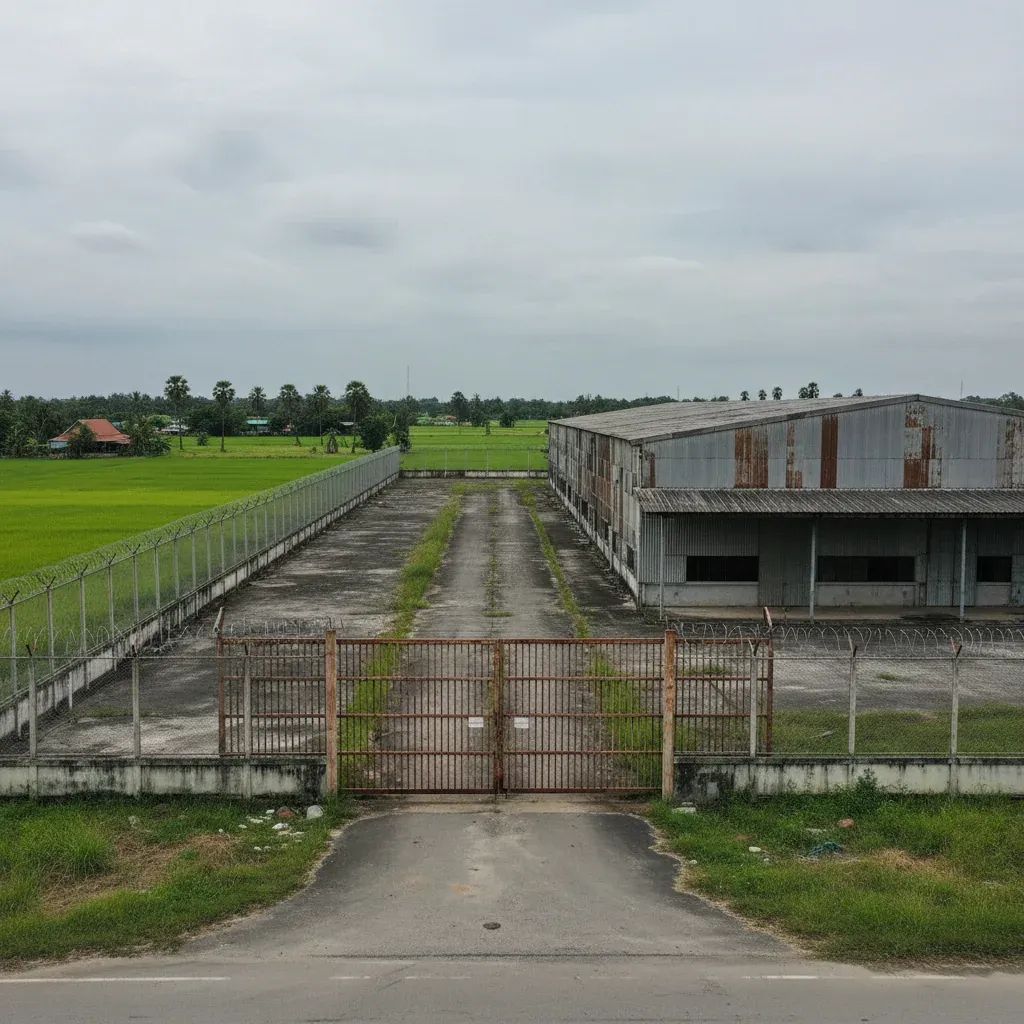
The Thailand Department of Business Development has escalated enforcement against foreign-controlled factories in the Eastern Economic Corridor, shifting from warnings to criminal prosecution of Thai nationals who served as nominee shareholders. The crackdown targets operations where foreign operators used Thai frontmen to circumvent ownership laws while controlling actual business operations.
Residents and investors in Chachoengsao, Chonburi, and Rayong provinces—the core EEC industrial zones—face immediate consequences: stranded land assets, criminal exposure for those involved in nominee arrangements, employment disruption, and heightened scrutiny of all industrial development in affected areas.
Why This Matters
• Stranded assets spreading: Properties purchased at 7 million baht per rai are now practically unsellable; buyers recognize legal exposure from potential government seizure or ongoing investigations into ownership legitimacy.
• Criminal exposure for all parties: Both Thai nominees and foreign operators face up to 3 years imprisonment, fines reaching 1 million baht, and potential seizure of company assets under the Foreign Business Act.
• Compliance tightened April 1, 2026: Order No. 1/2569 requires company directors to sign Investment Confirmation Statements explicitly declaring no nominee arrangements exist when foreign signatories are approved—false certification carries criminal penalties.
• Employment disruption underway: Thousands of improperly documented workers face deportation and work permit restrictions; employers face per-worker fines and potential imprisonment.
The Land Acquisition Strategy
Agricultural land transformation happened swiftly. Between 2020 and 2024, vast tracts of farmland in Chachoengsao, Chonburi, and Rayong—provinces forming the EEC's southern industrial base—shifted from cassava fields and crop rotation into construction sites spanning 500 to 1,000 rai. This wasn't organic development. Foreign investment groups, predominantly backed by Chinese capital, identified a critical vulnerability in Thailand's regulatory structure: while the Industrial Estate Authority maintains strict licensing protocols in official estates, the surrounding unzoned agricultural lands remained largely unmonitored.
The strategy was elegant in its simplicity. Rather than pursue IEAT-designated industrial plots, where transparency, environmental compliance, and factory licensing are mandatory, these groups acquired non-IEAT land through Thai nationals acting as nominee shareholders. The legal fiction was straightforward: a Thai person held the land title and company ownership on paper, while foreign operators controlled all operational and financial decisions in practice.
This mechanism came with a crucial advantage—land prices skyrocketed to 7 million baht per rai, creating artificial scarcity. Local Thai entrepreneurs and legitimate industrial developers couldn't compete at those valuations. Small farmers, presented with unprecedented offer prices, sold quickly. What they didn't realize was that bulk purchases were pooling land into foreign-controlled clusters while establishing a convenient legal barrier to ownership detection.
Once consolidated, development proceeded using a misclassification strategy with serious regulatory implications. Facilities were registered as "warehouses"—a classification that bypasses two critical Thai requirements. The first is the Factory License (Ror.Ngor. 4), which triggers environmental impact studies, emissions monitoring, and ongoing Ministry of Industry inspections. The second is mandatory compliance with the Enhancement and Conservation of National Environmental Quality Act, which establishes discharge limits, waste handling protocols, and regular environmental audits.
By registering as warehouses, these foreign operators conducted heavy manufacturing without environmental permits, effluent monitoring, or waste management oversight. Construction materials arrived directly from China. Cranes, forklifts, and machinery came through Thailand-Laos border crossings. Everything stayed within the compound—a self-contained industrial operation operating in regulatory shadow.
The Economic Exclusion Model
What residents of Chachoengsao, Chonburi, and Rayong witnessed was not industrial development benefiting their communities, but rather the establishment of what functioned as a foreign economic enclave—geographically Thai but operationally isolated. The surrounding landscape began displaying visible markers of foreign control: signage in Mandarin, restaurants serving only Chinese cuisine, convenience stores stocked with imported goods, and workers who didn't speak Thai.
The labor model reveals the clearest exclusion. Skilled positions—equipment technicians, production supervisors, quality control specialists—were staffed exclusively by Chinese nationals brought in on tourist visas or illegal employment arrangements. For manual labor, the model relied on Myanmar migrant workers recruited through cross-border brokerage networks, then housed in closed compounds behind factory perimeters. These workers were fed at Chinese-operated canteens, purchased basic goods from Chinese-controlled shops, and used services—transportation, communications, entertainment—within the network.
The economic circulation never reached Thai residents. A facility employing 2,000 workers generated virtually zero local employment. Thai suppliers received no procurement contracts. Thai service providers found no contracts for maintenance, transportation, or consulting. Local small businesses couldn't access these consumer bases; they were sealed off by language barriers and intentional separation.
For the Thailand Revenue Department, the implications were equally stark. These operations deliberately minimized their tax footprint. Nominee structures enabled profit shifting between entities, inflated operational costs were reported to reduce taxable income, and complex transfer pricing between related companies ensured minimal Thai-sourced taxation. DBD analysts later estimated that unrecorded tax evasion from these operations exceeded several hundred million baht annually in the EEC provinces alone—revenue that should have supported schools, hospitals, and infrastructure.
Infrastructure consumption, however, was substantial and real. These factories drew power from Thailand's national electricity grid, water from local sources, and depended on road networks and utilities funded by Thai taxpayers. The Thai state subsidized operations while foreign owners captured profits. Waste and emissions remained for Thai communities to absorb.
The AI Surveillance and Enforcement Shift
The turning point came from technological convergence. The Thailand Department of Business Development deployed artificial intelligence systems designed to analyze ownership patterns and flag suspicious financial behavior across thousands of company registrations. The iBas system—now integrated into the business registration process—identifies behavioral patterns suggesting nominee arrangements: when Thai shareholders are added without corresponding financial capacity, when directors or signatories change repeatedly, when registered office addresses shift frequently, or when communication records show the Thai shareholder exercising no actual control.
Simultaneously, the National Anti-Money Laundering Office traced cross-border capital flows, identifying foreign source funds, tracing their pathway into Thailand through nominee structures, and documenting how profits exited the country. When foreign ownership is concealed, financial forensics become the decisive investigative tool.
By January 2026, enforcement standards escalated sharply. New registration requirements mandated that Thai shareholders in companies with foreign participation below 50%, or where foreigners hold signing authority, submit audited bank statements proving genuine financial capacity. The rule required documented evidence that the money was authentically theirs—traceable to legitimate sources, held in personal accounts for adequate duration.
Order No. 1/2569, effective April 1, 2026, raised the bar further. Any company director approving amendments to add foreign nationals as authorized signatories must now execute an Investment Confirmation Statement explicitly certifying that all shareholders have genuinely invested capital and that no nominee arrangement exists. Signing false certifications carries criminal penalties.
The regulatory philosophy shifted from nominal share percentages to substance over form—examining who actually makes operational decisions, where financial control resides, whose capital genuinely funded the venture, and how profits are actually distributed.
Cascade of Consequences for Residents
For residents and investors in the EEC provinces, the crackdown has created several immediate pressures.
Property Owners and Stranded Assets
Individuals who purchased land at inflated prices during the boom now cannot exit. Legitimate buyers avoid these parcels, viewing them as potentially subject to government seizure or frozen pending resolution of ownership disputes. A Rayong property that commanded 7 million baht per rai in 2024 now sits on the market at 4.2 million baht with minimal inquiry. Owners face indefinite illiquidity on their single largest investment. Due diligence for Thai property buyers now requires title verification through the DBD and confirmation that ownership structures are compliant with foreign business restrictions.
Criminal Exposure for Nominees
Thai nationals serving as nominee shareholders face prosecution regardless of whether they profited. Even nominees compensated for their role face imprisonment up to 3 years, fines from 100,000 to 1 million baht, or asset dissolution. The government prosecutes the legal structure rather than evaluating individual motivation or compensation. The law applies to accomplices and architects equally.
Employment Sector Disruption
Chinese nationals on tourist visas face individual deportation, fines of 50,000 to 200,000 baht per person, and a two-year ban on Thai work permit applications. Myanmar migrant workers may face similar deportation consequences depending on their employment status documentation. Companies employing undocumented workers face fines per illegal worker, imprisonment for repeat violations, and a three-year prohibition on hiring any foreign nationals. Thousands of workers employed in these shadow factories are now transitory—unable to secure legal status and exposed to sudden displacement.
Reputational Contamination
Thai businesses considering industrial development in these zones now carry legal and reputational risk. Purchasing adjacent land or partnering with companies under investigation creates potential liability through association. Investment hesitation has frozen development in surrounding areas, particularly in Chachoengsao and northern Rayong.
Why Legitimate Foreign Investment Remains Available
Thailand has not closed doors to foreign industrial investment—it has streamlined legitimate pathways. The Board of Investment grants promotion certificates to foreign manufacturers meeting sector criteria, offering 100% ownership rights, corporate income tax exemptions for 5-8 years, permission for unlimited foreign employee hiring, and import duty exemptions on machinery and raw materials. These benefits are substantial and legal.
The Thai-Chinese Rayong Industrial Zone (TCRIZ), established in 2005 as a state-supervised joint venture, demonstrates the compliant model. TCRIZ hosts approximately 170 factory projects from Chinese investors, generated over 45,000 jobs, and generated measurable economic contributions through wages, tax payments, supplier contracts, and infrastructure investment. These operations comply with Thai environmental law, Factory Act requirements, and foreign employment regulations.
The distinction between TCRIZ and shadow zones is compliance. Legal operations file environmental reports, pay taxes, and integrate into local labor markets. They benefit from IEAT's centralized waste treatment, electricity distribution, and regulatory infrastructure. They are auditable and transparent.
The "zero-dollar" model promised short-term extraction at the cost of long-term illegality. Foreign operators who chose that path miscalculated the enforcement environment. That miscalculation is now proving ruinous.
Environmental Damage and Regulatory Reckoning
For years, factories operating as unclassified warehouses generated industrial waste without permits, documentation, or treatment. Hazardous substances were stored or disposed of outside legal frameworks. Wastewater bypassed monitoring systems binding legitimate operations. Emissions accumulated unmeasured.
Thailand's environmental legal framework is modernizing substantially. The proposed Pollutant Release and Transfer Register (PRTR) Act will require industrial operators to disclose all pollutant releases to air, water, and soil, establishing unprecedented environmental transparency. The Clean Air Management Act establishes PM2.5 regulatory frameworks. The Climate Change Act mandates greenhouse gas reporting and establishes carbon pricing mechanisms.
The Ministry of Industry targets 100% compliance with "green industry" guidelines by 2025, emphasizing sustainable development. IEAT is developing Bio-Circular-Green (BCG) economy industrial estates launching in 2026, where operations must meet rigorous environmental and social standards.
Illegal factories now face retroactive scrutiny. If environmental violations can be documented, facilities face shutdown orders, remediation costs, and administrative penalties. For foreign operators, environmental fines compound legal exposure from nominee arrangements.
The Long Lesson for Economic Zone Development
The EEC was designed to attract high-value foreign investment modernizing industrial capacity, transferring technology, and elevating regional prosperity. Instead, unregulated zones became vehicles for extraction—capital inflow without corresponding benefit for residents.
The nominee shareholder crackdown represents restoration of economic sovereignty. It signals that Thailand will not permit foreign capital to exploit regulatory gaps, that tax obligations apply regardless of ownership concealment, and that foreign labor cannot displace local employment without consequence.
The rusting warehouses and frozen properties scattered across Chachoengsao, Chonburi, and Rayong stand as monuments to unchecked greed and light-touch regulation. The next phase—rebuilding these zones around transparent foreign investment, compliant labor practices, and genuine local economic integration—will test whether Thailand can sustain development governed by rule of law rather than regulatory arbitrage.


