
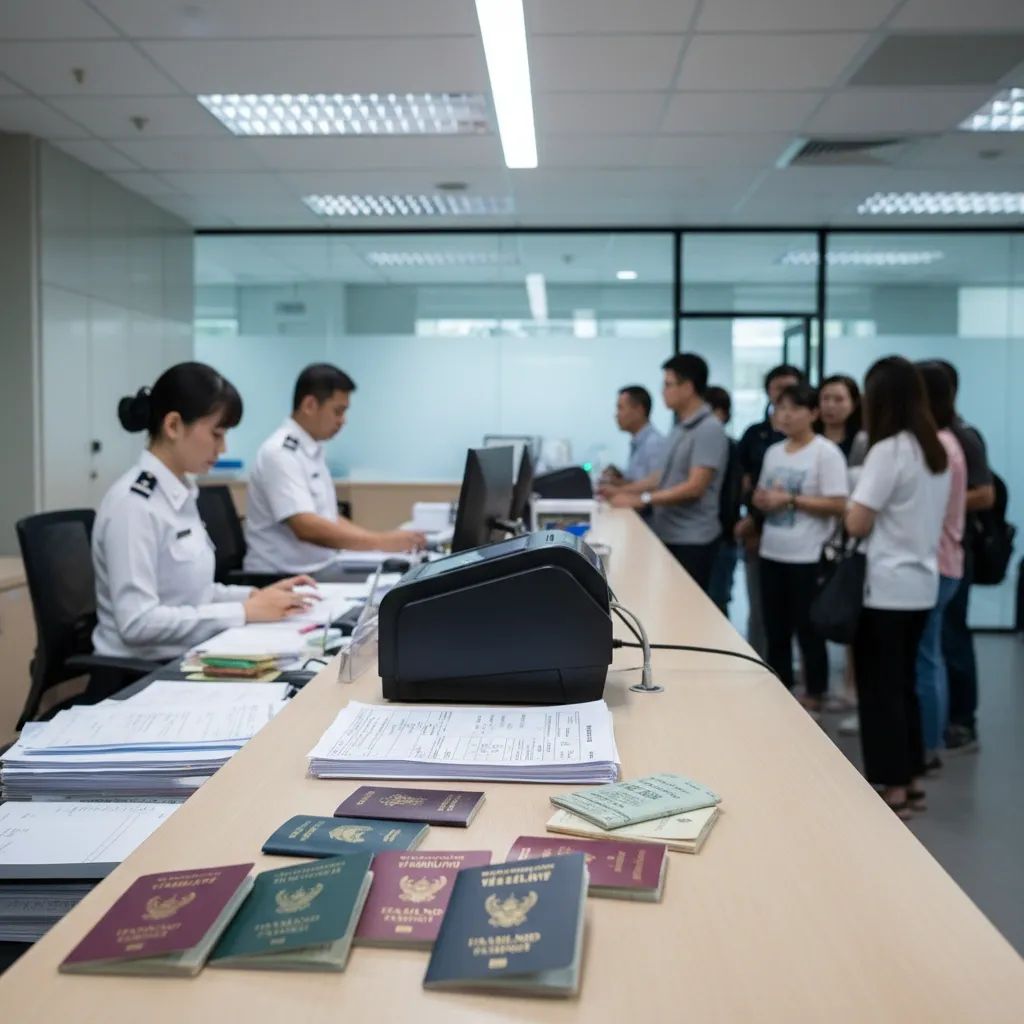
The Reset: How Thailand's Immigration Reckoning Reshapes Life for Residents and Workers
Thailand's immigration authorities have embarked on a data-driven enforcement campaign that is fundamentally altering who can enter the country, who can stay legally, and how long both tourists and long-term residents can plan their lives here. The shift, framed around the "No Entry, No Stay, No Escape" operational doctrine, represents a departure from decades of administrative leniency. It's now the governing reality for anyone crossing Thailand's borders.
Note on Timing: The enforcement measures and policies described throughout this article are being implemented and expanded during 2026. Timeline references reflect ongoing and projected enforcement through this year.
Quick Reference: What You Need to Know
• What changed: 60-day visa-free exemption reduced to 30 days (May 19, 2026); APPS pre-arrival screening expanded; ED visa enforcement intensified; new digital registration required
• Who's affected: Tourists, expats, business travelers, migrant workers, employers
• What to do: Verify your visa status now; bring complete documentation; don't rely on visa runs; maintain work permits; verify employee compliance if you're an employer
Why This Matters
• The 30-day exemption replaced the 60-day option on May 19, 2026, eliminating a key strategy used by repeat short-term visitors and creating urgency for those relying on visa cycling.
• Chonburi province received 147 of 190 nationwide raids (78%), making Pattaya the operational epicenter for organized crime dismantling—this concentration signals where authorities perceive the greatest threat.
• The enforcement mechanism combines three distinct pressure points: pre-arrival screening through the APPS (Advanced Passenger Processing System) blacklist, in-country visa enforcement, and data-linked raids with local police, creating layered risk for those operating outside legal frameworks.
• For legitimate workers and residents, bureaucratic complexity has increased, but paths remain clear for those with documentation, stable employment, and verifiable income sources.
The Intelligence Architecture: How Thailand Identifies Risk Before Arrival
Immigration enforcement in 2026 operates on a principle that most travelers never see: people are evaluated before they board the aircraft to Thailand. The Advanced Passenger Processing System (APPS) flags individuals months or years before they attempt entry, creating an invisible checkpoint that denies boarding without airport-based confrontation.
Between January and May 2026, this pre-flight mechanism prevented 29,490 foreign nationals from boarding Thai-bound flights. Airlines receive real-time flags linked to conviction records in Thailand, outstanding warrants, and Interpol red notices. But the system casts a wider net than criminal databases alone. Travelers flagged for repeated short-term visa entries—visa "runs"—enter the system. So do individuals with insufficient documented funds or vague travel itineraries. The criteria are designed to identify people who appear to be circumventing normal visa channels, not necessarily law enforcement issues in the traditional sense.
The APPS blacklist now contains 169,506 names, a figure that grows monthly. For someone on this list, Thailand becomes effectively unreachable by air. No appeal mechanism is transparent, no notification is guaranteed before the permanent categorization occurs. Affected individuals discover their blacklisting only when an airline denies boarding.
A Pattaya-based business consultant, speaking on condition of anonymity, described the frustration: "I have clients who did multiple 30-day runs for minor business purposes, never broke any law, and now can't re-enter. They don't know why. There's no process to challenge it."
This upstream filtering removes pressure on Thailand's border infrastructure. Immigration officers at airports no longer need to conduct extensive interviews on every arrival; the most problematic individuals are already denied boarding.
Inside Thailand: The Crackdown on Misused Visas and Overstays
Once inside Thailand's borders, the enforcement shifts from gatekeeping to active monitoring. The "No Stay" pillar targets two groups: those who abuse visa conditions and those who simply outstay their permits.
The most visible enforcement focuses on education visas, which are widely exploited. The ED (Education) visa is designed for foreign students enrolling in Thai language schools, vocational programs, or religious institutions. In practice, the visa has been used as a long-term residency workaround for people who never attend classes. Between January and May 2026, authorities revoked 668 ED visas after identifying holders who enrolled but never participated. Immigration officers now cross-check school attendance records against visa holder records, a coordination that was inconsistent before 2026.
The enforcement is rapid. Upon detection, revocation is nearly automatic, initiating a deportation processing timeline that typically leaves violators 24 to 48 hours to voluntarily depart or face official removal.
Beyond education visa abuse, the police and immigration have intensified raids on establishments employing undocumented workers. A construction site in Rayong, a restaurant kitchen in Bangkok, a farm operation in Nakhon Sawan—each can trigger an unannounced inspection. 14,161 overstayers and illegal workers were arrested between January and April 2026, with deportation proceedings initiated immediately. This represents both a quantitative and qualitative shift: pre-2026, many small-scale violations resulted in fines or warnings; now, formal deportation is the standard outcome.
The consequence for affected workers is immediate displacement. Individuals without valid work permits face detention in immigration holding facilities, often for weeks, pending transport to their country of origin. The process carries secondary consequences: confiscated earnings, severed employment relationships, and a permanent deportation record that complicates re-entry indefinitely.
Pattaya: The Focal Point of Organized Crime Enforcement
Pattaya's geographic position as a global tourist hub, combined with its concentration of expatriate residents, transient accommodation infrastructure, and entertainment establishments, has made it an attractive operational base for organized crime networks. The data reflects this reality: 147 of 190 targeted raids nationwide occurred in Chonburi province (which includes Pattaya), accounting for nearly 4 of every 5 high-risk enforcement operations.
In January 2026, immigration and Thai police arrested two Chinese nationals in Pattaya following an Interpol red notice. The suspects were allegedly participants in a transnational call center network targeting South Korean victims. The case involved coordinated action with South Korean law enforcement and included charges of luring people abroad under false pretenses and operating coercive scam operations. One victim had died by suicide under debt pressure, elevating the severity of the charges.
Three months later, in March 2026, another Pattaya operation netted two suspects apprehended in a shopping mall car park. Their alleged scheme involved operating fraudulent e-commerce operations, convincing victims to transfer money to set up fake online retail businesses. Both individuals had been living in residential properties in Pattaya, using VoIP technology and cryptocurrency to obscure transaction trails.
These cases represent a fraction of Pattaya's criminal landscape. Romance scams continue to victimize individuals globally, using Pattaya-based operatives to cultivate fake online relationships and extract money for invented emergencies. Forced labor recruitment schemes lure vulnerable workers from neighboring countries with job promises, then confiscate passports and demand labor repayment of inflated transport costs. The common element: all operate from within Pattaya's residential and commercial infrastructure, exploiting the city's density and transience.
The intelligence-driven approach merges immigration records, police intelligence, financial transaction patterns, and tip-off systems to narrow the search space. A flagged location receives surveillance; unusual occupancy or cryptocurrency payment patterns trigger raids. The coordination between Thailand's Immigration Bureau and local police represents the "Big Data" operational model that defines 2026 enforcement.
Effectiveness remains partial. Criminal networks adapt quickly. Some operations relocate to less-monitored provinces; others shift to online-only models with minimal physical footprint. Identifying all participants remains difficult when cryptocurrency and multiple identities obscure money flows. But the enforcement presence is undeniable, and each successful raid disrupts operational continuity.
Visa Restructuring: The Practical Reordering of Long-Term Residency
For expats and long-term visitors, 2026 has introduced structural changes that require strategic recalibration.
The 60-day visa-free entry period, which had been introduced as a tourism promotion measure, was terminated effective May 19, 2026. All visa-exempt travelers now receive only 30 days, extendable once at a local immigration office for a second 30 days. The government cited national security as the rationale, but the operational effect is immediate: repeat visa exemption entries are now subject to additional scrutiny, and those flagged for excessive cycling are at permanent blacklisting risk.
The Thailand Digital Arrival Card (TDAC) is now mandatory for all arrivals at major airports and land borders. This replaces the paper-based TM6 form. Travelers must complete TDAC registration online prior to arrival; failure to present a valid digital card can result in delayed entry processing or denied boarding at departure. The requirement adds administrative friction for repeat travelers who now manage multiple digital registrations across regional borders.
More strategically, the government introduced the Destination Thailand Visa (DTV), a 5-year long-stay visa for digital nomads and remote workers. The DTV allows 180-day stays per entry cycle, substantially longer than tourist visas. Applicants must provide proof of remote employment, demonstrate sufficient monthly income (typically 80,000 baht or equivalent), and must apply at a Thai embassy abroad prior to arrival. For those who qualify, the DTV offers stable, long-term residency without the bureaucratic cycling that characterized earlier migration patterns. For those without verifiable remote work or documented income, it's inaccessible.
Border processing has shifted toward heightened scrutiny for repeat arrivals. Immigration officers now conduct extended interviews for travelers with multiple recent entries, inquiring about accommodation arrangements, return flight bookings, financial capacity, and stated purpose of travel. These interviews can extend 20 to 40 minutes, introducing unpredictability for business travelers operating on fixed schedules. Legitimate travelers report increased questioning; some face secondary screening or delayed processing.
The cumulative effect is subtle but consequential: Thailand remains welcoming to compliant visitors and legal residents, but the margin for ambiguity has narrowed. Visa runs—the practice of exiting and re-entering Thailand repeatedly to reset tourist status—are no longer a reliable long-term strategy.
The Labor Economy's Uncomfortable Contradiction
Thailand's enforcement crackdown exists in tension with a fundamental economic reality: the country cannot function without migrant workers.
As of June 2026, Thailand hosts approximately 4.06 million documented migrant workers, predominantly from Myanmar, Cambodia, Laos, and Vietnam. These workers fill labor gaps in construction, agriculture, food processing, domestic service, and hospitality—sectors where Thai workers are unavailable or unwilling. In many industries, particularly construction and agricultural operations, migrant labor constitutes 60% to 80% of the workforce. Without this labor supply, significant sectors would face immediate production stalls.
Yet the enforcement framework treats unauthorized and undocumented workers primarily as security threats, not economic contributors. This creates a fundamental contradiction that policy has not resolved. In May 2026, the Joint Standing Committee on Commerce, Industry and Banking (a coalition representing major Thai businesses) formally appealed to the government to streamline work permit renewals, reduce application fees, and stabilize the e-WorkPermit digital platform, which has experienced recurring technical failures. The appeal reflected mounting frustration: legitimate businesses struggle to keep migrant workers in compliance, administrative friction pushes workers out of the formal system, and workers become undocumented and thus subject to enforcement raids.
The government has attempted periodic accommodation. A registration window in October 2025 allowed undocumented workers from four nationalities (Cambodia, Laos, Myanmar, Vietnam) to legalize their status without penalty. However, these windows are temporary and unrepeated. The resulting cycle—registration, compliance, expiration, and re-illegalization—destabilizes the labor supply and benefits no stakeholder.
In practice, this creates a perverse incentive: workers and employers both lack long-term certainty, so both operate with shorter planning horizons and higher risk tolerance for compliance failures.
The Victim Question: How Enforcement Affects Trafficking Survivors
An unresolved complication in Thailand's enforcement framework concerns individuals who are victims of trafficking or coercion. Thailand is not a signatory to the 1951 Refugee Convention, meaning asylum seekers, refugees, and undocumented migrants are classified as "illegal immigrants" regardless of their circumstances. This categorization places trafficking survivors at deportation risk even when they have been coerced into crimes or exploitation.
Between October 2025 and May 2026, Thai authorities reported rescuing 808 victims from trafficking and scam situations. The Thailand Ministry of Social Development and Human Security operates a national referral mechanism (NRM) designed to screen rescued individuals and provide protection. In theory, victims receive shelter, legal support, and repatriation assistance without prosecution. In practice, victim identification remains inconsistent, particularly for individuals subjected to forced labor or coerced into committing financial crimes.
The non-punishment principle, an established international legal standard, holds that governments should not penalize trafficking victims for crimes they were compelled to commit. Thailand's enforcement approach does not routinely apply this principle. A scam center worker coerced into fraud operations may be charged as a criminal rather than treated as a victim. A domestic worker holding falsified documents may be deported without victim status determination.
Thailand remains classified as Tier 2 in the U.S. State Department's 2025 Trafficking in Persons Report, indicating "significant efforts" but failure to meet all international standards. The government allocated 328.74 million baht for anti-trafficking initiatives in fiscal 2024 and has declared human trafficking a national agenda priority. Prosecutions and victim identifications have increased, but consistency and depth remain limited by identification capacity, training gaps, and prosecutorial resources.
The Regional Dimension: Crime Networks Operating Across Borders
Thailand's enforcement operates within a transnational context that national borders alone cannot contain. Cambodia, Myanmar, and Laos have become operational bases for call center networks, cryptocurrency fraud schemes, and trafficking operations that exploit victims across multiple countries. Criminal networks operate with geographic fluidity—establishing operations in one jurisdiction, shifting to another when enforcement pressure increases, and coordinating across borders through encrypted communications and cryptocurrency.
In June 2026, Thai authorities arrested a high-profile Japanese gang leader in Bangkok. Investigations revealed his syndicate had used Cambodia as its primary operational hub, exploiting weaker enforcement there while using Thailand as a trafficking destination and money laundering channel. The case illustrated how individual country enforcement, however rigorous, cannot address networks that operate across weak-enforcement zones with deliberate calculation.
ASEAN countries have initiated cooperation mechanisms—joint task forces, intelligence sharing, and limited extradition protocols—but inconsistency persists. Malaysia, Singapore, and Thailand operate different visa regimes, labor standards, and enforcement philosophies. Criminals exploit these regulatory gaps with precision, moving operations to lower-enforcement jurisdictions and adapting methods to match local regulatory blind spots.
Without harmonized regional standards, data-sharing agreements with enforcement teeth, and coordinated capacity building across Southeast Asia, Thailand's domestic enforcement disrupts individual operations without addressing the underlying transnational ecosystem that replaces them.
ACTION CHECKLIST: What to Do Now
For Tourists & Short-Term Visitors:
• [ ] Obtain 30-day visa exemption or tourist visa before traveling (no longer extendable to 60 days)
• [ ] Complete Thailand Digital Arrival Card (TDAC) online before arrival
• [ ] Bring documentation: accommodation bookings, return flight confirmation, financial statements
• [ ] Avoid multiple visa exemption entries within short periods; flag automatic scrutiny and blacklisting risk
For Business Travelers:
• [ ] Maintain consistent address records and return flight bookings
• [ ] Document business purpose for each trip
• [ ] Consider DTV visa if you have documented remote income (available at Thai embassies)
• [ ] Budget extra time for border interviews (20-40 minutes for repeat arrivals)
For Long-Term Expats:
• [ ] Prioritize DTV visa if you have documented remote employment or income (80,000 baht+/month required)
• [ ] If using ED visa, ensure genuine class attendance is verifiable
• [ ] Maintain work permit compliance; overstays trigger automatic deportation processing
• [ ] Do not rely on visa run cycles; they are now flagged and evaluated
For Migrant Workers:
• [ ] Verify work permit is current and renewed before expiration
• [ ] Keep documentation with you; deportation processes quickly for overstayers
• [ ] Register status during amnesty windows when available; don't rely on undocumented status
• [ ] Advocate through your employer for permanent work permit stability
For Employers (Hiring Migrant Workers):
• [ ] Verify all employee work permits immediately and establish renewal tracking
• [ ] Prepare for unannounced workplace inspections; employment of undocumented workers triggers penalties and worker deportation
• [ ] Streamline work permit renewals now; late renewals trigger violations
• [ ] If using e-WorkPermit platform, maintain updated records and expect technical issues
What Changes in Practice: The New Operating Environment
For residents, visitors, and workers, the practical landscape has shifted in ways that require strategic awareness.
For tourists and short-term visitors: Expect longer border processing times, more detailed questioning, and requirement for digital pre-arrival registration. The 30-day exemption is no longer extendable to 60 days; plan accordingly. Repeated entries within short timeframes risk scrutiny and potential blacklisting. Bring clear documentation—accommodation bookings, return flights, financial statements. The processing occurs at airports, borders, and increasingly through digital systems you cannot see.
For business travelers: Maintain consistent address records, return flight bookings, and documented business purpose. Multiple visa exemption cycles remain possible but are now flagged and evaluated. Border interviews may exceed typical duration. The DTV visa, if you have documented remote income, offers stability and eliminates exemption cycling.
For long-term expats: The DTV visa is now the preferable path if you qualify. ED visas are under active scrutiny; ensure any education enrollment includes genuine class attendance. Tourist visas followed by exemption cycling are no longer reliable strategies. Work permits require employer sponsorship and remain subject to labor ministry inspection. Non-compliance with work permit conditions results in rapid visa revocation and deportation.
For migrant workers: Ensure documentation is complete and work permits are regularly renewed before expiration. Overstays initiate automatic deportation processing with minimal discretion. Undocumented employment remains a deportation trigger. The short-term uncertainty of registration windows makes long-term planning difficult. Advocate through employers for permanent work permit stability rather than relying on periodic amnesty windows.
For employers hiring migrant workers: Verify employee work permits regularly. Unannounced inspections occur without warning. Employment of undocumented workers results in employer penalties, worker deportation, and operational disruption. Streamline work permit renewals now; late renewals trigger violations. The government's stated goal is employer accountability, not just worker enforcement.
The Thailand Immigration Bureau has signaled that intensified enforcement will persist throughout 2026 and beyond. Data-driven targeting remains the operational methodology. Resources have been reallocated to high-activity provinces, with Chonburi continuing as the enforcement epicenter.
For those operating within Thailand's legal frameworks—documented workers, legitimate residents, compliant tourists—the disruption is indirect. Bureaucratic friction has increased, but clarity is also higher: the requirements are now explicit and consequences are known. For those operating outside these frameworks—undocumented workers, visa abusers, criminal network participants—the enforcement environment has become materially more hostile.
Thailand remains open to foreign residents, workers, and tourists. But the era of administrative leniency and implicit tolerance for visa exploitation has closed. Those adapting to this new clarity will navigate Thailand's immigration system successfully. Those relying on pre-2026 assumptions will encounter consequences that are swift, automatic, and increasingly permanent.


