
Why This Matters
• A preventable tragedy in Nakhon Si Thammarat highlights the enforcement gap between holiday crackdowns and routine weekend monitoring.
• Alcohol accounts for over 90% of traffic violations during peak holiday enforcement, but weekend monitoring drops sharply outside these campaigns.
• Practical survival skills matter: late-night weekend travel, defensive driving, and transportation alternatives directly reduce personal risk for people living in Thailand.
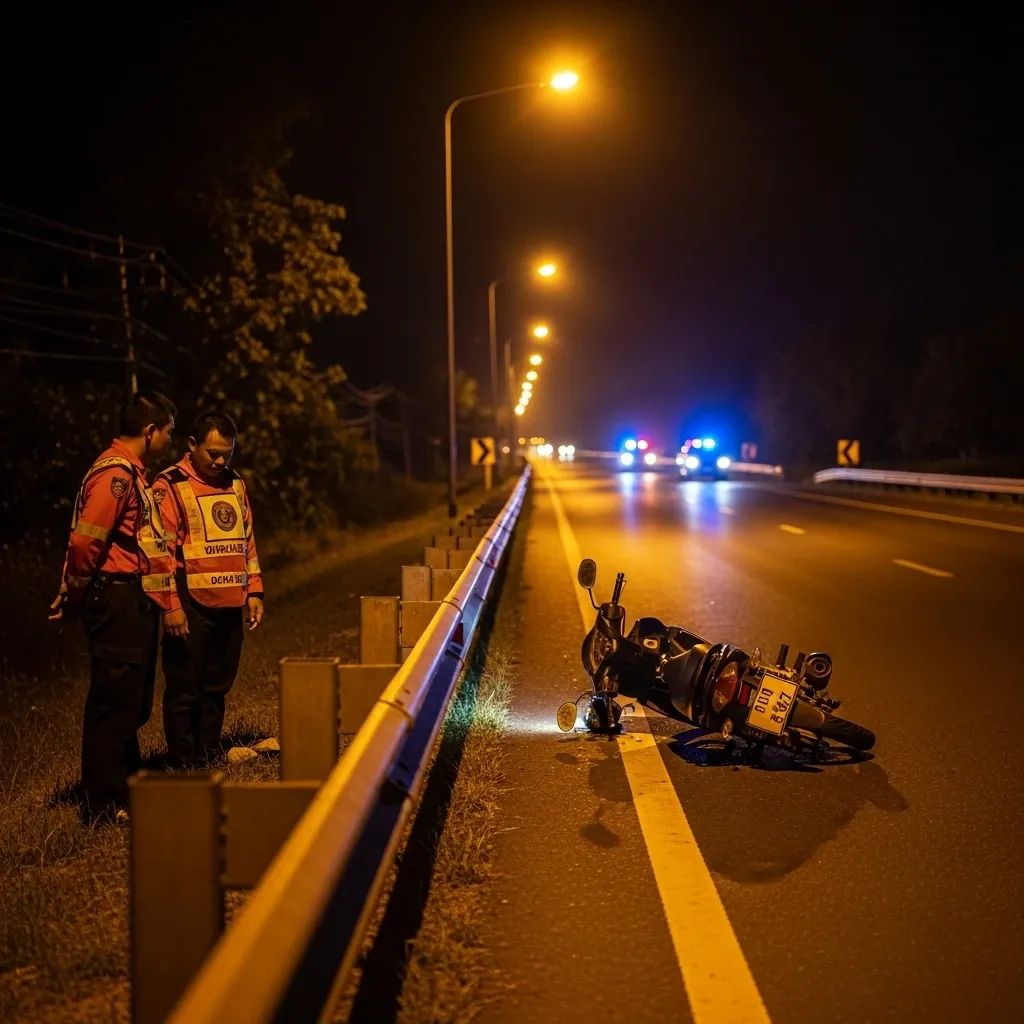
The death of 38-year-old Winwit Liawpatanapong in the early hours of Sunday, June 7, reflects a pattern so consistent it has become almost statistical. A white Mitsubishi Pajero struck a concrete barrier outside the People Unity rescue foundation on Therd Prakiat Road in Muang district around 2:30 AM. Emergency responders needed hydraulic extraction equipment to retrieve his body from the vehicle. Eyewitnesses described a vehicle traveling at considerable speed before losing control. The driver had been returning from a party.
What distinguishes this incident from the thousands of similar crashes in Thailand isn't the individual tragedy—it's the machinery behind it: a legal and enforcement system that functions intermittently, intensifying during designated "dangerous days" campaigns, then retreating into routine neglect. That inconsistency determines who lives and who dies on Thai roads.
The Enforcement Cycle That Drives Risk
The Thailand Royal Police operate a deliberate strategy calibrated to holiday periods. When the nation enters its official "seven dangerous days" campaigns—around New Year and Songkran festivals—enforcement intensity reaches a measurable peak. Earlier this year during the New Year 2026 campaign (December 30, 2025–January 5), authorities documented 1,511 accidents resulting in 272 deaths and 1,464 injuries. On the first two days alone, 1,366 of 1,473 traffic violations logged (92.74%) involved alcohol consumption. By January 2, 1,349 of 1,401 people entering the probation system faced charges related to drunk driving.
That concentration of enforcement produces results. Officers deploy checkpoints systematically. Penalties function with consistency. Police visibility deters casual risk-taking. The system demonstrates it can work when resources align with political will.
Then the campaign ends. Checkpoints disappear. Deployment levels drop to routine staffing. The infrastructure that made detection probable becomes sporadic. This withdrawal creates exactly the conditions under which repeat offenders calculate risk-reward: minimal surveillance, known gaps in enforcement, and a weekend night outside official monitoring windows. Habitual violators—individuals with prior convictions who understand the enforcement calendar—time their risky behavior accordingly.
Just two months before this accident, the Songkran 2026 festival (April 10–16) followed an identical trajectory. Police documented 1,242 accidents, 242 fatalities, and 1,200 injuries across eight days. Drunk driving cases during the festival totaled 3,726. Yet by mid-April, that intensive presence had already begun contracting, returning to baseline operations by late month.
Structural fragmentation compounds enforcement ineffectiveness. Thailand's probation departments, transportation authorities, and provincial police operate with minimal coordination systems. A repeat offender arrested in one location may move to another province where prior convictions don't surface in local databases. Bureaucratic silos that should function as safeguards instead become escape routes.
The Persistent Challenge of Late-Night Weekends
Sunday morning's fatal crash occurred outside the official campaign window—a routine weekend night when enforcement presence reflects standard allocation rather than crisis response. This matters because the data shows a divergence: holiday periods capture enforcement attention while ordinary weekends, particularly the midnight-to-4-AM window, remain comparatively under-resourced despite carrying measurable elevated risk.
A resident traveling late-night Friday or Saturday faces different police presence than someone driving during a designated dangerous-days campaign. That difference isn't marginal. It shapes decision-making for intoxicated drivers and passengers accepting rides from compromised operators. The person who declines a ride during Songkran—deterred by visible checkpoints—accepts the same ride on an ordinary Saturday when enforcement visibility drops. The calculation changes. Behavior shifts. Outcomes diverge.
Thailand experiences approximately 40 road deaths daily according to civil society assessments from late 2025. That baseline suggests a chronic condition poorly addressed by periodic campaigns. When translated to annual figures, the phenomenon generates ฿500B–600B in direct economic losses: medical costs, lost productivity, disability care, and funeral expenses. For perspective, that figure approximates half the nation's annual defense budget distributed across thousands of funerals and rehabilitation facilities.
The World Health Organization attributes 26% of all Thai road fatalities to alcohol, a statistic underscoring the scale of the problem relative to documented prevention success.
Where Intervention Begins: The Prevention Ecosystem
Recognition of the crisis has produced layered responses, though effectiveness remains uneven. The Thai Health Promotion Foundation operates emotional messaging campaigns designed to trigger behavioral change before risky decisions materialize. The "Dad" campaign uses narrative storytelling—grieving children, disrupted families—to connect abstract statistics to concrete human loss. These interventions attempt to rewire decision-making at the psychological level rather than through enforcement alone.
Youth-focused education delivers measurable structure in regions like southern Thailand. Organizations including the AIP Foundation operate "Street Wise" programming in provinces including Songkhla, delivering road safety instruction to kindergarten through grade-6 students. The curriculum emphasizes helmet use, safe crossing, and traffic sign recognition—foundational knowledge that may eventually translate into safer driving behaviors once these children reach adulthood. The investment occurs years before these students operate vehicles, representing prevention at the developmental stage.
Infrastructure improvements complement behavioral approaches. The Thailand Department of Highways systematically upgrades road lighting in identified dark sections, optimizes traffic signal timing, and closes dangerous U-turn intersections identified through accident data analysis. Rural areas remain infrastructure-challenged; resources stretch thin across hundreds of kilometers of provincial roadway where motorcycle accidents concentrate due to inadequate road conditions and limited visibility.
The Thailand Public Health Ministry maintains 24-hour emergency medical coordination linking hospitals to accelerate post-crash response. A dedicated hotline (1784) and the mobile application "DDPM 1784" provide immediate assistance dispatch, reducing elapsed time between accident occurrence and medical intervention. Survival outcomes, however, remain brutally dependent on impact severity and crash location—proximity to medical facilities cannot resurrect someone killed on impact.
Community-level initiatives show localized promise. Volunteer-organized checkpoints and door-to-door monitoring in specific districts intercept risky drivers before they depart residential areas. These grassroots efforts supplement official enforcement but remain geographically scattered and dependent on local organizational capacity that isn't uniformly available across provinces.
Understanding Enforcement Patterns: What Residents Need to Know
For people living in Thailand, understanding when and where enforcement intensifies directly impacts personal risk assessment. During official "dangerous days" campaigns—typically New Year (late December through early January) and Songkran (mid-April)—expect highly visible checkpoint concentrations on major highways, city center party districts, and routes connecting Bangkok to provincial destinations. Checkpoints operate 24 hours during these periods, with intensified presence during 8 PM–4 AM windows.
Outside these campaigns, enforcement follows standard provincial police allocation. City centers and major highways receive routine patrols, but secondary roads and late-night Friday-Saturday routes see dramatically reduced police presence. Expats and long-term residents can identify campaign periods by checking Thai news sources or official police announcements typically released one week prior to each campaign.
Thailand's legal blood alcohol limit is 50mg per 100ml of blood (0.05%), equivalent to approximately one standard drink for most adults. First-time offenders face fines ranging from ฿3,000–฿10,000 and license suspension (3 months–1 year depending on severity). Repeat offenders within five years face higher penalties: ฿10,000–฿20,000 fines and imprisonment up to one month. Vehicle breathalyzers become mandatory for repeat offenders. Insurance companies may deny claims for alcohol-related accidents, leaving drivers personally liable for all damages—a devastating financial consequence that regularly exceeds ฿100,000 for serious injuries or fatalities.
International driver's licenses receive no different treatment than Thai licenses. Expats and tourists face identical penalties and criminal records visible to immigration authorities. Alcohol-related convictions trigger special visa scrutiny and may affect renewal eligibility.
Practical Risk Assessment for Residents
Late-night travel on weekends—particularly between midnight and 4 AM—carries statistically elevated danger. These patterns recur consistently in accident data and remain visible to anyone paying attention to timing and context.
Defensive driving isn't optional caution; it's adapted survival skill. Maintaining generous following distance, anticipating erratic behavior, avoiding poorly lit secondary roads, and refusing rides from visibly intoxicated drivers aren't paranoid precautions—they're informed decisions based on documented local conditions. Passengers bear equal responsibility: intervening when drivers show impairment, arranging alternative transportation, or simply declining to board prevents fatalities with measurable regularity.
Ride-hailing services, despite their own safety complications, generally present lower risk than accepting rides from party attendees who've consumed alcohol. The ฿200–300 cost of a taxi or Grab ride represents trivial insurance against becoming another traffic fatality statistic. For expats and long-term residents, adjusting behavior based on these patterns isn't excessive caution—it's rational adaptation to documented local risk.
The ฿500B–600B annual cost of road accidents permeates the broader economy through elevated insurance premiums, strained hospital resources, and lost workplace productivity. A fatal crash removes not just one person but frequently an entire family's primary income earner, creating multigenerational financial devastation. For households, the financial cascade extends across years through lost educational opportunity, reduced consumption, and accelerated poverty dynamics.
What Comes After the Incident
Nakhon Si Thammarat authorities have not announced specific local enforcement escalations following Sunday's crash. The province will continue following national protocol: intensive enforcement during official "dangerous days" periods, reduced pressure elsewhere. Winwit Liawpatanapong becomes one of several documented fatalities in Nakhon Si Thammarat this year involving party-related travel during return journeys. He joins thousands of others who died on routes they drove regularly, in vehicles they trusted, with assessment capabilities compromised by alcohol consumption.
The People Unity rescue foundation, where his body was discovered, exists because Thailand consistently requires rescue facilities. It's positioned outside a residential neighborhood specifically to respond rapidly to emergencies. That Liawpatanapong died at its entrance—rather than inside it, saved—illustrates the harsh boundary between prevention and emergency response. No facility, no matter how proximate or well-equipped, can substitute for not crashing in the first place.
The system will process Sunday's incident as institutional data: another case file, insurance claim, and family arranging funeral services. Unless structural shifts occur—consistent weekend enforcement outside holiday campaigns, stricter prosecution of repeat offenders, mandatory vehicle breathalyzers for drivers with prior convictions—the pattern will continue repeating into next weekend. Another partygoer will make the calculation Liawpatanapong did Sunday morning and reach a different, fatal outcome. The infrastructure for prevention exists. The political will to apply it consistently does not. That gap, more than any single accident, determines Thailand's ongoing road fatality crisis.


