
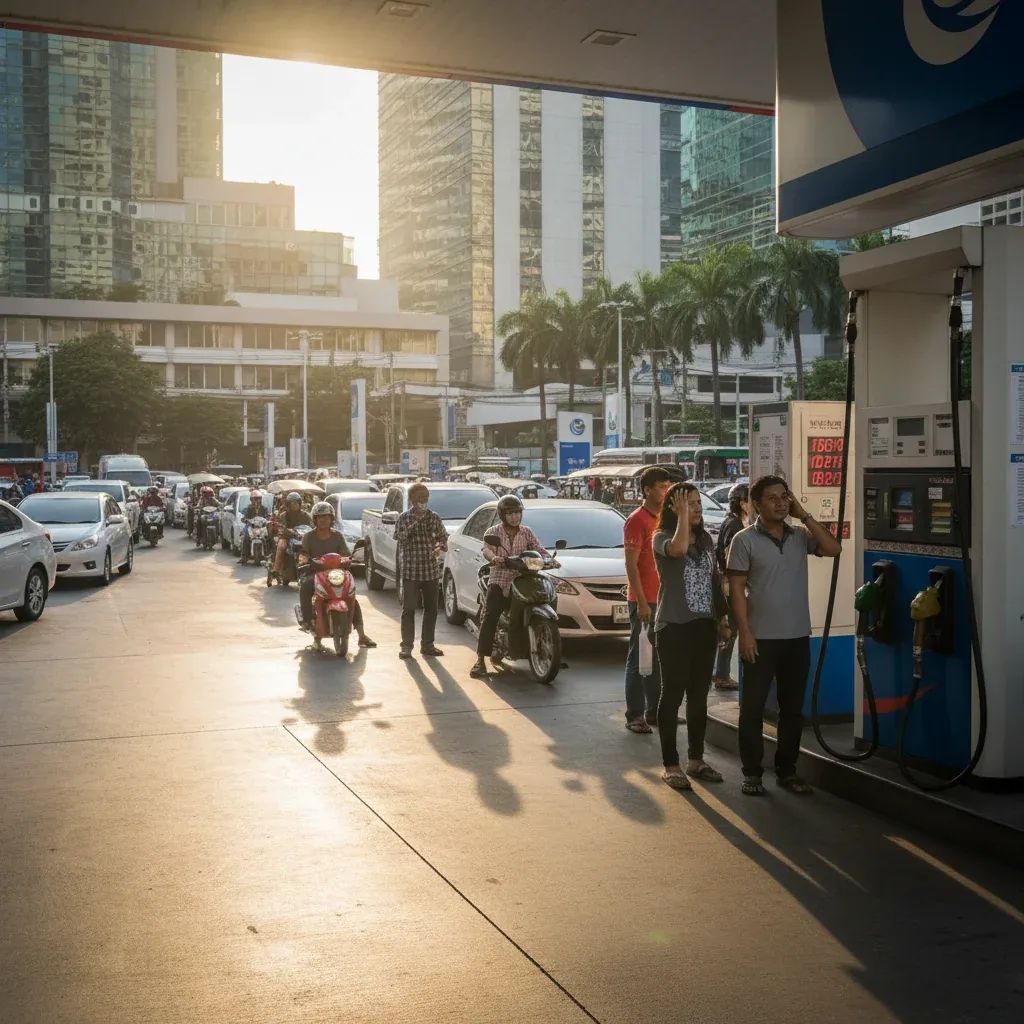
Emergency Measures on Standby: Thailand's Incoming Government Faces a Fuel Crisis Demanding Speed
The Thailand incoming Cabinet is preparing to navigate a constitutional provision that would allow immediate action on energy security matters—a signal that policymakers recognize fuel volatility as a genuine threat requiring accelerated response. With global oil turbulence rippling through Thailand's economy and diesel supply chains straining under panic buying and logistical bottlenecks, the political transition scheduled for March 19 now carries operational urgency that transcends the typical parliamentary calendar.
Quick Read: Key Takeaways for Residents
• March 19 deadline: Cabinet may invoke emergency powers to bypass standard 15-day policy delays
• Immediate impact: Diesel prices rose ฿3.06 per liter when subsidies ended March 17
• Your fuel options: E20 ethanol and biodiesel blends (B10, B20) offer lower prices and domestic sourcing
• Timeline: Price stabilization expected within weeks; structural changes take months
• What's at stake: Transport, food, and manufacturing costs will rise; inflation estimates at 1.2-4.5% depending on global oil trajectories
Why This Matters
• Constitutional emergency powers may activate by March 19, compressing the standard 15-day policy statement delay into immediate action on energy distribution and subsidy reform
• Diesel prices rose ฿3.06 per liter when the government subsidy ended on March 17, creating cascading cost increases across transport, food, and manufacturing
• Global crude at US$128 per barrel (87% above pre-crisis levels) means every week of administrative delay translates directly into higher household and business costs
• Strategic reserves exist (101 days of supply) but distribution networks cannot match panic-driven demand spikes without logistical acceleration
The Constitutional Workaround and Why Officials Are Considering It
The idea circulating among senior policymakers is neither novel nor routine. Deputy Prime Minister Borwornsak Uwanno, the Thailand government's chief legal architect, proposed invoking Section 161, paragraph 2 of the Constitution during a caretaker Cabinet meeting on Tuesday, March 17. The mechanism is elegant in its specificity: it allows His Majesty the King to issue a royal command authorizing a Cabinet to begin executive duties before the formal oath ceremony and policy statement to Parliament.
Ordinarily, the timeline unfolds across weeks. The prime minister-elect receives royal appointment around April 10-11, the ministry roster undergoes vetting, and Cabinet swearing-in occurs by mid-April at the latest. Only then does Parliament hear the policy statement. The standard clock runs to day 15 before formal governance can proceed.
Section 162, paragraph 2 fills the gap: if circumstances are "of importance and urgency," and delay would "affect the State's vital interests," the Cabinet may act immediately. The phrase is deliberately broad—it encompasses fuel distribution crises that threaten transportation networks, hospital backup power, and inflation trajectories. Borwornsak's argument is straightforward: Middle East tensions have created an emergency that administrative delays cannot absorb.
This constitutional maneuver is rarely invoked. Its mere consideration signals that Thailand's energy bureaucracy has concluded the crisis rises above procedural niceties.
The Crisis: Three Colliding Forces
Thailand's diesel shortage erupted not from scarcity but from a cascade of simultaneous pressures—geopolitical, fiscal, and psychological—that overwhelmed the distribution system.
Global Oil Shock
The Iran-U.S.-Israel tensions have pushed Brent crude above US$100 per barrel and Dubai crude to US$128, representing an 87% spike from pre-crisis levels. The Strait of Hormuz, through which roughly 20% of the world's seaborne oil transits annually, now carries heightened disruption risk. Thailand sources 58% of its crude from Middle Eastern suppliers, making the kingdom acutely exposed to any interruption along that vital corridor.
This is not mere speculation about supply chains—it is concrete economic arithmetic. A prolonged closure of the strait would cascade through the Thai economy within weeks, snarling truck transport, stranding factory production, and compressing household purchasing power.
The Subsidy Trap
The Thailand Ministry of Energy maintained a diesel price ceiling of ฿29.94 per liter through March 17 using Oil Fund subsidies. This price control created two tiers of the market: branded fuel stations sold at the capped rate, while independent pumps and industrial buyers faced world prices. The disparity was irresistible.
Heavy trucking operators, construction firms, and logistical networks queued at subsidized pumps, driving demand to three times normal volume at major branded stations. Refineries running at maximum capacity could not replenish inventory fast enough, particularly in provincial towns where distribution infrastructure is already thin. The Oil Fund hemorrhaged ฿16.5 billion underwater to maintain this fiction.
Panic Buying and the Herd
Rumors that the price cap would expire triggered coordinated rushing to top off tanks. Stations across the country reported simultaneous demand spikes, exhausting local supplies while tanker trucks struggled to keep depots stocked. This was not an aggregate shortage—the Thailand Energy Ministry confirms 101 days of strategic reserves remain—but rather a logistics gridlock where centralized supply networks could not flex to match demand that had spiked artificially across hundreds of retail points simultaneously.
Immediate Economic Spillover: Who Pays Now
For residents and workers across Thailand, the effects are tangible and cascading.
Transport costs have begun climbing. The ฿3.06 per liter diesel increase flows directly into freight rates, which operators pass along supply chains. Food prices at morning markets, construction material costs, pharmaceutical distribution, and consumer goods shipped via truck all respond to logistics costs. Those earning wages in the informal sector—taxi drivers, small vendors, tricycle operators—face immediate margin compression. There is no buffer for them.
Inflation risk is now live. Research from Krung Sri estimates that sustained oil prices in the US$110 to US$130 range could push Thailand's inflation to 3-4.5% while shaving 0.6-0.9 percentage points from GDP growth. Even if prices stabilize at US$85-90 per barrel, inflation still edges up 1.2-1.6% and growth slips 0.2-0.3%. Every dollar swing in global crude ripples through the economy like a stone in water.
Essential services face genuine risk. Hospitals in provincial towns depend on diesel-powered backup generators; water treatment plants rely on consistent fuel supply. While blackouts remain rare and reserves are adequate, if distribution gridlock persisted—it hasn't, yet—health-system continuity could be jeopardized. Government offices and private firms have already circulated work-from-home advisories, mimicking pandemic-era responses to reduce fuel demand.
Thailand's regional peers face harsher consequences. Cambodia saw diesel prices jump 70% in less than three weeks with no subsidy apparatus to cushion the blow. Laos updates pump prices every 2-3 days to track volatile markets. Myanmar's fragile supply chains are buckling. Vietnam is dipping into strategic reserves. Philippines has shifted some offices to four-day work weeks. By comparison, Thailand—despite genuine friction—remains relatively insulated, a byproduct of having refining capacity and a (costly) subsidy mechanism.
For expats or investors with regional interests, or those considering relocation, Thailand's response has been relatively measured compared to neighbors.
Practical Steps for Residents
Checking Fuel Availability in Your Area:
• Call the Energy Ministry Hotline: 1300 (Thai language) or visit energy.go.th for real-time fuel station inventory
• Use the PTT, Shell, or Bangchak mobile apps to locate nearby stations with available fuel
• Many provinces operate fuel station databases through Provincial Administrative Organization (PAO) websites
Should You Switch to E20 or Biodiesel?
• E20 (20% ethanol gasoline): Safe for vehicles manufactured after 2007. Check your vehicle manual or contact your dealer if unsure. Price savings: approximately ฿0.79 per liter compared to standard gasoline
• B10 (10% biodiesel for passenger vehicles): Compatible with most diesel vehicles. Launching within approximately one month
• B20 (20% biodiesel for trucks): Designed for commercial heavy trucks. Launching within approximately one week; not recommended for standard passenger vehicles
• When in doubt, stick with standard fuel grades—no risk of engine damage
Expected Timeline for Price Stabilization:
• Weeks 1-2 (Late March): Panic-buying subsides; distribution networks rebalance. Prices may remain elevated
• Weeks 3-4 (Early April): B10 and E20 rollout reduces demand for standard diesel; prices stabilize toward equilibrium
• Month 2+: Structural measures (biodiesel expansion, subsidy reform) take effect; prices reflect new market dynamics
Government Resources and Hotlines:
• Thailand Energy Ministry: 1300 (Thai), or visit energy.go.th
• PTT Customer Service: 1149 (24 hours)
• SME Relief Program (for small businesses): Contact your local Ministry of Commerce office for eligibility
• Farmer Support (agricultural fuel relief): Inquire through Provincial Agricultural Extension Office
What the New Cabinet Will Likely Execute Immediately
If the incoming prime minister is confirmed on March 19 and opts for the constitutional emergency route, expect rapid executive action across multiple fronts within days.
Biodiesel blending will expand aggressively. Plans are already sketched for B10 (10% biodiesel) for passenger vehicles within approximately one month, and B20 (20% biodiesel) for heavy trucks within a week. Both carry lower retail prices than conventional diesel and reduce crude imports. The pivot also supports Thailand's domestic palm oil farmers—a political constituency worth attending to, and a sensible structural hedge against Middle Eastern supply risk.
E20 ethanol gasoline will be heavily promoted. The Thailand energy sector has already cut E20 prices by ฿0.79 per liter, widening the savings gap against other fuel grades. Since E20 contains ethanol produced domestically (primarily from sugarcane), the shift reduces import bills and redirects agricultural income toward fuel producers rather than foreign oil companies.
Trucking regulations will be relaxed. Coordination with the Ministry of Transport and Bangkok Metropolitan Administration will extend operating hours for fuel-distribution fleets, permitting longer and more frequent runs to speed inventory replenishment. The bottleneck is logistics, not supply—removing regulatory friction is the lever.
Targeted relief packages will be announced. Farmers, SMEs, and low-income households will receive support—the details remain under negotiation. The optics matter: a new government will want to be seen as acting decisively to protect those most exposed to energy volatility, and distributional fairness softens criticism of inevitable price adjustments.
The Structural Vulnerability Beneath This Month's Crisis
This diesel squeeze exposes a deeper fragility: Thailand's dependence on imported fossil fuels and an energy transition pace many analysts consider insufficient.
The Power Development Plan 2026 (PDP 2026) (a comprehensive government roadmap for electricity generation and energy security through 2026) represents the most ambitious energy overhaul in decades. Its architects aim to cut natural gas dependence from over 60% of electricity generation down to below 50%, with renewables filling the gap. Small Modular Reactors (SMRs) (compact nuclear power plants designed for flexible deployment) will provide low-carbon baseload power. The government is reasserting control over power generation, targeting a 51% public / 49% private split, reversing decades of privatization. And the entire system must accommodate surging demand from electric vehicles, data centers, and artificial intelligence infrastructure.
The stated timeline is ambitious: carbon neutrality by 2050, net-zero by 2065. Yet these goals depend entirely on phasing out natural gas and coal faster than current policy trajectories suggest. In the interim, the Thailand government is negotiating accelerated LNG delivery schedules with suppliers and diversifying crude sources—now sourcing from Angola and the United States alongside Middle Eastern suppliers. But these are medium-term mitigations. The next 12-24 months will remain volatile.
What to Expect in Coming Weeks
As the new Cabinet takes shape in late March and early April, watch for announcements on:
• Acceleration of PDP 2026 timelines, particularly renewable deployment and SMR negotiations with international partners
• Subsidy architecture reform, because the current Oil Fund model is fiscally unsustainable and creates the distortions now visible
• Biodiesel and ethanol blending targets, which indicate how seriously the incoming administration views import substitution
• Supply diversification deals, especially new crude contracts with non-Middle Eastern sources
What Residents Should Understand
If you live in Thailand, several sobering realities emerge from this episode.
Energy security is structurally fragile. The kingdom's geographic profile—import-heavy, transit-dependent, subsidy-prone—means that external shocks transmit quickly into domestic friction. A closure of the Strait of Hormuz, though unlikely, would cascade through the economy within weeks. There is no way around this vulnerability without years of restructuring.
Price controls create distortions that often exceed their intent. Capping diesel sounded compassionate in the short term. But it drained the Oil Fund, incentivized hoarding, and delayed necessary market adjustments. That ฿16.5 billion deficit will eventually materialize as tax burden, inflation, or fuel levies on future generations.
Renewable energy and biofuels are pragmatic hedging, not virtue signaling. The push for B10, B20, and E20 is deliberate de-risking against Middle Eastern supply vulnerability and a fiscal transfer to domestic agriculture. Expanded adoption is structural insurance, not ideology.
Constitutional flexibility exists—and its invocation signals genuine concern. The Section 161/162 mechanism is a safety valve reserved for authentic emergencies. That policymakers are contemplating its use underscores they view the energy crisis as a threat to State interests, not mere inconvenience.
The diesel queues may ease within days or weeks as distribution networks rebalance and panic-buying subsides. But the underlying vulnerabilities—import dependence, geographic exposure to geopolitical shocks, and the glacial pace of renewable buildout—will take years to remedy. For now, the Thailand Energy Ministry has been clear: reserves are adequate, distribution is the bottleneck, and solutions require logistical agility and structural reform. Whether the incoming Cabinet will use emergency powers to accelerate systemic change—beyond immediate fuel crisis management—remains the open question. If invoked, such a move would signal that policymakers view current energy turbulence not as temporary weather to manage, but as evidence of structural fragility demanding long-term recalibration.


