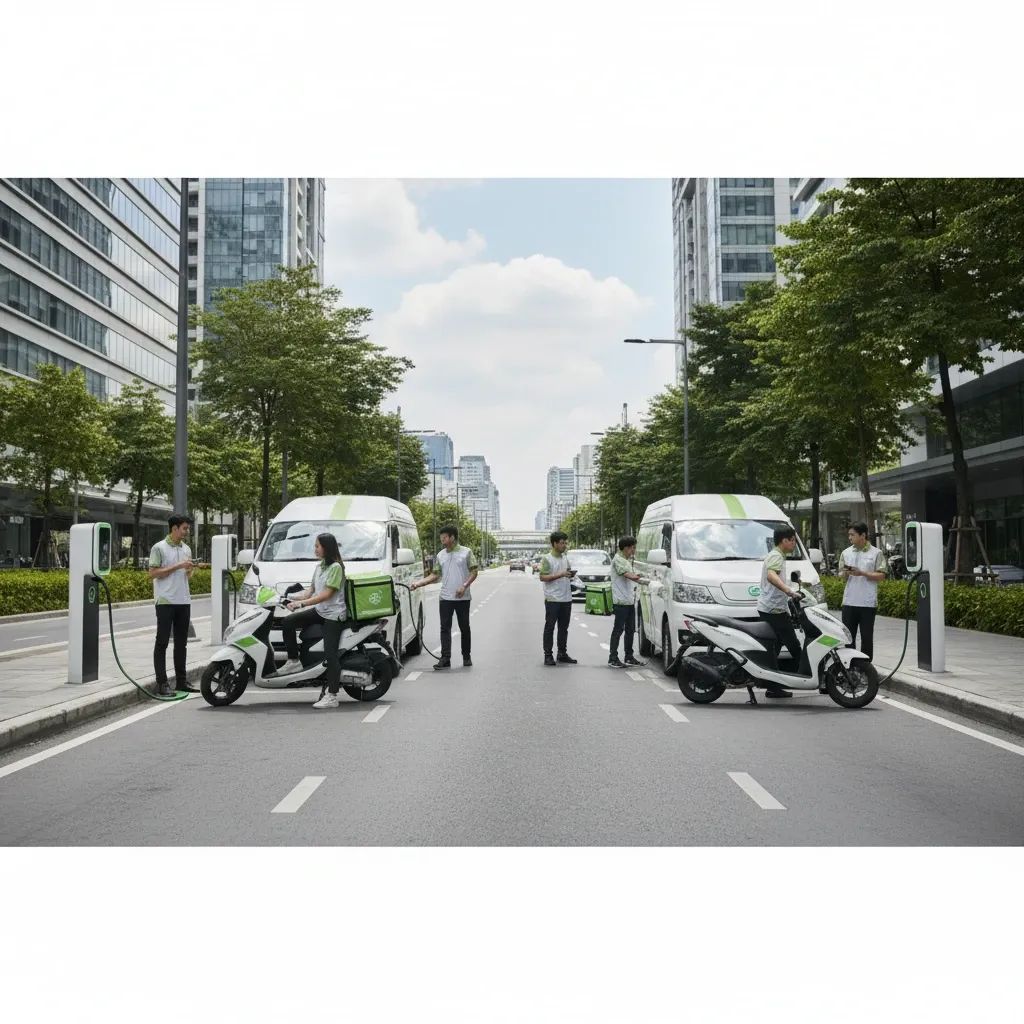
Thailand's Electric Vehicle Market Transforms: When Oil Anxiety Met Industrial Policy
Throughout 2026, Thailand's automotive sector is experiencing significant acceleration in electric vehicle adoption. The convergence of global oil supply concerns, manufacturing capacity coming online, and government incentives is compressing what analysts expected to unfold gradually. Battery-electric vehicles are moving from niche preference toward mainstream purchasing logic, particularly for middle-income Thai families—though they remain a growing portion rather than the majority of new vehicle sales.
Why This Matters
• Battery-electric registrations are projected to reach 125,000 units in 2026, representing 3.8% compound annual growth—a meaningful acceleration that demonstrates sustained adoption momentum building across consumer behavior.
• Purchase prices achieved parity with diesel equivalents in volume segments, making the decision economic rather than ideological.
• Thailand is positioning itself as ASEAN's EV production hub, with multiple manufacturers establishing local assembly facilities and exporting vehicles across the region.
• Charging access remains geographically divided, with functional coverage in Bangkok and major highways but significant gaps across provincial zones where residents still depend on established fuel infrastructure.
When Crisis Became Accelerator
The global oil supply volatility in the first half of 2026 functioned as unintentional marketing for electrified transport. Thai consumers who had intellectually understood EV benefits suddenly faced real questions about fuel availability and volatility. Dealership data tells the story: battery-electric registrations showed significant spikes compared to the previous year, suggesting that decision timelines accelerated once anxiety shifted abstract concerns into immediate practical worry.
Mercedes-Benz Thailand leadership's public declaration that "the future is fully electric" reflected industry consensus that had been building gradually—until the oil crisis transformed it from minority position to operational inevitability. The shift wasn't ideological conviction; it was financial reality colliding with supply uncertainty.
Current year-to-date projections track toward 125,000 battery-electric registrations for 2026, representing a 3.8% compound annual growth rate that shows acceleration momentum as charging networks mature and purchase prices continue downward trajectory.
Manufacturing Transforms: From Pickup Truck Capital to EV Hub
Thailand's Board of Investment executed a strategic pivot through the EV 3.5 framework, operational through 2027. The policy wasn't accidental—it was engineered to restrict the most generous tax benefits to locally assembled vehicles, creating a financial incentive that cannot be exported or redirected to foreign manufacturing.
Hyundai committed significant investment to establish an EV assembly facility in Samut Prakan Province, commencing production of the 2026 IONIQ 5 N Line. Chinese manufacturers moved swiftly into the market: MG initiated Thai production in Q1 2024, followed by BYD in Q2 2024, GAC AION later that same quarter, and Changan in Q1 2025. These aren't token operations—each represents serious manufacturing capacity with explicit export ambitions across Southeast Asia.
The logic for manufacturers is straightforward: Thailand offers ASEAN's most mature automotive supply chain, accumulated infrastructure from decades as the region's pickup truck production center, and government willingness to exchange tax holidays and import duty exemptions for production commitments. For Chinese brands facing tariff barriers in Western markets, Thailand offers strategic positioning—a manufacturing base here can access ASEAN preferential trade agreements while maintaining geographic distance from geopolitical friction.
The Board of Investment's component localization requirement conditions the most favorable excise tax treatment on domestically-sourced parts percentages, effectively building incentive for supply chain integration rather than mere final assembly. This policy architecture ensures that production benefits extend beyond simple chassis assembly into parts manufacturing, creating deeper economic impact across industrial zones.
Entry-Level Pricing: The Crossover Arrives
The moment electric and diesel compete on price rather than ideology has arrived. A BYD Atto 1 Dynamic starts at ฿429,900, while the MG4 D model costs ฿549,900—directly competitive with the Toyota Hilux Champ (฿519,000-615,000). Budget-conscious buyers can now acquire the Lumin L DC for ฿399,000, equivalent to approximately one month of premium Bangkok condo rent multiplied by 20—genuinely accessible for middle-income Thai families.
Government subsidies of up to ฿50,000 remain available through 2027 for vehicles under ฿2M with battery capacity exceeding 50 kWh, covering most family-oriented models. This creates defined incentive window: buyers who purchase before subsidy expiration preserve support, creating psychological urgency around decision timing.
The used vehicle market presents uncertainty territory. Traditional diesel models like the Fortuner, Hilux Revo, and Isuzu D-Max maintain strong resale values due to proven durability and the fact that rural charging infrastructure remains inconsistent. EV resale dynamics are still emerging—genuine concerns persist around long-term battery economics. Tesla's ฿880,000 battery replacement cost has become a reference point in consumer discussions about ownership longevity expenses, creating anxiety around total cost of ownership beyond purchase price.
Charging Infrastructure: Expanding Yet Geographically Divided
Thailand counted 4,643 charging stations and 13,977 individual charge points as of January 2026. This represents meaningful expansion from a decade ago, yet distribution remains skewed. Bangkok residents generally find reasonable coverage across shopping malls, corporate office parks, and residential developments. Provincial highways have seen expansion, but serious gaps persist—particularly across the northeast and far south where vehicle volumes haven't justified private sector investment.
The government's target of 12,000 DC fast-charge stations by 2030 implicitly acknowledges current shortfalls. This gap creates practical constraints: residents in rural provinces or those dependent on frequent long-distance travel face genuine logistical uncertainty that doesn't apply to diesel infrastructure, which extends reliably to remote areas.
Smart charging technology that shifts EV charging to off-peak hours will become critical infrastructure, not optional enhancement, as grid demand grows. The Thailand Electricity Generating Authority is monitoring impact modeling, though no comprehensive capacity expansion plan has been publicly released. Hot season performance remains a specific concern—air conditioning already strains generation and distribution capacity when temperatures peak.
For daily commuting under 50 kilometers with overnight home charging using off-peak electricity rates, EVs cost dramatically less to operate than diesel or gasoline alternatives. For people who regularly travel to distant provinces or operate from multiple locations, conventional powertrains still offer logistical advantages despite higher fuel costs.
Technology Features Migrate Downmarket
Advanced Driver Assistance Systems utilizing camera, LiDAR, and radar sensors now appear in mid-tier EV models priced below ฿700,000, bringing features previously reserved for premium segments to mass-market buyers. This technological democratization represents material change in vehicle capability accessible to ordinary buyers.
The Thailand Ministry of Digital Economy and Society has positioned the country as ASEAN's regulatory reference point for autonomous vehicle governance. This transcends aspirational rhetoric—pilot programs analyzing driver behavior in real-time through AI have launched in Bangkok, with Kasikorn Research estimating potential 15% congestion reductions if deployed broadly. Technology vendors are actively testing safety systems that provide collision warnings, manage lane-keeping on highways, and handle stop-and-go traffic autonomously.
Vehicles equipped with these systems reduce driver workload in Thailand's challenging urban environment. The technology isn't fully autonomous, but the practical impact on daily commuting during Bangkok's notoriously frustrating peak hours is meaningful for drivers who spend significant time navigating congestion.
Government Financial Architecture: Subsidies, Taxes, and Credit Programs
The Thailand Ministry of Finance is developing a scrappage program structure for 2026 that would incentivize trading older vehicles for locally-produced EVs or hybrids. The dual objectives are explicit: reduce PM 2.5 urban pollution while stimulating domestic manufacturing. Potential structures under study include direct subsidies, subsidized financing through government-owned banks, or point-of-sale discounts, though details remain unfinalized. The government has signaled commitment to a defined program rather than ad-hoc measures.
Excise tax restructuring explicitly favors EVs with progressive rates that penalize large-displacement combustion engines while exempting or minimizing taxes on battery-electric powertrains. For manufacturers, the calculation is elementary: producing in Thailand unlocks both subsidy access and favorable tax treatment, while imports face steeper duties designed to fund incentive programs.
Credit constraints have dampened overall auto sales across price segments, with buyers unable to secure financing despite lower vehicle prices. The planned government support through three mechanisms—purchase-price reduction assistance, interest-rate subsidies, and point-of-sale financing—aims to address this bottleneck. Implementation details on eligibility and funding levels remain under internal ministry discussion.
Regional Competition: Thailand's Strategic Position
Thailand operates within a competitive regional environment. Indonesia has launched competing EV incentives, while Vietnam's VinFast manufactures locally and exports globally. Malaysia offers its own EV tax exemptions. The competition for regional EV manufacturing dominance will structurally determine Thailand's automotive trajectory across the next decade.
Current indicators support Thailand's competitive position. Manufacturing investments from multiple international brands demonstrate confidence in Thailand's regulatory environment and supply chain maturity. BEV exports are projected at approximately 20,000 units annually through 2028—numerically small but accelerating as local production capacity expands and international supply chain resilience becomes critical following recent geopolitical supply disruptions.
Japanese brands are adapting more gradually, with Toyota's bZ4X starting at ฿1.53M for front-wheel drive—pricing that reflects Thailand's position in Toyota's global strategy as a pickup truck manufacturing base rather than a passenger vehicle priority market.
Diesel's Trajectory: Decline Without Disappearance
Conventional powertrains aren't vanishing from Thai roads. Commercial operators, construction firms, and rural residents continue selecting diesel for legitimate operational reasons: established refueling infrastructure extending to remote areas, proven durability under heavy loads, and lower upfront costs for work trucks.
The GWM POER Sahar diesel (฿799,000-999,000) and Isuzu D-Max Hi-Lander (฿770,000-1.15M) serve market segments where electric alternatives remain impractical. Diesel's high torque at low RPMs delivers tangible benefits for towing and off-road use. Fuel availability extends to provincial zones unlikely to see charging stations within five years.
Yet the trajectory is unmistakable. Generation Y buyers demonstrate 34% preference for EVs when purchasing new vehicles, driven by lower operating costs, technology features, and environmental considerations. As this demographic cohort becomes the dominant buyer group over the next decade, diesel's market share will contract to specialized applications—commercial vehicles, agricultural machinery, long-distance transportation. Diesel will occupy an increasingly narrow segment but won't disappear.
Unresolved Structural Risks
Rapid transformation carries risks that policymakers and consumers should acknowledge candidly. Thailand's electrical grid must absorb growing charging demand without destabilizing supply—a challenge that extends beyond simple capacity. The interaction between residential charging demand and industrial load during peak hours requires sophisticated management infrastructure that's still being designed rather than deployed.
Service network gaps outside major cities present practical problems. While Bangkok offers multiple authorized service centers for most EV brands, provincial buyers face uncertainty about repair capabilities if sophisticated battery or electrical systems fail. BYD's lifetime warranty on certain battery packs addresses one concern, but the broader service ecosystem will require years to fully develop across rural Thailand.
Data security represents an emerging concern that regulators haven't fully addressed. Modern EVs collect driving behavior, location, and performance data that connects to manufacturer cloud systems. While foreign manufacturers operate under established privacy protocols, some Chinese manufacturers' data governance practices remain opaque to Thai regulators. The Thailand Personal Data Protection Act technically applies to vehicle data collection, but enforcement against manufacturers who prioritize data value over compliance remains uncertain and untested.
The 12-Month Outlook
Thailand's automotive transition will accelerate through 2027 as production capacity comes online, charging infrastructure expands, and subsidy programs take effect. The growth trajectory suggests electric vehicles will become increasingly mainstream rather than alternative choices as the decade progresses.
For residents evaluating vehicle purchase decisions, practical due diligence matters. Evaluate charging access at both home and workplace before committing to an EV. Calculate actual driving patterns rather than theoretical maximum range—most owners operate vehicles well below advertised capacity in normal use. Research manufacturer service networks and warranty terms carefully, particularly for less-established brands expanding into the Thai market. Understand the distinction between home charging speed (6-8 hours overnight) versus public DC fast-charging (20-40 minutes), as this shapes realistic ownership experience.
Thailand's automotive future is being manufactured in real time across factories in Rayong, Samut Prakan, and elsewhere—not speculated about in boardrooms, but built piece by piece into tangible industrial capacity. The electric market shift is accelerating, driven by crisis, commercial calculation, and genuine consumer preference. Whether this constitutes a "revolution" depends on perspective, but the transformation is operationally underway.