
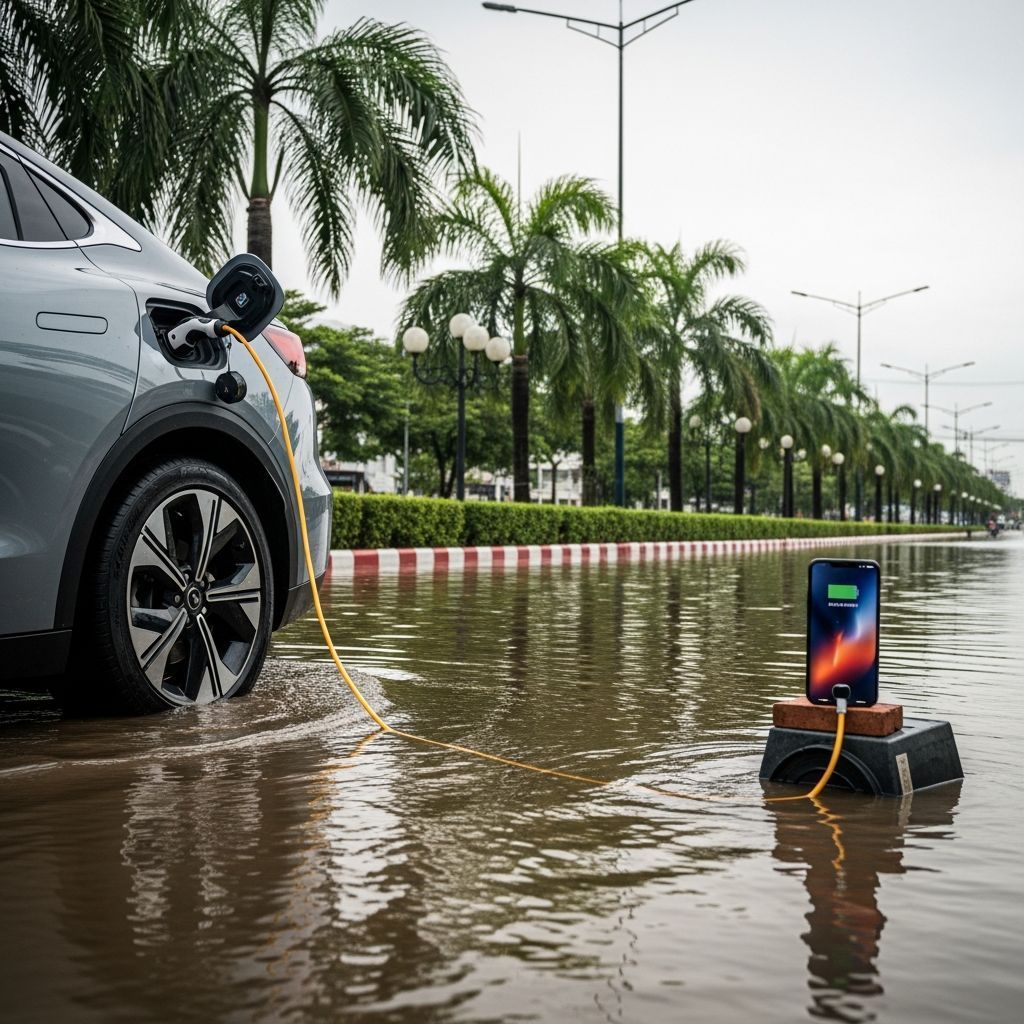
Thailand's fragmented EV charging landscape is about to consolidate under a unified platform controlled by the country's major electricity utilities and fuel retailers, a structural overhaul that promises to eliminate the multiple-app frustration plaguing electric vehicle owners while simultaneously giving the national grid unprecedented control over power consumption forecasting.
Why This Matters
• One app replaces the current chaos: By late 2026 or early 2027, drivers will book and pay for charging across the kingdom using a single Thailand EV Roaming Hub instead of juggling separate applications for different network operators.
• Over 22,900 charging points arriving by 2030: More than 10,000 will be fast chargers, directly supporting the government's goal of making 30% of new car production electric within four years.
• Mandatory safety standards now in force: New labeling regulations (March 2026) and technical rules (April 2026) establish binding equipment standards, removing dangerous or unreliable chargers from the network.
The initiative represents far more than consumer convenience—it's infrastructure alignment that will determine whether Thailand becomes a manufacturing hub for regional EV exports or remains a market with inconsistent charging capability. The Energy Policy and Planning Office, working with Egat (Electricity Generating Authority of Thailand), the Metropolitan Electricity Authority (MEA), the Provincial Electricity Authority (PEA), and PTT Oil and Retail Business Plc, has signed a memorandum of understanding to transform how drivers access charging and how grid operators manage demand.
The Disjointed Reality EV Drivers Live With
Venture beyond Bangkok in an electric vehicle today and the experience deteriorates sharply. Thailand currently runs approximately 3,720 charging stations containing 11,622 individual chargers, yet this raw number masks a deeper problem: fragmentation across incompatible payment systems, separate mobile applications, divergent pricing models, and operators who don't share real-time availability data.
Within the capital and surrounding provinces, the MEA manages most charging infrastructure. Travel north or into provincial territory and you're suddenly dependent on PEA stations or PTT-operated chargers—each requiring a different wallet, different authentication, different communication protocols. A driver planning a long-distance trip faces a decision: memorize multiple apps, call ahead to confirm chargers are operational, or abandon the journey altogether. Many choose the last option.
Of the 11,622 chargers, approximately 6,524 are DC fast chargers capable of reaching 80% battery capacity in 20–30 minutes, while 5,098 remain AC units suitable for overnight workplace or home charging. Connector standardization has partially solved itself: Type 2 connectors now account for 61% of all stations (the Thai Industrial Standard adapted from international IEC 62196-2 protocols), while CCS2 comprises 32% (the emerging global standard for fast charging). A diminishing 7% still operate the older CHAdeMO standard.
But hardware compatibility hasn't translated into user satisfaction. Drivers report chargers displayed as available on maps that are actually offline, occupied by vehicles that finished charging hours earlier, or blocked by conventionally fueled vehicles. Payment systems don't sync. Pricing information diverges between platforms. Mobile connectivity fails precisely when users need it.
More alarming are safety failures: melting connector pins, faulty cables, interrupted charging mid-session, and battery communication failures. These aren't cosmetic inconveniences—they represent genuine hazards, particularly for owners of niche imported EVs or modified vehicles navigating a regulatory environment that still treats electric transport as a novelty rather than mainstream infrastructure.
How the Roaming Hub Actually Works
The Thailand EV Roaming Hub functions as a national data clearinghouse—a central system that aggregates information from every charging network and serves it through a single interface. Rather than each operator maintaining isolated databases, all charging providers feed real-time operational data into a unified architecture modeled after successful systems deployed across Europe and parts of Asia.
For the driver, the transformation is straightforward: one application displays all available chargers within your radius, confirms operational status, shows pricing, and processes payment regardless of which utility or private operator owns the station. Authentication happens once. You select a charger, drive there, and charge—whether you're at a rural PEA location, a MEA urban hub, or a privately operated flagship station.
The infrastructure benefits are equally significant. The Electricity Generating Authority of Thailand gains real-time visibility into national charging demand patterns. With thousands of fast chargers simultaneously drawing substantial power, grid operators can forecast consumption peaks, adjust generation schedules, and prevent cascading failures as EV adoption accelerates. Without this centralized data infrastructure, rapid adoption of fast charging creates genuine risk of brownouts or rolling outages in provinces with constrained electrical capacity.
Technical architecture relies on a central data standard (EV Data Standard) that standardizes how location information, charger specifications, real-time status, and pricing flows between networks. The system echoes successful roaming platforms in telecommunications—where a subscriber can access networks globally using standardized protocols—applied to physical charging infrastructure.
The Regulatory Framework Taking Shape
Parallel to the roaming hub, the Department of Energy Business has enacted regulatory reforms designed to enforce safety and attract investor confidence. In April 2026, updated technical rules for EV charging stations took effect, formalizing requirements for equipment reliability, electrical safety, and operational protocols. These rules establish baseline standards: equipment below these specifications cannot be legally deployed.
In July 2026, five mandatory standards covering chargers and vehicle safety were approved by the Thai Industrial Standards Institute and refined by the Energy Regulatory Commission. These benchmarks draw from international protocols like ISO 15118—the standard enabling secure authentication, advanced smart charging, and "Plug & Charge" experiences already common in Europe and China. The goal is harmonizing Thailand's technical environment with global markets where manufacturers test equipment, reducing foreign supplier hesitation about developing products specifically for Thailand.
Perhaps most telling was the regulation that took effect March 21, 2026, designating electric vehicles as label-controlled products. This bureaucratic categorization is actually a consumer protection mandate: every EV sold in Thailand must carry standardized labeling with detailed specifications—battery capacity, certified charging speeds, safety certifications, warranty terms, and battery recycling information. No more vague marketing claims. No unvetted imports. This transparency mechanism directly addresses the earlier unsafe charger problem: now equipment and vehicles must be traceable to verifiable performance specifications.
The Investment Velocity Behind Growth
Between May and July 2026 alone, the Board of Investment approved 42 charging infrastructure projects, targeting deployment of 22,900 new charging points. This isn't abstract planning—major global automakers, sensing both regulatory requirements and export opportunity, are committing to Thailand as a manufacturing hub. BMW, Volvo, and Chinese manufacturers are announcing EV assembly operations and local supply chain investments. If charging infrastructure lags manufacturing capacity, the result is economic stagnation: factories producing vehicles that buyers avoid because range anxiety remains legitimate.
The government committed to 12,000 DC fast chargers by 2030—whether sufficient depends on adoption trajectories, but the direction is unmistakable. Historically underserved rural provinces are being prioritized in expansion targets. PEA stations, which serve areas outside Bangkok's metropolitan sprawl, are growing in both density and capability, reducing the current urban-centric bias.
This acceleration is deliberate. Thailand's target of 30% of domestic vehicle production being electric by 2030 creates hard deadline pressure. Factories require confident charging availability to market EVs credibly. Without it, manufacturers pivot investment elsewhere.
Obstacles Remaining Despite Standardization
Unification solves navigation, payment, and interoperability headaches. It doesn't resolve every operational friction.
Equipment reliability remains uneven across the current network. Some drivers report disappointing charging speeds, often linked not to charger hardware but to provincial grid capacity constraints. A 150-kilowatt fast charger connected to a substation originally designed for steady-state demand may chronically underperform if the local electrical network hasn't been upgraded simultaneously. Standardization and the roaming hub help, but they don't substitute for ongoing maintenance, predictive cable inspection protocols, or rapid repair response when connectors fail.
Consumer confidence still lags infrastructure growth. Warranty terms are frequently opaque. Claims processing is sluggish. Spare parts for niche EV models remain difficult to source. Modified EVs face bureaucratic hurdles during registration. Awareness of government incentives—tax credits, rebates, subsidized charging at public stations—varies widely outside Bangkok and international tourist corridors.
Rural connectivity gaps persist despite expansion targets. Central Thailand maintains sparse charging density compared to the coastal southeast or northern urban concentrations. Long-haul travel between southern and northern regions still requires careful route planning and intimate knowledge of network coverage.
What Comes Next
The roaming hub remains in feasibility studies without a firm launch date, though government timelines suggest late 2026 or early 2027 for an operational pilot. EV owners should prioritize CCS2 and Type 2 compatible vehicles while unification remains incomplete, as these standards now dominate Thailand's ecosystem. Multi-app route planning remains necessary until the unified system launches. Vehicle dealers with robust service networks and established parts stockpiles present lower risk than boutique importers still establishing support infrastructure.
Thailand's commitment to electrification is institutional—backed by regulatory enforcement, investment incentives, and infrastructure budgets. Execution risk remains genuine: translating feasibility studies into a platform that doesn't crash during peak demand periods, into chargers that stay reliably operational, into a user experience that matches the simplicity of a petrol station transaction. But the groundwork is concrete. Utilities are aligned. Standards are being written and enforced. The next 24 months will reveal whether Thailand emerges as a regional EV leadership model or joins the list of nations with ambitious plans and modest execution.


