
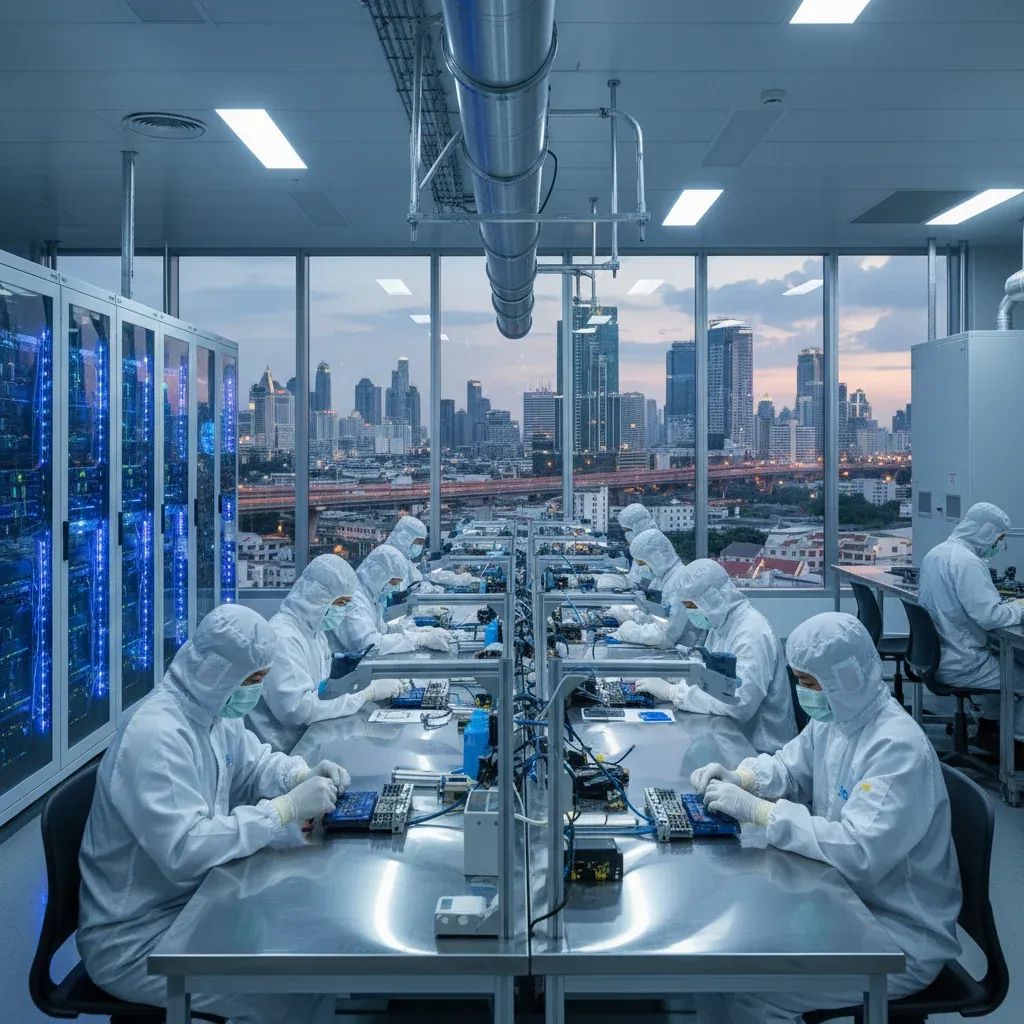
The Thailand Board of Investment has approved over $26B in data center projects through early 2026, but the nation's electronics manufacturers—responsible for one of the country's largest export categories—now face a dual squeeze: US tariffs reaching 19% on many Thai goods and a strengthening baht that threatens to erase already-thin profit margins. Industry leaders are responding with accelerated investment in high-value segments and aggressive product diversification, banking on surging global demand for AI infrastructure and data center hardware to cushion the blow.
Why This Matters
• Tariff deadline looming: Thailand has until July 2026 to finalize a reciprocal trade deal with Washington or face a permanent 19% baseline tariff instead of the current 15% temporary rate.
• Export contraction forecast: The University of the Thai Chamber of Commerce projects tariffs could cut Thai exports by ฿275B (1.48% of GDP) in 2026, with electronics and machinery particularly exposed.
• Currency headwind: The baht is expected to average 31.8 per US dollar this year—a 3.2% appreciation—squeezing margins for exporters who typically operate on 3–8% profit spreads.
• AI boom offsetting pain: Early 2026 data shows robust growth in computer components and telephones, driven by data center expansion that could add 1 gigawatt of capacity by 2027.
The Tariff Landscape: A Moving Target
Thailand's electronics exporters entered 2026 navigating a complex tariff regime. A 19% reciprocal tariff officially took effect last July 31, applying broadly to Thai goods including semiconductors, circuit boards, and consumer electronics. While an initially proposed 36% rate was temporarily rolled back to 10% in April 2025 after intense lobbying, the baseline has settled at 19%—though a 15% flat global tariff announced following a US Supreme Court ruling adds another layer of uncertainty.
The stakes are considerable. The Thailand Ministry of Commerce estimates that electrical and electronic equipment, alongside machinery and components, face the highest vulnerability due to their heavy reliance on American buyers. A 19% levy translates directly into higher shelf prices in the US market, prompting importers to scout for cheaper alternatives in Vietnam, Indonesia, or Mexico.
Exporters are now engaged in a high-stakes lobbying effort to secure inclusion in Annex III of the relevant Executive Order, which grants a 0% reciprocal tariff for designated products. Success here could mean the difference between maintaining market share and losing contracts to regional competitors. Meanwhile, enhanced anti-transshipment enforcement—carrying penalties up to 40%—means Thai manufacturers must rigorously document genuine local production, adding compliance costs and administrative friction.
The removal of the de minimis exemption for shipments under $800 compounds the challenge for smaller exporters, forcing repricing strategies and logistical adjustments that eat into already compressed margins.
Currency Pressure: The Baht's Double-Edged Strength
A stronger baht sounds like good news, but for electronics manufacturers converting dollar-denominated export revenue back into local currency, it's a profitability killer. The Fiscal Policy Office forecasts the baht will trade between 31.3 and 32.3 per dollar this year, with an average of 31.8—a notable appreciation driven by capital inflows, a robust current account surplus, and anticipated Federal Reserve rate cuts.
For an industry operating on margins as thin as 3–8%, even modest currency swings matter. The Thai National Shippers' Council warns that baht strength, combined with softer global orders and a high comparative base from 2025, could limit overall export growth to just 2–4% in dollar terms this year. Regional rivals like Vietnam benefit from weaker currencies, making their products more attractive on price alone.
Mid-sized and larger Thai manufacturers are turning to hedging instruments—forward contracts and currency swaps—to lock in exchange rates and stabilize revenue flows. Some are diversifying invoice currencies beyond the US dollar, incorporating yen or euro contracts to spread risk. The Bank of Thailand's commitment to exchange rate stability provides a predictable framework, but the underlying pressure remains a persistent drag on competitiveness.
What This Means for Residents
For anyone living in Thailand and working in or investing around the electronics sector, these developments carry tangible implications. Jobs in electronics manufacturing—a sector that employs hundreds of thousands—are tied to export volumes. A sustained downturn in US demand or failure to secure tariff exemptions could slow hiring or trigger layoffs, particularly in provinces like Chonburi, Rayong, and Samut Prakan where production clusters dominate.
Investor portfolios with exposure to Thai electronics firms face near-term volatility. Companies unable to diversify markets or move up the value chain risk margin compression; those pivoting successfully into AI hardware or EV components may outperform. Property markets in industrial zones adjacent to data center projects—especially in Bangkok and Pathum Thani—are likely to see sustained demand as tech giants pour capital into infrastructure.
For small and medium-sized enterprises (SMEs) in the supply chain, the message is clear: compliance costs are rising, pricing power is shrinking, and the path forward requires either specialization in niche components or strategic partnerships with larger players who can absorb tariff and currency shocks.
Strategic Pivot: Higher Value, Broader Markets
Delta Electronics (Thailand) and other major manufacturers are responding by diversifying production bases geographically—a hedge against tariff concentration risk. But the more fundamental shift involves moving up the value chain. Thailand's "Made-in-Thailand Chips" roadmap, spanning 2026 to 2050, targets over ฿2.5 trillion ($79B) in investment and aims to build a fully integrated semiconductor ecosystem. The initial five-year phase focuses on strengths in Outsourced Semiconductor Assembly and Test (OSAT), IC design, and advanced electronics while encouraging upstream wafer fabrication.
Printed Circuit Boards (PCBs) represent one bright spot: Thailand has become ASEAN's largest PCB production base, attracting over ฿200B in investment applications between 2022 and mid-2025. The Board of Investment projects the country could capture 10–15% of global PCB production within three to five years, with output valued at $5.62B by 2030—driven largely by demand for AI servers.
Hard disk drives (HDDs) are another growth engine. Production and exports are forecast to expand 6.5–7.5% annually through 2028, fueled by data center buildouts. Seagate Technology and Western Digital are both expanding capacity in Thailand and developing next-generation HDD technology optimized for cloud storage.
The government is incentivizing this transition with tax breaks and low-interest loans for companies investing in R&D, automation, and skills training. BOI policy EV 3.5, mandating domestic battery pack assembly starting this year, further boosts demand for automotive-grade electronics—a higher-margin segment where Thai manufacturers are gaining traction.
The AI Windfall: Data Centers as Revenue Driver
Despite tariff and currency headwinds, AI infrastructure demand is delivering a powerful countercyclical boost. Thailand's AI-optimized data center market is projected to surge from $0.51B in 2026 to $1.49B by 2031, a compound annual growth rate exceeding 24%. Amazon, Google, TikTok, and Microsoft are channeling billions into Thai facilities, leveraging the country's strategic location, reliable power grid, and improving digital infrastructure.
The Digital Economy Promotion Agency (DEPA) and the broader Thailand 4.0 policy framework are accelerating this momentum. The government has pledged $15.4B in AI infrastructure investment by 2027 and allocated ฿25B over the next two fiscal years to establish nine AI Centres of Excellence and a National Data Bank. This investment cycle is translating directly into orders for integrated circuits, PCBs, HDDs, and specialized server components—all areas where Thai manufacturers have established expertise.
Early 2026 trade data confirms the trend: exports of computers, equipment, components, and telephones posted significant surges in January, driven by AI-related demand. Integrated circuits are forecast to grow 3.0–4.0% annually in production through 2028, while HDDs could see 7.5–8.5% export value growth over the same period.
Navigating the Trade-Off
The tension between tariff exposure and AI-driven growth defines the strategic calculus for Thailand's electronics sector in 2026. SCB EIC anticipates overall export growth may contract around 1.5% this year due to the full impact of US tariffs and a high comparative base from 2025. Yet within that aggregate figure, subsectors tied to data centers and advanced manufacturing are expanding rapidly.
Manufacturers are pursuing a three-pronged approach: negotiating for tariff relief and increased US imports to rebalance trade; expanding into new markets in the Middle East, Africa, and South Asia while leveraging Free Trade Agreements; and investing aggressively in compliance systems, pricing transparency, and strategic partnerships—including selective production within the US to become more integrated market participants.
A ฿10B robotics investment in the Eastern Economic Corridor, involving five Chinese technology firms, signals confidence in Thailand's long-term manufacturing trajectory. The focus is on humanoid-robot components, a nascent but high-potential segment aligned with automation trends across Asia.
Long-Term Outlook: From Assembler to Innovator
The immediate turbulence masks a deeper transformation. Thailand is leveraging the "China Plus One" strategy—multinational firms relocating production amid geopolitical tensions—to attract higher-value operations. The Board of Investment's designation of electronics as a "strategic industry" under Thailand 4.0 has delivered tangible results: record investment approvals, expanding R&D facilities, and a growing pipeline of joint ventures with global tech leaders.
The question is whether Thai manufacturers can execute the pivot quickly enough. Rising labor costs demand automation and efficiency gains; tariff pressures require geographic and product diversification; currency strength demands margin expansion through innovation. The convergence of data center investment and a long-term semiconductor strategy offers a rare opportunity to shift from contract manufacturing to technology innovation—but only if the July 2026 trade deadline yields a favorable outcome and the baht's appreciation doesn't accelerate beyond current forecasts.
For now, the sector is bracing for a turbulent year, cushioned by AI demand but acutely aware that competitive advantage in global electronics is never guaranteed—and always under pressure.


