
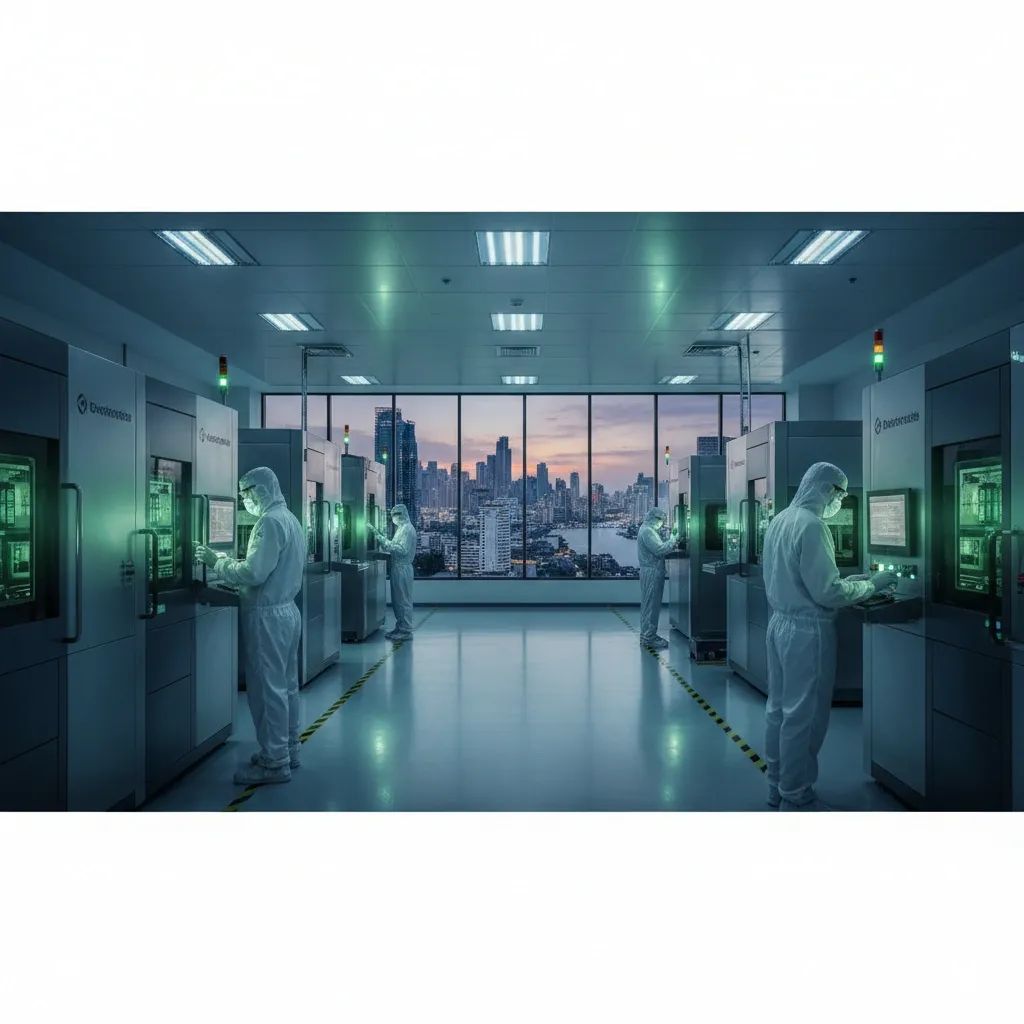
The Thailand Commerce Ministry has reported that customs-cleared exports rocketed 24.4% year-on-year in January, demolishing economist forecasts of 9.35% growth and marking the 19th consecutive month of expansion. For foreign residents, investors, and businesses operating here, the number signals both opportunity and turbulence: while AI-driven electronics shipments are booming, imports surged even faster at 29.4%, widening the trade deficit to $3.30 billion and raising fresh questions about exchange-rate stability and the impact of evolving U.S. tariff regimes.
Why This Matters:
• Export competitiveness surge: Thailand recorded its fastest export growth since late 2021, powered by global AI and data-center demand for Thai-made electronics.
• Trade deficit widens: Imports grew faster than exports, creating a $3.30B deficit—significantly worse than the $2.03B forecast—which may pressure the baht.
• U.S. tariff regime in flux: A new 15% global tariff from Washington replaces the previous 19% reciprocal levy, with Thailand racing to finalize a bilateral trade deal by July 2026.
• Strategic positioning: The performance cements Thailand's role in the AI supply chain, but heightened import costs and policy uncertainty demand close monitoring by businesses and expats alike.
AI Electronics Drive Record Shipments
Behind January's explosive growth sits a singular force: artificial intelligence. Global hunger for servers, data-center equipment, and advanced computing hardware has turbocharged demand for Thailand-manufactured printed circuit boards (PCBs), hard disk drives (HDDs), integrated circuits, and telecommunications gear. Electronics already account for 21.5% of Thailand's total export value, and the sector shows no sign of cooling.
The Thailand Board of Investment has greenlit roughly $2 billion in data-center and electronics-manufacturing projects over the past year, while more than 180 PCB ventures worth over 200 billion baht have been filed since 2022. Industry analysts project Thailand will command 10–15% of global PCB production within three to five years, up from under 5% two years ago. Meanwhile, HDD exports are forecast to grow 7.5–8.5% annually through 2028, driven by the same data-center appetite.
For foreign manufacturers and tech investors in Thailand, this translates to a deepening supply-chain footprint: upstream semiconductor assembly, power-component fabrication, and advanced packaging are all expanding under the government's Thailand 4.0 initiative, which channels 25 billion baht into AI development and establishes nine Centers of Excellence across manufacturing, education, and health care.
Imports Outpace Exports, Deficit Balloons
January's headline export figure tells only half the story. Imports climbed 29.4% year-on-year—faster than outbound shipments—as Thai factories pulled in raw materials, machinery, and intermediate goods to feed electronics production lines. The result: a customs-cleared trade deficit of $3.30 billion, nearly $1.3 billion worse than consensus.
The Thailand Commerce Ministry has flagged exchange-rate volatility as a key watch item. A widening deficit typically weighs on the baht, raising costs for imported fuel, food, and consumer goods—expenses that hit both expatriates' household budgets and local purchasing power. For businesses hedging currency exposure or negotiating supply contracts, the January data underscores the need for active risk management as global tariff policies shift.
What This Means for Residents and Investors
Currency and cost of living: A softer baht makes overseas remittances and foreign-currency obligations more expensive. Expats paying rent in dollars or euros, or transferring retirement funds, should monitor daily rates and consider locking favorable forwards if the deficit persists.
Job market and wages: Electronics manufacturing and related logistics are hiring. The government is scaling up workforce-development programs in semiconductor engineering, computer science, and advanced assembly, creating white-collar and technical roles for both Thai nationals and skilled foreign professionals holding the appropriate work permits.
Real-estate and infrastructure: Surging FDI in digital infrastructure and battery plants is concentrating investment in the Eastern Economic Corridor (Chonburi, Rayong, Chachoengsao). Property demand in these provinces is ticking up, and transit upgrades—high-speed rail, port expansions—are accelerating to accommodate freight volumes.
Tariff uncertainty: The Thailand government is negotiating a bilateral trade framework with Washington, targeting conclusion by July 2026. Until then, Thai goods face a 15% global U.S. tariff under Section 122 of the Trade Act of 1974, down from the 19% reciprocal levy imposed in August 2025 but still above historical norms. Exporters are front-loading shipments to capture current rates, a tactic that may briefly inflate Q1 figures but leaves Q2 vulnerable if talks stall.
Regional Context: How Thailand Stacks Up
Across Southeast Asia, electronics are the new oil. Vietnam saw its U.S. electronics exports jump 150% in 2025, and analysts forecast GDP growth between 5.6% and 7.2% for 2026. Malaysia's electrical-and-electronics sector—where semiconductors represent roughly 65% of shipments—is projected to lift exports by 4.6% this year. Singapore continues to dominate high-end semiconductor manufacturing, though its GDP growth is expected to moderate to 1.8%.
Thailand enters the race with advantages: a diversified industrial base, established automotive and appliance sectors pivoting toward electric vehicles and green manufacturing, and a geographic position that appeals to companies hedging against concentration risk in northern Vietnam or southern China. Yet the high base effect from 2025's 12.9% export expansion means sustaining double-digit growth will be difficult. Full-year forecasts for 2026 range from a contraction of 3.3% to modest growth of 1.1%, depending on how quickly U.S. tariffs settle and whether Chinese demand rebounds.
Green Goods and Trade-Agreement Push
One bright spot beyond AI electronics: green exports. Products such as energy-efficient air conditioners, solar photovoltaic modules, and EV components already represent nearly 10% of total shipments and carry higher margins than legacy commodities. The Thailand Commerce Ministry is rushing to finalize a Free Trade Agreement with the European Union by mid-2026, aligning local manufacturing standards with stringent EU environmental rules and unlocking tariff-free access for electric-vehicle supply chains.
Separately, Thailand activated its agreement with the European Free Trade Association (EFTA)—covering Switzerland, Norway, Iceland, and Liechtenstein—offering niche but high-value markets for specialized industrial goods and precision components.
Tourism Recovery Underpins Broader Stability
While not a merchandise export, inbound tourism acts as a crucial economic stabilizer. Thailand anticipates 35.5 million foreign arrivals in 2026, injecting service income that supports domestic consumption, employment, and infrastructure investment. For expatriates, a buoyant tourism sector translates to a more resilient hospitality and service economy, better airport connectivity, and sustained government revenue that funds public services without aggressive tax increases.
Structural Challenges and Policy Response
Beneath the January surge lie persistent structural headwinds. Household and SME debt remain elevated, constraining domestic demand and forcing The Bank of Thailand to maintain accommodative monetary policy—interest rates have been trimmed to ease refinancing burdens. Political uncertainty around fiscal disbursements has also slowed infrastructure rollouts, though the current administration has prioritized digital transformation and green-trade initiatives to keep private investment flowing.
For small and medium-sized enterprises in Thailand, the Commerce Ministry is promoting market diversification: exporters are urged to reduce dependence on the United States by targeting the Middle East, Africa, and Latin America. Trade missions, co-financing schemes, and streamlined customs procedures are part of the toolkit.
Tariff Timeline and Negotiation Outlook
On February 20, the U.S. Supreme Court ruled that President Trump's use of emergency economic powers to levy "reciprocal" tariffs was unconstitutional, shifting authority back to Congress. In response, the White House announced a 10% global tariff effective February 24 under Section 122 of the Trade Act of 1974, later raising it to 15% for a 150-day period. For Thailand, this means exporters now face normal duties plus the 15% levy, plus any applicable anti-dumping or countervailing charges.
Thailand's Commerce Minister, Suphajee Suthumpun, has committed to continuing director-general-level talks, with policy approval required on several sticking points. The October 2025 Framework for an Agreement on Reciprocal Trade obligates Thailand to recognize U.S. motor-vehicle standards and FDA certifications, permit American ethanol imports, amend customs laws, and adopt sound regulatory practices—reforms that will ripple through automotive, food-safety, and pharmaceutical sectors.
What to Watch in Coming Months
Baht volatility: A widening deficit and shifting tariff landscape make daily currency swings likely. Businesses with dollar liabilities and expats remitting funds should budget conservatively.
July trade-deal deadline: Success or failure of bilateral talks will determine whether Thai goods retain competitive access to the U.S. market or face sustained punitive rates.
China demand: Beijing's economic slowdown directly affects Thai commodity and intermediate-goods exports; any stimulus measures will show up in Thailand's monthly trade data within 60 days.
Electronics project completions: As PCB and semiconductor fabs come online in the Eastern Economic Corridor, watch for hiring announcements and infrastructure bottlenecks—both signals of whether the AI boom can be sustained.
January's 24.4% surge offers a snapshot of Thailand's evolving role in the global tech supply chain, but the full picture depends on tariff negotiations, import-cost management, and the durability of AI-driven demand. For residents and investors, the message is clear: opportunity abounds in electronics, green manufacturing, and digital infrastructure, yet currency risk, policy uncertainty, and regional competition require vigilance and diversification.


