
Thailand's export machine hit a significant milestone in June: US$34.7 billion in customs-cleared shipments, marking the 24th consecutive month of year-on-year expansion. The 20.8% surge signals far more than healthy manufacturing activity—it reflects a fundamental repositioning of global supply chains in which the kingdom is capturing disproportionate share of investment and orders. For people working in manufacturing, logistics, and related services across Thailand, this trajectory carries immediate implications for employment, wages, and career positioning.
Why This Matters
• Electronics now comprise over half of all Thai exports, and crucially, remain exempt from US tariffs that are reshaping trade flows elsewhere in Asia.
• Telephone components jumped 186.1% and computer equipment rose 57.4%, driven by multinational firms rushing to build AI infrastructure capacity before further policy shifts.
• Foreign firms account for a substantial majority of electronics exports, meaning most output flows through contract manufacturers and component suppliers owned by international capital.
• Import content for Thai electronics shipments reportedly reaches 70% or higher, creating a trade dynamic where headline export figures mask the actual value retained within Thailand's economy.
The Infrastructure Behind the Numbers
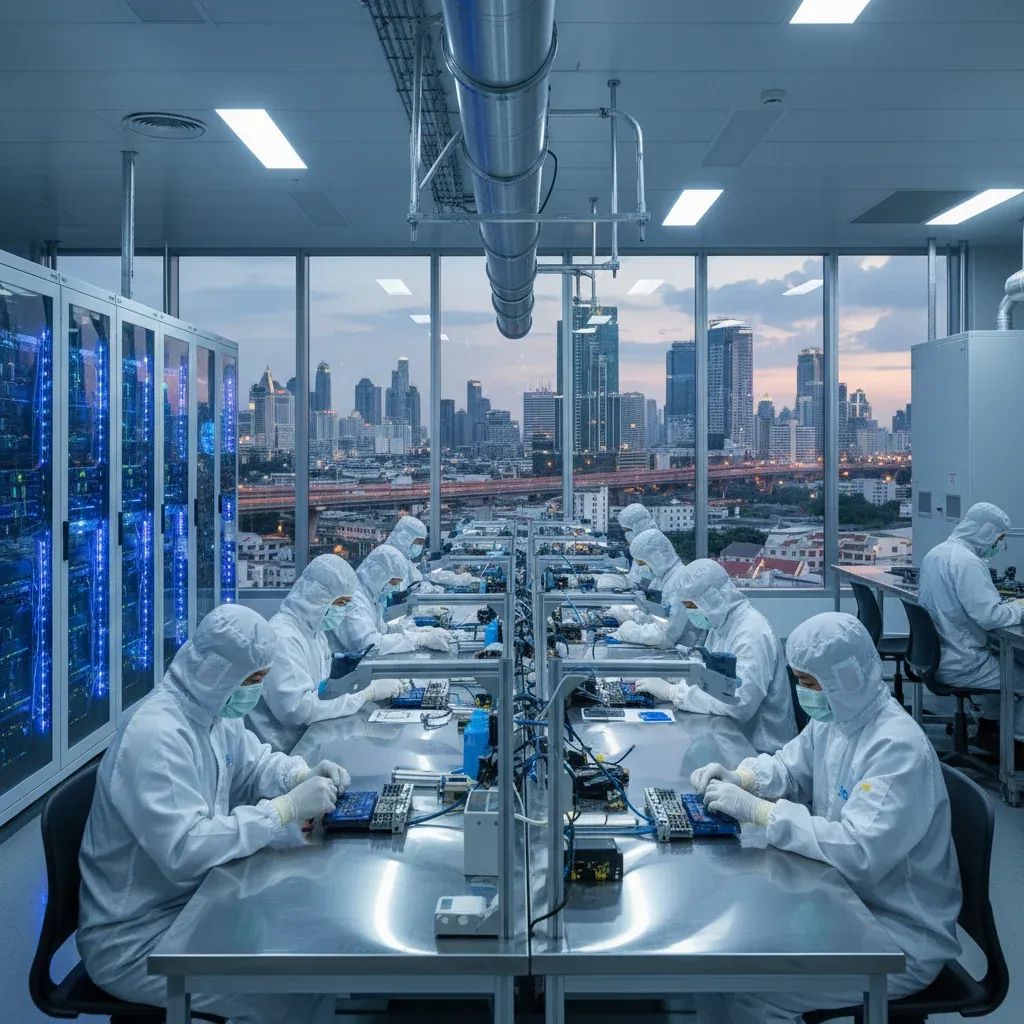
To understand what's driving these export figures, one must examine Thailand's industrial zones closely. The factories across Rayong, Samutprakarn, and the Eastern Economic Corridor are largely owned or contracted by Samsung, Apple, Intel, and Dell—firms racing to expand server capacity and data center components as artificial intelligence applications proliferate globally. When a Silicon Valley technology company needs circuit boards, processors, or battery modules, production orders flow directly to these Thai facilities. The urgency is real: companies fear tariff escalation or supply shortages, so they're front-loading orders wherever possible.
This creates a peculiar economic dynamic. While US buyers accelerated purchases by 44.3% in June alone, sending Thailand's dominant export market into overdrive, the actual wealth generation looks different on the ground. According to industry analysis, electronics exports carry import content of approximately 70% or higher, meaning a substantial portion of shipment value represents payments for foreign raw materials, components, and equipment. The remainder—what actually stays in Thailand as wages, local profits, and tax revenue—represents a compressed domestic economic multiplier compared to other manufacturing sectors.
For context: if a garment factory were shipping equivalent value, the import content would typically run 30-40%, leaving substantially more wealth inside the country. Thailand's transformation into a high-tech assembly hub has traded broad-based prosperity for concentrated gains among foreign investors and a smaller cadre of local skilled workers.
Why American Demand is Reshaping Southeast Asia
US trade policy has substantially shifted the competitive landscape for Thai exporters. Electronic products—the bulk of Thai exports—face favorable conditions, while competing nations absorbed tariff burdens that redirected orders toward Thailand. For American importers, Thailand's electronics suddenly cost less than competitors' shipments subject to trade barriers.
This tariff arbitrage has turbocharged order flows. The Thailand Ministry of Commerce is expecting sustained electronics demand through at least the fourth quarter as companies lock in production capacity before any further policy shifts. But the government is also acutely aware that this advantage is contingent. A single policy change in Washington could pivot the entire dynamic overnight.
Exports to the United States expanded 44.3% in June alone, consolidating America's position as Thailand's largest customer by a substantial margin. The European Union added another 20.6% growth in the first two months of the year. These two markets are absorbing the vast majority of Thailand's electronics boom.
The Automobile Question: Export Decline Amid Domestic Surge
Thailand's automotive sector presents a starkly different picture. Vehicle exports dropped 7.45% in June, accelerating a painful trend that saw significant decline in May. The Federation of Thai Industries revised its full-year production forecast downward, now anticipating contraction instead of earlier growth expectations. The culprit: Middle East hostilities have disrupted logistics corridors and dampened demand from buyers in that region who historically represent substantial export volume for compact sedans and commercial trucks.
Yet the domestic market is thriving. Car sales within Thailand surged 17.26% year-on-year in June, building on earlier gains. More striking still: electric vehicle sales are accelerating significantly in the first half of the year, putting the country on pace for substantial unit growth. Government incentives combined with declining battery costs have triggered a genuine consumer migration toward electrification, at least among Bangkok-based and middle-income purchasers.
This bifurcation matters. Export-oriented assembly plants manufacturing traditional combustion-engine vehicles for international markets face headwinds that efficiency improvements alone cannot overcome. Simultaneously, the domestic market is migrating toward EV infrastructure—charging networks, battery recycling, specialized financing products—creating new business opportunities for investors and supply chain professionals willing to pivot away from legacy automotive segments.
What This Export Surge Means for Your Career and Wallet
For professionals employed in electronics logistics, technical staffing services, and industrial real estate, the current expansion is translating into sustained hiring pressure and wage growth outpacing inflation. Manufacturing zones like Rayong are experiencing genuine labor tightness as multinational firms expand production. Career advancement opportunities exist for those with relevant technical backgrounds or supply chain expertise.
Trade policy creates friction across other sectors. Agricultural and processed food exporters—industries employing millions in rural Thailand—now face tariff pressures that buyers will either absorb or pass back to producers. A shipment of Thai rice destined for international markets now carries tariff costs that reduce what growers receive. The Thai government is accelerating negotiations, attempting to secure better terms for vulnerable agricultural sectors. Exporters in affected industries should explore geographic indication labeling and value-added certification programs to justify premium pricing despite tariff headwinds.
For automotive supply chain workers facing export sector turbulence, the strategic calculus is shifting. Export-oriented work in traditional vehicle manufacturing carries cyclical risk linked to geopolitics and global vehicle demand. Domestic work servicing the EV transition, by contrast, sits at the beginning of a multi-year expansion cycle. Retraining and repositioning toward battery suppliers, charging infrastructure installers, and EV-specific logistics represents an increasingly rational career move.
The Regional Competitive Landscape
Thailand is not alone in experiencing manufacturing booms. Vietnam and the Philippines are both tracking solid growth trajectories, fueled by manufacturing expansion and strong domestic consumption. Indonesia and Singapore led the broader ASEAN region in growth metrics. Yet Thailand holds distinct advantages in several dimensions.
Foreign direct investment surged substantially in recent months, with capital flowing heavily into advanced industries—robotics, aviation, semiconductors, and digital infrastructure. These sectors offer higher margins and superior potential for local technology transfer compared to contract assembly work. When a foreign firm builds a robotics facility in Thailand, a portion of the supply chain and expertise eventually locates domestically; when the same firm builds a contract assembly line, the technology remains owned externally.
The "China Plus One" strategy continues reshaping supply chains globally. Multinational corporations seeking geographic diversification to reduce China exposure have funneled billions into Vietnam, Thailand, and Malaysia. Thailand's infrastructure maturity creates a genuine competitive advantage. The Eastern Economic Corridor integrates ports, rail connections, and dedicated industrial estates that enable faster production ramp-up compared to greenfield sites in competing nations. A semiconductor manufacturer opening a new facility in Thailand can achieve operational capacity significantly faster than equivalent timelines in competing locations. That speed differential translates directly into return-on-investment calculations.
The Second Half: Growth Sustainability and Risks
The Thailand Ministry of Commerce has maintained its export growth forecasts, but government officials are signaling caution ahead. The term "front-loading" has begun circulating in official briefings, suggesting that companies accelerated orders earlier to avoid anticipated tariff increases or secure delivery slots. If this thesis proves accurate, the second half could see growth rates moderate as this artificial demand boost dissipates.
Forecasts reveal varying expectations among agencies, with some projecting stronger growth and others more conservative estimates. These outlooks rest heavily on sustained electronics demand. If artificial intelligence infrastructure investment moderates—an outcome that remains plausible but uncertain—export momentum could decelerate sharply.
Several headwinds warrant attention. Import growth hit 50.3% in June, creating widening trade deficits as electronics shipments require ever-larger quantities of foreign inputs. Production costs remain elevated across raw materials, labor, transportation, and energy. Agricultural sectors face climate-related risks that could increase raw material expenses across food and beverage exports—sectors that employ rural Thailand significantly.
The Concentration Problem
Thailand's export profile has become increasingly concentrated in a narrow sector: electronics and AI-adjacent manufacturing. This creates vulnerability. If global demand for AI infrastructure moderates, or if American trade policy shifts, Thailand's export trajectory could reverse sharply. The automotive sector is already weakening. Agricultural exports remain foundational but face climate and tariff exposure.
For long-term stability, policymakers must diversify sectoral performance and deepen local value-added across all three pillars. The current expansion is genuinely impressive on headline metrics. But it rests on a concentrated, import-intensive foundation vulnerable to sudden shocks in global technology demand or American trade policy. Thailand's challenge ahead is converting near-term export success into durable, broadly distributed economic gains—ensuring that prosperity extends beyond factory floors in major industrial zones and touches communities across the kingdom.


