
Why This Matters
• Enforcement intensity peaks: Thai authorities intercepted a record 74.7M baht in contraband in a single Mae Sai checkpoint bust, signaling that border seizures are accelerating even as trafficking networks adapt their tactics.
• Vulnerability extends beyond borders: A flight attendant's arrest in Melbourne exposed how narcotics routed through international courier networks exploit personal relationships and social media recruitment, putting ordinary travelers at legal risk abroad.
• Precursor chemicals remain a choke point: Ethnic militias in Myanmar's Shan State control both production and supply chains, making interdiction a battle fought across geography rather than within Thailand's borders alone.
The Northern Border's Unyielding Challenge
The Thailand Customs Mae Sai checkpoint operates at the narrow gate between prosperity and chaos. On a July morning, officers performing routine inspections on a three-wheeled cargo truck flagged something askew: fruit baskets stacked with mechanical precision, yet the driver's answers wavered under questioning. Inside those wicker containers lay 600,000 methamphetamine tablets and 111 kilograms of ketamine—a haul valued at 74.7M baht on the street, enough to fund operations for a mid-sized trafficking network for months.
The Myanmar national behind the wheel now faces prosecution under Thailand's narcotics statutes, which impose sentences up to life imprisonment for trafficking in quantities this substantial. But the bust itself tells a larger story: this seizure represents neither an anomaly nor a triumph. It is, rather, routine desperation—a moment when enforcement worked precisely as designed, intercepting one shipment among dozens that cross daily through porous geography and weakly fortified corridors.
The Mae Sai crossing, which links Chiang Rai province to Tachileik township across the border, has functioned for decades as a dual-purpose gateway. Merchants move legitimate goods; tourists pass through freely; commerce flows. Beneath this veneer, a parallel economy runs: narcotics move through the same channels at night, hidden in truck beds and boat holds, exploiting the same infrastructure that serves civilian populations.
How Myanmar's Internal War Fuels Production
The acceleration of narcotics trafficking reflects a political reality rarely mentioned in enforcement announcements: Myanmar's civil conflict has incentivized drug production as a revenue mechanism for armed groups. Ethnic militias controlling territory in Shan State—particularly the Border Guard Force (BGF) and factions loyal to former warlord networks—have substantially increased manufacturing capacity not merely to meet Thai demand but to finance ongoing military operations against Myanmar's central junta.
Intelligence assessments from the Thailand Office of the Narcotics Control Board (ONCB) indicate that these militias view narcotics proceeds as strategic assets equivalent to taxation. Production capacity has not diminished despite regional instability; rather, it has intensified. Staging areas near border villages such as Phu Na Ko and Mae Chok maintain substantial reserves, ready for shipment whenever market conditions and security calculations align favorably.
The precursor chemical supply chains—which govern whether labs can synthesize methamphetamine or ketamine at scale—remain tightly controlled by these same armed groups. Thai enforcement can intercept finished products, but closing down production requires direct intervention in Shan State, a step geopolitically impossible for Thailand to undertake unilaterally.
The Flight Attendant Case Exposes Network Complexity
On the same day customs officers made the Mae Sai seizure, the Thailand Royal Police moved against a figure in what first appeared to be an isolated smuggling operation but has since revealed itself as symptomatic of a broader trafficking architecture.
Nantawat, 47, a resident of Phayao province, was detained at a modest apartment in Phra Nakhon Si Ayutthaya. Investigators identified him as a courier in the heroin pipeline connected to a Thai flight attendant arrested at Melbourne Airport months earlier. The attendant, they established, had been recruited through Facebook by an account calling itself "Rose"—offering payment for what seemed like straightforward courier work: transport a parcel internationally, collect cash.
The mechanics were unremarkable until Australian Federal Police opened the package at Melbourne customs. Inside lay heroin sufficient to trigger international narcotics protocols and expose a supply chain stretching from production facilities in Shan State through Thai intermediaries and into the hands of airline crew members who carry contraband across borders where commercial privileges grant them lighter scrutiny than ordinary passengers.
Nantawat's confession—that he had completed multiple similar deliveries prior to arrest—suggests the network operated with established routines. Investigators are now working to identify the person or persons behind the "Rose" account and determining whether coordination occurred entirely within Thailand or involved operatives embedded in Australia managing distribution. The ambiguity itself reflects the sophistication of these operations: they operate across jurisdictions, exploiting the gaps between national investigative authorities.
Seizure Statistics Reveal Scale and Direction
The numbers tell a sobering story. Between October 2025 and June 2026, the Thailand Customs Bureau documented 214 narcotics cases, confiscating over 917 kilograms of controlled substances valued at approximately 691M baht. The burden falls disproportionately on methamphetamine (locally termed "ice") and heroin.
Looking at enforcement across all agencies from April through early June 2026, the ONCB reported 59,609 arrests, 64 major trafficking networks dismantled, and 10.2 billion baht in frozen assets. Those figures—nearly 273 million methamphetamine tablets and 17.7 tons of crystal methamphetamine seized in barely 10 weeks—show that production capacity in Myanmar continues to expand despite the country's civil chaos. These operations are massive. They're industrial-scale manufacturing with supply chains that rival legitimate chemical businesses.
The seizure patterns also show how traffickers are adapting. They're sending larger quantities per shipment, using more sophisticated hiding methods, and diversifying their routes. The three-wheeled cargo truck with hidden fruit baskets succeeded for a while—a reminder that sometimes simple methods work best when border checkpoints are overwhelmed with traffic.
What This Means for Residents and Travelers
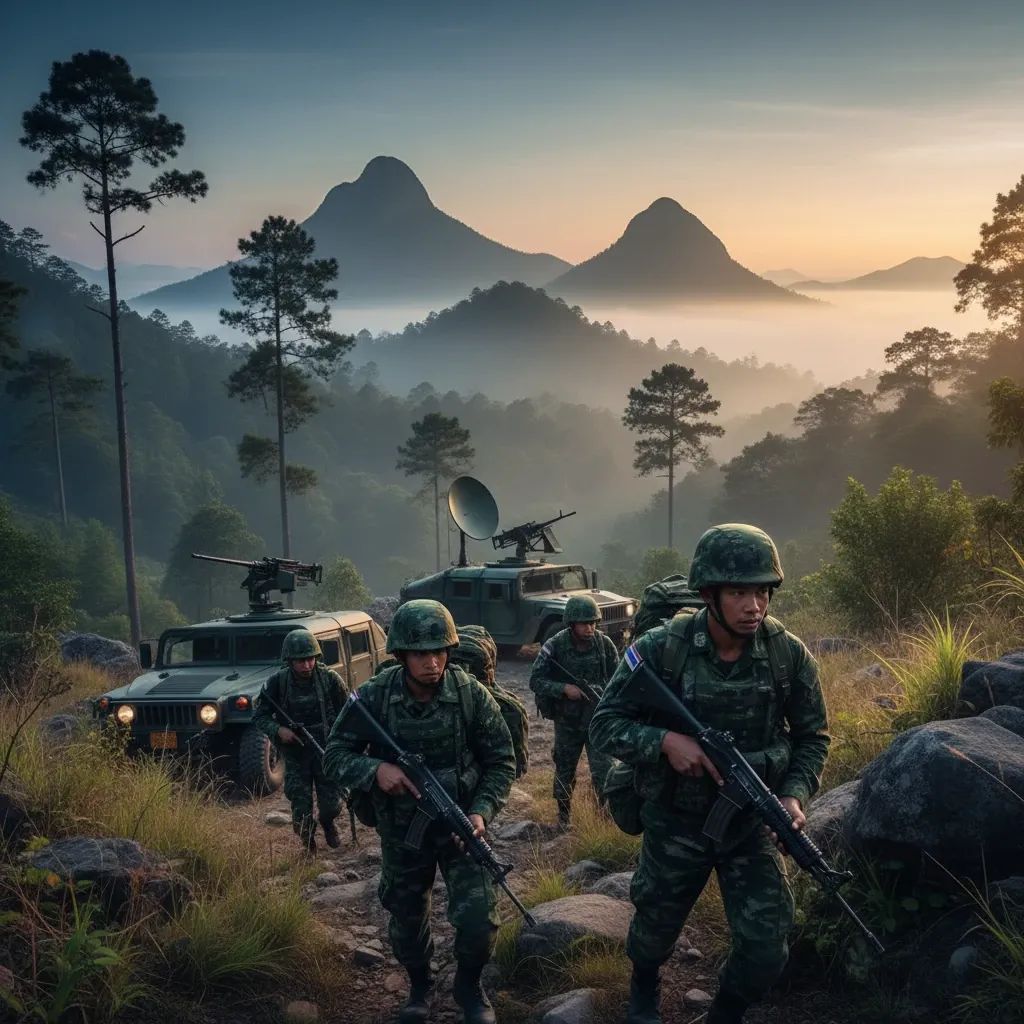
For people living in Chiang Rai, Chiang Mai, and other northern provinces, the changes are immediate and concrete. Border checkpoints now run tighter operations. Vehicle inspections take longer. Commercial freight requires more paperwork. Military patrols have increased along secondary roads, particularly in districts like Mae Sai, Mae Fah Luang, and Chiang Saen.
The government has rolled out the "Smart Border" program, which will install drones, high-resolution cameras, and connected computer systems at checkpoints across 31 border provinces. Here's what this means for you: expect longer processing times at checkpoints during the implementation phase. If you're crossing regularly for visa runs, shopping trips, or tourism, plan for an extra 15–30 minutes depending on traffic. The system may eventually streamline crossings once fully operational, but the transition period will likely feel more cumbersome.
You won't need additional documentation beyond your usual passport and any required visas for visa-exempt entries. The system primarily flags suspicious patterns—repeat travelers on unusual schedules, vehicles with unexplained weight discrepancies—rather than targeting ordinary residents. However, if customs officers do conduct a search, they'll have access to your entry history and previous border crossing records, so be prepared for more detailed questioning if you have an unusual pattern of travel.
More critically, anyone considering involvement in courier work—whether advertised online or through personal networks—faces severe legal liability. Thai law imposes strict liability for possession; the burden falls entirely on the accused to prove innocence through compelling evidence. The flight attendant case demonstrates that accepting a package for transport, even when no actual knowledge of contents exists, can result in arrest abroad, prosecution in a foreign legal system, and years of incarceration separated from family and support networks.
The precedent is clear: ignorance offers no protection. Social media recruitment exploits the appearance of legitimacy. Promises of payment are designed to obscure the true nature of the transaction. Thailand's courts have convicted dozens of such couriers on similar facts with little sympathy for claims of deception or lack of awareness.
Government Enforcement Architecture and Strategy Shift
The Thailand Ministry of Interior, working in coordination with the Royal Thai Army and National Police, has restructured how forces deploy along the border. Joint task forces now operate around the clock in high-risk zones, rotating personnel to prevent corruption and fatigue-related lapses. Intelligence-sharing platforms allow customs, narcotics, and immigration databases to communicate automatically, flagging suspicious patterns before they escalate.
Airline operations have changed too. Flight manifests are now cross-checked against watchlists maintained by multiple agencies before passengers board. This system looks for red flags—multiple trips on the same route, traveling companions who appear repeatedly, booking inconsistencies—before anyone steps on a plane. It's not perfect, but it has closed a significant loophole that trafficking networks previously exploited easily.
Financial investigation has become a strategic priority equal to seizure operations. The 10.2 billion baht in frozen assets during the April–June period represents a deliberate shift in enforcement philosophy: dismantling the economic foundation of trafficking organizations rather than merely intercepting individual shipments. Under Thai law, proceeds from drug sales can be traced through banking records, property registrations, and cryptocurrency wallets. Asset forfeiture proceedings allow the state to confiscate homes, vehicles, and business interests tied to narcotics revenue, even absent criminal conviction of the original owner.
This approach aims to make smuggling financially unviable by eliminating profit incentives entirely. A trafficker may evade arrest temporarily, but if enforcement agencies can freeze his family's properties or seize business assets, the operation becomes unsustainable. Early results suggest the tactic has merit: networks that previously operated with relative impunity now face financial strangulation that sometimes forces them to cease operations or relocate.
Looking Forward: Enforcement Without End
The seizures of July 5 and the Ayutthaya arrest represent incremental victories in a campaign that shows no indication of concluding. Myanmar's internal conflict will continue driving militia groups to view narcotics as a strategic resource. Thailand's geographic position—situated directly south of the world's largest concentration of clandestine methamphetamine laboratories—guarantees its role as both destination market and transit hub for decades to come.
Thai authorities acknowledge this reality privately, even as public statements emphasize enforcement success. Prevention programs targeting vulnerable communities, rehabilitation services for users, and economic development initiatives in border areas form the other pillars of the national strategy outlined in Thailand's 2023–2027 drug policy framework. Yet these programs remain chronically underfunded relative to enforcement, and their effectiveness remains difficult to measure reliably.
For now, residents and travelers should expect continued high-profile busts, expanded checkpoint operations, and periodic public awareness campaigns. The institutional message is unambiguous: the price of participation—whether as a knowing trafficker or an unwitting courier—remains steep, and the enforcement net continues to tighten. Whether that deterrent effect matches the scale of the challenge remains an open question Thai policymakers are only beginning to confront seriously.


