
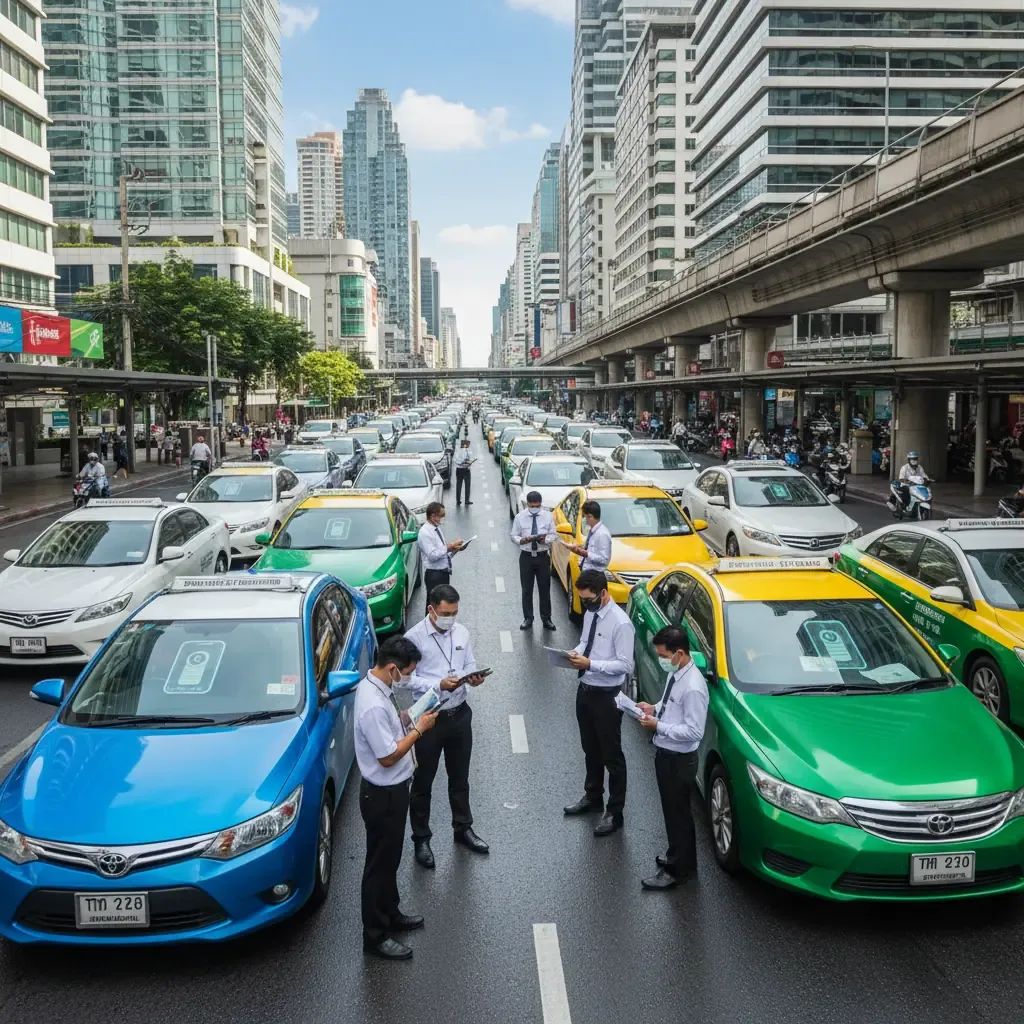
Tough New Rules for Thai App-Based Drivers: What You Need to Know
The Thailand Transport Ministry has drawn a hard line in the sand—app-based drivers must now hold a public license and pass a police criminal check, or lose the ability to work. Starting April 2026, drivers operating on platforms like Grab and Bolt face a four-month compliance window, after which enforcement will intensify dramatically. Those still operating outside the rules will face removal from apps, penalties, and platform shutdowns.
Why This Matters
• Strict August deadline: All drivers must secure a public driving license and clear a criminal background screening by late August 2026, or face suspension.
• Platform enforcement: Grab and Bolt risk business license suspension if they allow non-compliant drivers to accept rides.
• Financial impact on drivers: Transitioning to public-status vehicles means higher insurance costs, registration fees, and vehicle inspection requirements.
• Safety gains: The screening targets individuals with violent histories or risky behavior patterns, raising passenger security standards.
A Movement Brewing: What Taxi Groups Really Want
Deputy Transport Minister Siripong Angkasakulkiat received the demands on Tuesday, April 28, 2026, when representatives from traditional taxi associations and ride-hailing driver unions gathered outside the Thailand Transport Ministry offices. The licensing deadline emerged from a broader negotiation—one that revealed deep frustrations simmering beneath the surface.
The six formal proposals reveal the industry's core concerns. Taxi groups submitted demands including: extending vehicle operational lifespans from 9 years to 12 years—and up to 15 years for electric vehicles—to stretch profit margins over longer periods; restructuring fares to reflect energy costs spiraling upward, particularly in Bangkok and surrounding provinces; requesting the government develop a centralized ride-hailing application consolidating all transport into a single platform with transparent, verifiable pricing; exemptions from airport competition where app-based services undercut metered cabs; protection from "wing taxis"—informal taxi rackets operating outside legal channels; designated parking zones at transit hubs; access to government fuel subsidies; integration into the national digital wallet program; and strict enforcement preventing non-Thai nationals from obtaining public driving licenses.
These demands reflect the competitive pressures traditional operators face. The regulatory tightening on app-based drivers creates an opportunity to rebalance market conditions, though the practical outcome will depend on how consistently these measures are enforced.
How Drivers Caught in the Middle React
The compliance mandate hits drivers where it hurts: the wallet. Converting from a private to public vehicle registration triggers a cascade of costs. Insurance premiums can triple. Financed vehicles face potential covenant violations if banks reclassify collateral. Resale values drop as buyers recognize the vehicle carries public-service mileage. Many drivers operate part-time, cobbling together income from other work—the regulatory burden discourages these supplementary operators from formalizing.
Both Grab Thailand and Bolt Thailand acknowledge the friction. Bolt has mobilized aggressively, reporting that more than 36,000 partner drivers successfully obtained public licenses in 2025—a threefold increase from early-year numbers. The platform launched "Booster Week" initiatives and partnered with insurers and financial institutions to reduce friction. Grab emphasized commitment to regulatory alignment in its 2026 roadmap and confirmed criminal background screening protocols already exist.
Yet commitment and capability aren't the same. Drivers resist the process. Platforms face operational challenges. Part-time workers—often the backbone of available capacity during peak hours—abandon the prospect when the bureaucratic and financial burden outweighs income gains.
What Passengers Should Prepare For
For Thailand's 70 million residents and the hundreds of thousands of expats navigating the country's transport network, the regulatory tightening carries direct consequences that experts warn about.
Service gaps may occur. Transport analysts warn that if a significant percentage of drivers fail to comply by August, ride availability could contract—particularly in suburban zones or during off-peak hours where driver density is thin. This happened in neighboring Malaysia following stricter ride-hailing regulations, where wait times increased by 15-20% during transition periods. Similarly, Singapore experienced temporary service disruptions when implementing its licensing requirements in 2015. For Thailand residents, this means possible longer wait times, especially outside Bangkok's central areas.
Fares could increase. Drivers absorbing higher operating costs may demand fare adjustments, either through formal platform rate increases or informally by selecting higher-value trips. The competitive pricing environment that made apps attractive may shift. Regional precedent suggests fare increases of 10-15% typically follow stricter licensing requirements.
Safety standards should improve. Mandatory criminal screening and professional competency training should reduce incidents involving unvetted or high-risk drivers—a concern that surfaced periodically in local media following harassment or assault reports. This is the genuine trade-off: convenience and cost against security.
Traditional metered taxis could regain ground. If app-based services become less convenient, taxis may recapture market share. Whether they'll capitalize depends on execution—and on whether the Transport Ministry pursues its proposed government-run platform, which could fundamentally reshape the competitive landscape.
What Passengers Can Do
Residents can take practical steps to navigate these changes:
• Verify driver compliance: After August 2026, both Grab and Bolt plan to display compliance verification badges in their apps. Check for these indicators before booking.
• Report non-compliant drivers: If you encounter a driver claiming to operate without proper licensing after the August deadline, report through the app's safety feature or contact the Thailand Department of Land Transport.
• Plan ahead during transition period: Expect higher wait times in July and August 2026. Book rides earlier and consider backup transport options like traditional taxis or mass transit during peak compliance-checking periods.
• Monitor platform announcements: Both Grab and Bolt will communicate compliance details through in-app notifications and SMS. Review these communications to understand how the transition affects your area.
Regional Precedent: How Neighbors Handle the Challenge
Thailand isn't pioneering this terrain. Singapore implemented mandatory knowledge tests and Land Transport Authority (LTA) registration for ride-hailing drivers as early as 2015, enforcing competitive parity between metered cabs and app-based services. Malaysia mandates licenses from the Land Public Transport Agency (APAD) and requires platforms like Grab and Maxim to implement safety infrastructure: AudioProtect (ride audio recording) and Women's Rate options allowing female passengers to request female drivers. Vietnam lacks comprehensive legislation but issues guidance recommending licensed platforms like Grab and Gojek to avoid airport scams and imposter drivers.
For Thailand residents, these regional implementations suggest that stricter licensing can stabilize markets and improve safety, though transition periods typically involve service adjustments. Thailand's four-month rollout is notably aggressive compared to the phased timelines regional peers adopted, which may create tighter supply constraints during the compliance window.
The Implementation Reality: August or Bust
The Thailand Department of Land Transport opened One-Stop Service centers at provincial transport offices through May 2026 to expedite registration. After August, enforcement becomes visible and harsh.
The Royal Thai Police and transport inspectors will conduct spot checks at high-traffic zones—airports, shopping districts, transit hubs. Non-compliant drivers face fines up to 2,000 baht per violation, with penalties escalating for repeat offenses. Platforms allowing unauthorized drivers risk administrative suspension and, in severe cases, license revocation. The Thailand Ministry of Digital Economy and Society oversees platform compliance; the Electronic Transactions Commission fields consumer complaints about app functionality and privacy violations.
This is where the deadline transforms from a policy announcement into a practical gauntlet. Thousands of drivers must navigate government bureaucracy, finance transitions, and bureaucratic delays—all within 120 days. Platforms must deactivate non-compliant drivers, risking driver shortages. Passengers must adapt to service adjustments.
The Deeper Stakes
Whether Thailand's ride-hailing ecosystem emerges more equitable, more safe, or simply more restricted hinges on what happens next. The August date isn't arbitrary; it's a stress test for a sector operating in regulatory ambiguity for nearly a decade.
Successful implementation requires simultaneous buy-in: drivers must choose compliance despite financial friction; platforms must sacrifice short-term capacity for long-term legitimacy; the government must balance taxi industry demands against consumer service expectations; and regulators must enforce consistently without paralyzing the sector.
History suggests Thailand excels at regulatory announcements but often struggles with uniform enforcement. If the August deadline enforcement is selective or inconsistent, non-compliance will proliferate, platform accountability will blur, and the policy will become toothless. If enforcement is strict but inflexible, driver supply could collapse, fares could spike significantly, and passengers may face genuine hardship.
The real test isn't the deadline. It's whether Thailand's transportation leadership can navigate the competing pressures—taxi operators seeking protection, app-based platforms defending profitability, drivers seeking livelihood, and passengers demanding affordable mobility—without sacrificing the fundamental goal: safe, fair, and accessible transport for a sprawling, transport-dependent nation.


