
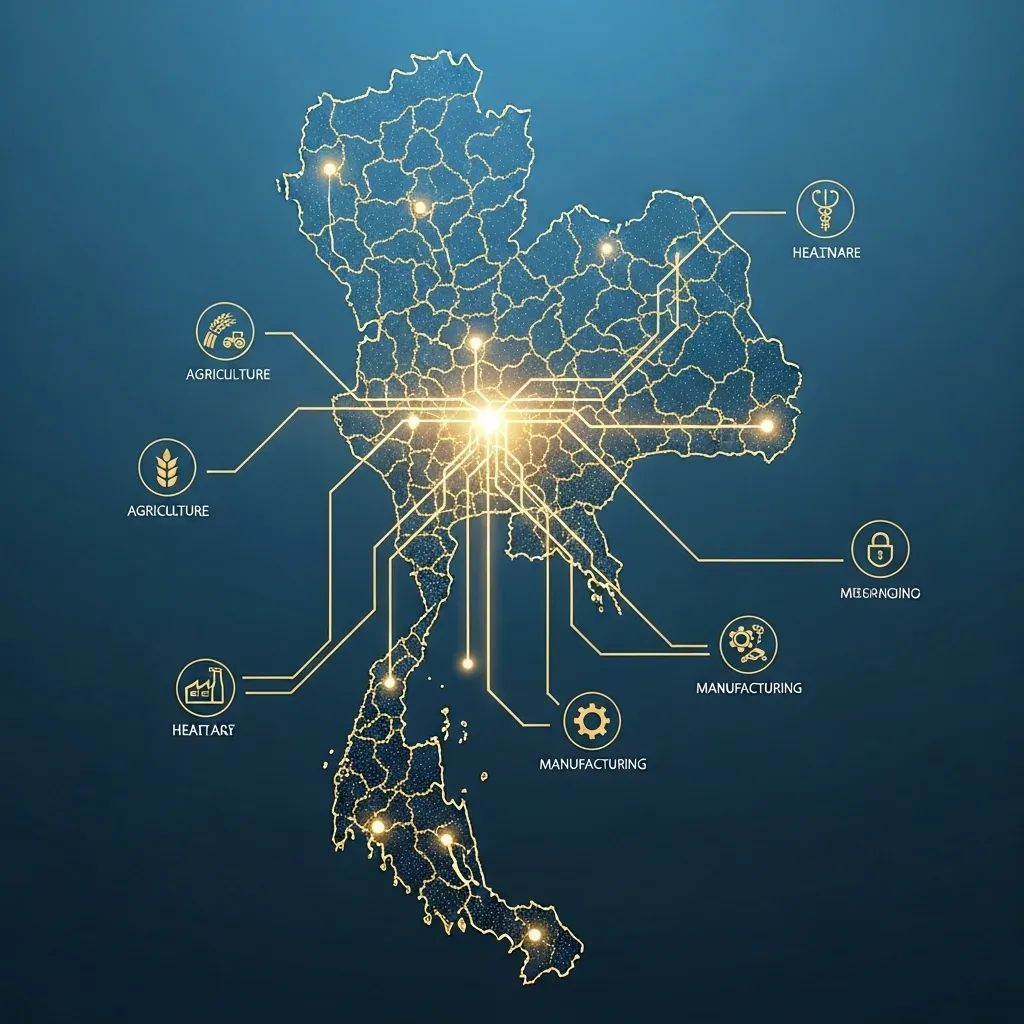
The Thailand government has approved 25 billion baht for AI infrastructure and regulation through 2027, a move that will reshape compliance obligations, workforce demands, and competitive positioning for every business operating in the kingdom—from foreign multinationals to local startups.
Why This Matters
• Regulatory deadline approaching: Formalized AI legislation is expected to pass in 2026, imposing duties on high-risk AI providers and deployers.
• Spending surge: IT investment in Thailand is forecast to hit 1.1 trillion baht this year, up 8.36% year-on-year, driven almost entirely by AI infrastructure.
• Workforce gap: An estimated 56% of the Thai workforce will need AI upskilling by year-end to remain employable, yet most organizations still treat AI competency as a specialist skill rather than a baseline requirement.
• Cybersecurity spike: Over 63% of Thai businesses have experienced data breaches in the past year, with 52% paying ransoms—a trend accelerating as AI-driven attacks grow more sophisticated.
What the National AI Framework Actually Does
Thailand's AI Governance Center, operating under the Electronic Transactions Development Agency, is transitioning into the AI Governance Practice Center—a shift that signals enforceable oversight rather than advisory guidance. The body now serves as the primary touchpoint for questions on compliance, risk classification, and international cooperation.
The emerging regulatory model borrows heavily from the EU AI Act's risk-based architecture. High-risk applications—think credit scoring, hiring algorithms, healthcare diagnostics—will face mandatory impact assessments, transparency requirements, and individual rights protections. Sectoral regulators, such as the Bank of Thailand, are already issuing binding rules: financial institutions must comply with mandatory AI Risk Management Guidelines introduced in September 2025.
For businesses, this means dual compliance layers. You'll answer to both the national framework and your sector's regulator. The government is establishing AI sandboxes to allow controlled experimentation, but these are approval-gated and still carry regulatory scrutiny.
Where the 25 Billion Baht Is Going
The National AI Committee, chaired by the Prime Minister since April 2025, has earmarked the budget across three pillars:
Nine AI Centers of Excellence have been approved, spanning education, agriculture, tourism, manufacturing, health, wellness, creative industries, and safety. These hubs will function as research and commercialization nodes, offering subsidized GPU access, datasets, and technical mentorship for firms willing to relocate or partner.
A National Data Bank is being consolidated to supply training datasets for AI development. The government expects all public agencies to complete digital system migration by the end of this year, creating a centralized repository for everything from land titles to health records. Private-sector access will be controlled but available under licensing agreements.
The Thai Large Language Model Network Group will oversee development of domestically trained LLMs capable of handling Thai-language nuance. The government's Big Data Institute has already released ThaiLLM, which is now being tested in customer service, document drafting, and public search functions. Enterprises that rely on English-only models may find themselves at a linguistic disadvantage as government procurement and consumer-facing services increasingly demand Thai-capable systems.
Healthcare AI Is Already Live
Bangkok Hospital has deployed AI Mirror, a contactless vital-signs scanner that measures heart rate, respiration, and oxygen saturation in 45 seconds using facial recognition technology. The system has reduced nursing workload significantly during intake triage.
Pilot programs in Bangkok have achieved over 92% accuracy in detecting lung cancer from X-rays, cutting false-negative rates and enabling earlier intervention. AI is also being used to screen for tuberculosis and diabetic retinopathy from retinal scans.
The Ministry of Public Health's "Mor Prom" Super App now provides patients with electronic health records, appointment reminders, telemedicine consultations, and AI-driven health recommendations. The platform is designed to shift the system from reactive treatment to proactive wellness management, a necessity as Thailand confronts an aging population and chronic disease burden.
Behind the scenes, hospitals are using AI-powered dashboards to manage bed density, staff allocation, and supply chain logistics in real time. The goal is to free physicians and nurses from administrative tasks so they can spend more time on direct patient care—an outcome that matters in a country facing acute shortages of medical personnel.
What This Means for Businesses
If your firm builds, deploys, or relies on AI systems in Thailand, prepare for three immediate impacts:
1. Compliance costs will rise. Risk assessments, explainability documentation, and audit trails are no longer optional for high-risk applications. Budget for legal and technical overhead.
2. Talent competition is intensifying. The government plans to train 10 million general AI users, 90,000 AI professionals, and 50,000 AI developers over two years. That sounds ambitious, but it also signals how far behind current demand already is. Salaries for Data Science and Data Engineering roles are climbing, and firms are increasingly poaching from universities before graduation.
3. Sector-specific enforcement is accelerating. The Bank of Thailand's AI Risk Management Guidelines are mandatory, not voluntary. Expect similar mandates from the Food and Drug Administration, Securities and Exchange Commission, and other regulators as high-risk use cases emerge in their domains.
Corporate Investment Is Pouring In
Bluebik Group (BBIK) has announced a 2026 strategy centered on transforming Thai organizations into "intelligent enterprises," building interconnected digital ecosystems across major industries.
Central Retail Corporation (CRC) is deploying AI to personalize online shopping experiences and optimize pricing, inventory, and logistics in real time.
SCB 10X, the venture arm of Siam Commercial Bank, has invested in Spacely AI and other Thai startups, positioning itself as a leading AI capital provider in the kingdom.
Ingram Micro Thailand has labeled 2026 the year of "AI transformation," predicting sustained IT investment growth in cloud, data centers, and GPU infrastructure, with Thailand positioned as a regional hub for digital processing.
The National Innovation Agency (NIA) has launched Global Startup Hub 2026, selecting 30 high-potential Thai innovators across five industries—including AI and IoT—for intensive incubation and ASEAN market expansion support.
The Risks No One Is Talking About Enough
Cybersecurity vulnerability is growing faster than defenses. AI-driven attacks—particularly DDoS, ransomware, and deepfake phishing—are increasing in volume and sophistication. Over half of Thai businesses hit by ransomware in the past year chose to pay rather than face operational shutdown.
Data quality and governance remain weak. Many organizations are rushing to deploy AI without cleaning datasets, standardizing formats, or implementing access controls. The result: unreliable outputs, compliance violations, and privacy breaches that expose firms to both regulatory penalties and reputational damage.
AI adoption is shallow. A staggering 97% of Thai organizations have begun experimenting with AI, but most remain stuck in pilot purgatory. Responsibility is often dumped on IT departments without strategic oversight or integration into core business processes. Without executive sponsorship and cross-functional coordination, AI remains a novelty rather than a competitive advantage.
Job displacement is real, even if gradual. AI is already automating repetitive document work, data entry, and basic customer service. Sectors like retail, finance, and logistics are restructuring roles, and workers without digital literacy will find fewer opportunities. The government's training programs are a start, but they won't reach everyone in time.
What Residents and Investors Should Watch
The draft AI Guide for Citizens, released earlier this year, emphasizes data protection, digital literacy, and ethical use. It explicitly warns against using AI to generate misinformation or harmful content—language that suggests the government is prepared to enforce criminal penalties, not just civil fines.
For expatriates and foreign investors, the regulatory environment is tightening but also clarifying. Thailand is positioning itself as a regional AI hub with serious infrastructure, capital, and policy support. That creates opportunity, but it also means higher standards and closer scrutiny than neighboring markets.
The kingdom's ambition is clear: become Southeast Asia's leader in AI governance and development. Whether it can balance innovation with enforcement—and close the talent gap before competitors do—will determine which businesses thrive and which get left behind.


