
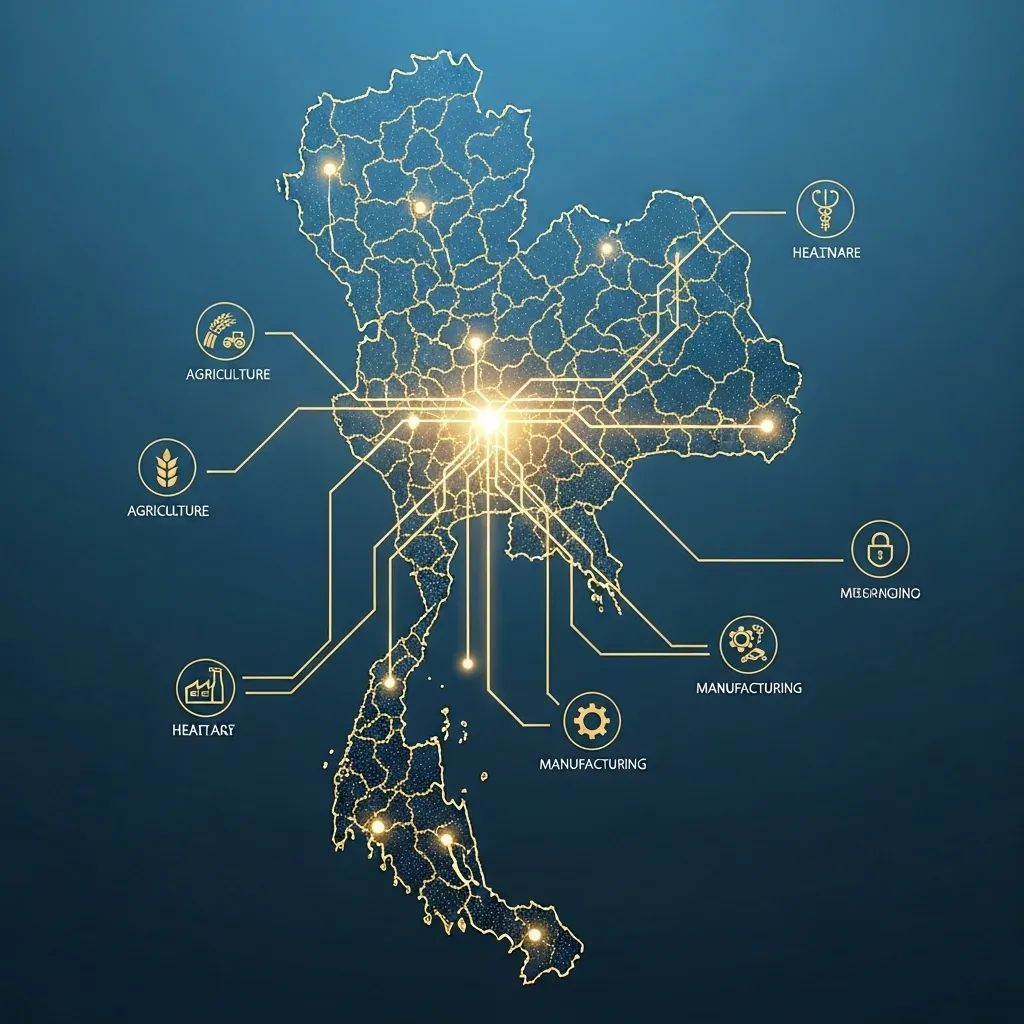
Artificial intelligence is no longer a distant buzzword in Thailand; it is shaping how citizens secure loans, how farmers look at weather data and even how scammers imitate loved ones on the phone. A rapid mix of public-sector megaprojects, private-sector experimentation and headline-grabbing frauds is forcing the kingdom to decide whether it wants merely to consume foreign tools or to start engineering its own.
Quick pulse of the story
• ฿25,000 M public budget for a national AI framework has been approved.
• Draft legislation will classify systems as either "high-risk" or outright prohibited.
• Business adoption jumped from 56% to 66% in 1 year, yet only 16% create new AI-driven products.
• A skills gap of ≈80,000 specialists threatens momentum.
• Voice-cloning scams exceeded 1,000 attempts per day in early 2025; regulators are scrambling.
Why this matters beyond the hype
Thailand’s export-led economy sits between global giants doing an AI arms race. Remaining a technology taker could erode competitiveness just when reshoring and new supply chains are rewriting trade maps. Conversely, credible local capability could turn the country into the ASEAN data-science hub officials keep promising. The stakes are high for Thai readers, whose jobs, security and public services are already feeling AI’s fingerprints.
The policy push: big money, bigger promises
The cabinet has set aside ฿25 B (≈$770 M) for the 2026-2027 National AI Development Framework. Part of the cash funds 9 new centres of excellence spanning agriculture, healthcare, tourism and more; a 10th centre for AI safety is awaiting final sign-off. Complementing the money are draft rules modelled in part on the EU: any system judged to enable social scoring or mass surveillance would be banned, while applications such as medical diagnosis would fall under "high-risk" scrutiny and a sandbox regime.
Regulators insist this is not red tape for its own sake. “Without guard-rails we risk amplifying existing inequality,” one senior NBTC official told reporters, hinting at how English-language bias in large models could sideline Thai speakers. The Cyber Security Agency also released an AI Security Guideline that warns developers about data poisoning and model theft—problems unfamiliar to many local start-ups.
Inside government: ambition collides with analogue habits
The bureaucracy knows its own paperwork is legendary. Some district offices still demand physical copies of land deeds. Under an "AI-first" mantra championed by the Bhumjaithai Party, every ministry must now draft a plan to automate at least one mission-critical workflow. The Land Department, for instance, is piloting identity-verification bots so deeds can be filed online. Yet progress is uneven. Internal surveys show that fewer than 1 in 5 agencies have integrated any machine-learning tool beyond basic chatbots. Officials blame mind-set more than budget: many civil servants fear that algorithms will expose legacy inefficiencies—or their own lack of data literacy.
Boardrooms and factory floors: enthusiasm with caveats
A 2025 survey by the Digital Economy Commission found two-thirds of Thai firms now run some form of AI, up sharply from a year earlier. But delve deeper and only 16% use the technology to invent new products; most are still automating back-office paperwork. Manufacturing illustrates the gap. Despite loud talk of Industry 4.0, only 2% of factories have reached that standard. Executives complain about dirty data, unclear ROI and scarce talent, yet 67% say they would move faster if the state led by example and shared anonymised data troves.
The 80,000-person hole
Analysts at TDRI estimate Thailand needs ≈120,000 AI professionals by 2027; today it has barely 40,000. Universities are responding with free AI & Metaverse courses backed by Amazon Web Services, and graduates will soon train on the government’s LANTA supercomputer—now ASEAN’s 3rd-fastest. Still, recruiting platforms posted 22,800 AI-related vacancies in the past 12 months, many unfilled. Without a talent pipeline, the country risks buying expensive foreign APIs forever.
Deepfakes, voice fraud and the trust deficit
Thai social media feeds have turned survival guides. Criminal rings now clone the voice of a relative in under 30 seconds of audio, creating emergencies that pressure victims to send cash. In the first half of 2025 alone, authorities logged 182,190 voice-phishing attempts. The NBTC is pushing carriers to flag suspicious overseas calls, while police direct victims to an online portal—and remind citizens of an old-fashioned defence: call back on a known number. Banks too are rolling out deepfake-detection software during eKYC, though customer education remains the weak link.
Regional race: can Thailand lead?
Singapore and Vietnam are also throwing money at AI. Thailand’s edge could be its bilingual data sets, strong manufacturing base and a population keen to try new tech (91% of Thai netizens interacted with AI at least once a day in 2025). But converting those advantages into intellectual property—Thai-language foundation models, sector-specific algorithms—will require long-term political will and relentless up-skilling.
What to watch next
Final text of the AI bill expected in parliament soon; lobbying over trade-secret disclosures will be fierce.
AWS Thailand Region goes live early 2026, slashing cloud-compute latency and cost.
First batch of AI-ready civil-service exams launches, testing coding and prompt-engineering skills.
A promised national data exchange platform could make or break private innovation.
Whether Thailand becomes a regional powerhouse or remains a power user hinges on one question: can the country close the gap between eye-catching announcements and on-the-ground execution before its neighbours do? The next 18 months will provide the clearest answer yet.


