
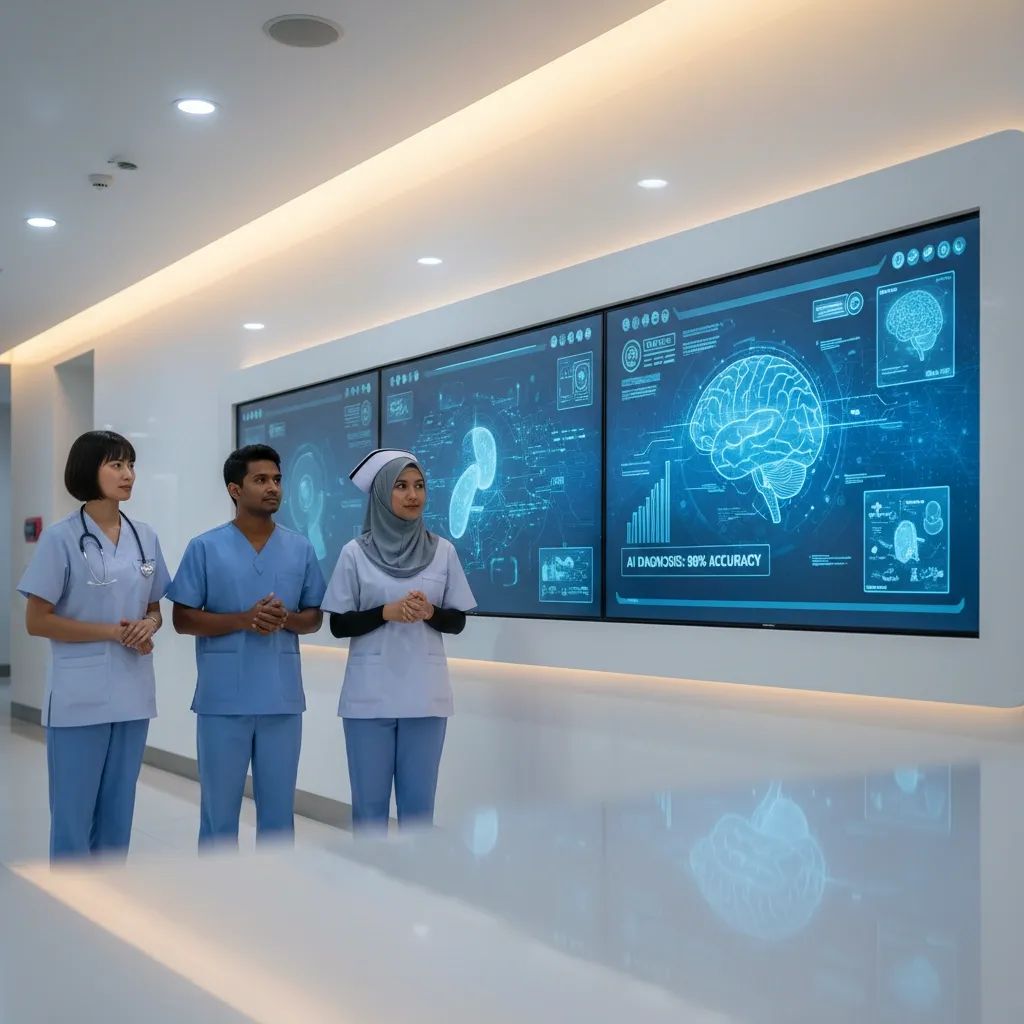
The Thailand Ministry of Public Health has positioned the country's healthcare sector for aggressive expansion through 2026, with Siriraj Hospital—the nation's oldest and largest public medical facility—spearheading the integration of artificial intelligence, robotic surgery, and 5G-enabled medical infrastructure. The move reflects a calculated strategy to capture a larger share of Southeast Asia's medical tourism market while serving the country's 70 million residents with increasingly sophisticated care.
Why This Matters
• AI chest X-ray systems developed by Siriraj will be deployed to 450 hospitals nationwide by 2026, with over 95% accuracy and report generation in under 10 seconds.
• The Bangpho Medical Hub—a ฿17 billion project—will add 794 beds and 22 operating theaters, targeting international patients with pricing 20% below Bangkok's private hospital average.
• Thailand anticipates 2.5 million international medical patients in 2026, contributing $9.5 billion to the economy—triple the per-visit spending of leisure tourists.
• Siriraj's new Interventional Radiology Center opens this year on Si Ayutthaya Road, offering minimally invasive procedures for 10-15 patients daily under medical school standards.
The Technology Push Behind Siriraj's Expansion
Siriraj Hospital, affiliated with Mahidol University, has accelerated its transformation from a traditional public hospital into what administrators describe as a "5G Smart Hospital." The institution now operates Thailand's first MEC-based 5G private network, developed in partnership with Huawei under a framework launched in 2020. The infrastructure supports autonomous vehicles for contactless delivery of medical supplies, AI-assisted diagnostics, and real-time data transmission from 5G-equipped ambulances.
The AI program for radiology has become a cornerstone of the hospital's expansion strategy. Since initial deployment in 2018-2019 for detecting lung abnormalities and coronary arterial calcification, the system has evolved to interpret computed tomography scans of the brain and mammograms. Notably, the mammography AI was trained specifically on the anatomical structure of Asian women's breasts, addressing a known gap in diagnostic tools developed primarily using Western datasets.
The AI chest X-ray platform, developed with Perceptra, is under review for inclusion in Thailand's national healthcare benefits package—a designation that would enable widespread adoption across the public hospital network and reduce diagnostic wait times in rural provinces.
Advanced Cancer Treatment and Surgical Precision
The Siriraj Center of Radiation Oncology operates the first Magnetic Resonance Linear Accelerator (MR LINAC) installed in Southeast Asia, a system that integrates an MRI scanner with a linear accelerator for real-time tumor targeting during radiation delivery. Since commencing operations in October 2020, the platform has treated over 400 patients, with applications ranging from brain tumors to soft-tissue cancers where precise anatomical imaging is critical.
Robotic surgery continues to expand at the facility, enabling minimally invasive procedures with faster recovery times. The Siriraj Hand and Upper Extremity Surgery Symposium in 2026 showcased technologies including Endoscopic Carpal Tunnel Release using MicroAire SmartRelease and 4-Corner Fusion with Medartis Locking Plate System, indicating adoption of specialized tools beyond general surgical robotics.
Mixed Reality technology, combining Virtual Reality and Augmented Reality, has been integrated into medical training programs, allowing students to practice procedures like injections and thread lifts using hologram glasses and 3D virtual objects. The system is expected to reduce training costs while improving skill acquisition rates.
Competing in a Crowded Regional Landscape
Thailand's healthcare market is projected to grow from $37.65 billion in 2026 to $61.38 billion by 2032, a CAGR of 8.49%, but the sector faces intense competition from Singapore's regulatory-driven reputation, India's price advantage, and South Korea's dominance in cosmetic surgery.
Siriraj's competitive approach leverages its status as a tertiary referral center for complex cases, a distinction that attracts patients with rare diseases who require specialist teams typically found only in academic hospitals. The hospital's pathology laboratory holds ISO 15189 and ISO 15190 certifications and is the sole teaching hospital in Thailand accredited by the College of American Pathologists, a credential that resonates with international patients seeking diagnostic certainty.
The Siriraj Piyamaharajkarun Hospital private wing already offers services with multilingual interpreters and dedicated international patient coordinators, while maintaining pricing roughly 20% below competing private facilities like Bumrungrad International—which treats 520,000 international patients annually—and Bangkok Hospital.
The upcoming Bangpho Medical Hub, slated for completion by 2031, will operate on a hybrid model: attracting foreign patients at private-wing rates while reinvesting profits into the main public hospital. The facility anticipates 10-20% international patient composition in its initial phase, with 442 regular beds, 352 private beds, and 90 intensive care unit beds.
What This Means for Residents
For Thailand residents, the AI radiology rollout translates to faster diagnostic turnaround at public hospitals, particularly in provinces where radiologist shortages create bottlenecks. The technology's inclusion in the national benefits package would mean no additional out-of-pocket cost for chest X-ray interpretation, a significant advantage for patients navigating the 30-baht universal coverage scheme.
The new Interventional Radiology Center on Si Ayutthaya Road offers an alternative to surgery for conditions like uterine fibroids, liver tumors, and vascular abnormalities, with procedures conducted under image guidance and same-day or next-day discharge in many cases. The center's medical school affiliation ensures access to ongoing clinical research and the latest IR techniques.
Elderly residents benefit from the second phase of the Siriraj Academic Centre of Geriatric Medicine, which adds screening and check-up services tailored to aging populations. The facility opened its first phase in mid-2024 and completes expansion in the 2025-2026 timeframe.
The hospital's collaboration with the World Health Organization on trauma and injury prevention, formalized in January 2025, includes a commitment to perform hip surgery within 48 hours—a timeline critical for reducing mortality in elderly patients with hip fractures.
Infrastructure and Investment Dynamics
The Thailand Ministry of Public Health allocated $14.6 million in its 2026 budget to develop wellness hubs in border provinces and upgrade cancer treatment centers to international standards. The investment reflects a strategic shift from attracting medical device buyers to fostering long-term partnerships in drug production, medical AI, and clinical research.
Health expenditure in Thailand is projected to reach $880.58 PPP per capita in 2026, representing a 2% annual growth rate from 2021. The "Amazing Thailand 2026" campaign targets ฿3 trillion in national revenue, with medical tourism identified as a primary driver.
Medical travelers spend 80-120% more per visit than leisure tourists, and private hospitals are expected to generate 70% of the $9.5 billion medical tourism revenue in 2026. Siriraj's expansion positions the public sector to capture a larger share of this high-value segment without displacing domestic patients—a challenge that has sparked debate around equity in Thailand's two-tier healthcare system.
The Innovation Ecosystem
Siriraj's participation in Siriraj Research and Innovation Week 2026 and Mahidol University's involvement in the AI HealthCare & Well-Being Summit 2026 underscore the institution's role as a test bed for medical technologies. Collaborations showcased at these events include AI-driven patient-specific implants using medical-grade 3D printing and automated centroblast cell detection in pathology labs.
The Siriraj × MIT Hacking Medicine 2025 event, focused on "AI Today, Transforming Tomorrow's Healthcare," attracted international startups and highlighted use cases ranging from diabetic retinopathy screening to predictive analytics for sepsis risk.
The Siriraj Center of Applied Thai Traditional Medicine, an internationally recognized WHO Collaborating Centre, offers integrative medicine that combines herbal therapies with Western clinical protocols, a service increasingly sought by international patients interested in holistic approaches.
Navigating the Competitive Realities
Despite technological advances, Siriraj competes against well-established private players like Bumrungrad International, which treats over 1.1 million patients yearly, and regional powerhouses such as Mount Elizabeth Hospital in Singapore and Apollo Hospitals in India. These institutions benefit from decades of branding, luxury amenities, and streamlined international patient services.
Siriraj's value proposition hinges on academic credibility, specialized care for complex cases, and affordability—attributes that appeal to cost-conscious international patients and domestic residents requiring tertiary-level expertise. The hospital's challenge lies in scaling patient-facing services to match the efficiency and hospitality standards of private competitors while maintaining its public mission.
The Siriraj H Solutions Wellness Center and expansion of preventive care programs represent an effort to capture the wellness tourism segment, a market projected to grow alongside curative medical services. By integrating hospital-level medical expertise with holistic wellness programs, the facility targets patients seeking anti-aging therapies and preventive diagnostics.
As Thailand's healthcare market matures, the balance between serving domestic populations and attracting international revenue will shape policy debates around resource allocation, pricing transparency, and the role of public institutions in a competitive regional landscape.


